We Have a Recognition Problem
We have more mental health resources than we did a decade ago.
More conversations.
More workplace benefits.
More employee assistance programs.
More awareness.
More training.
More organizations saying mental health matters.
That progress is real.
Yet I believe we still have a fundamental problem.
Recognition.
How do you know when someone isn't doing well, especially when they aren't telling you?
How does a parent know whether their teenager is going through a difficult week or whether something more significant is happening?
How does a manager know whether an employee is simply having an off week or whether a change deserves a conversation?
And how does an executive know whether the culture they believe they have built is actually the culture employees experience every day?
These look like different problems.
I don't think they are.
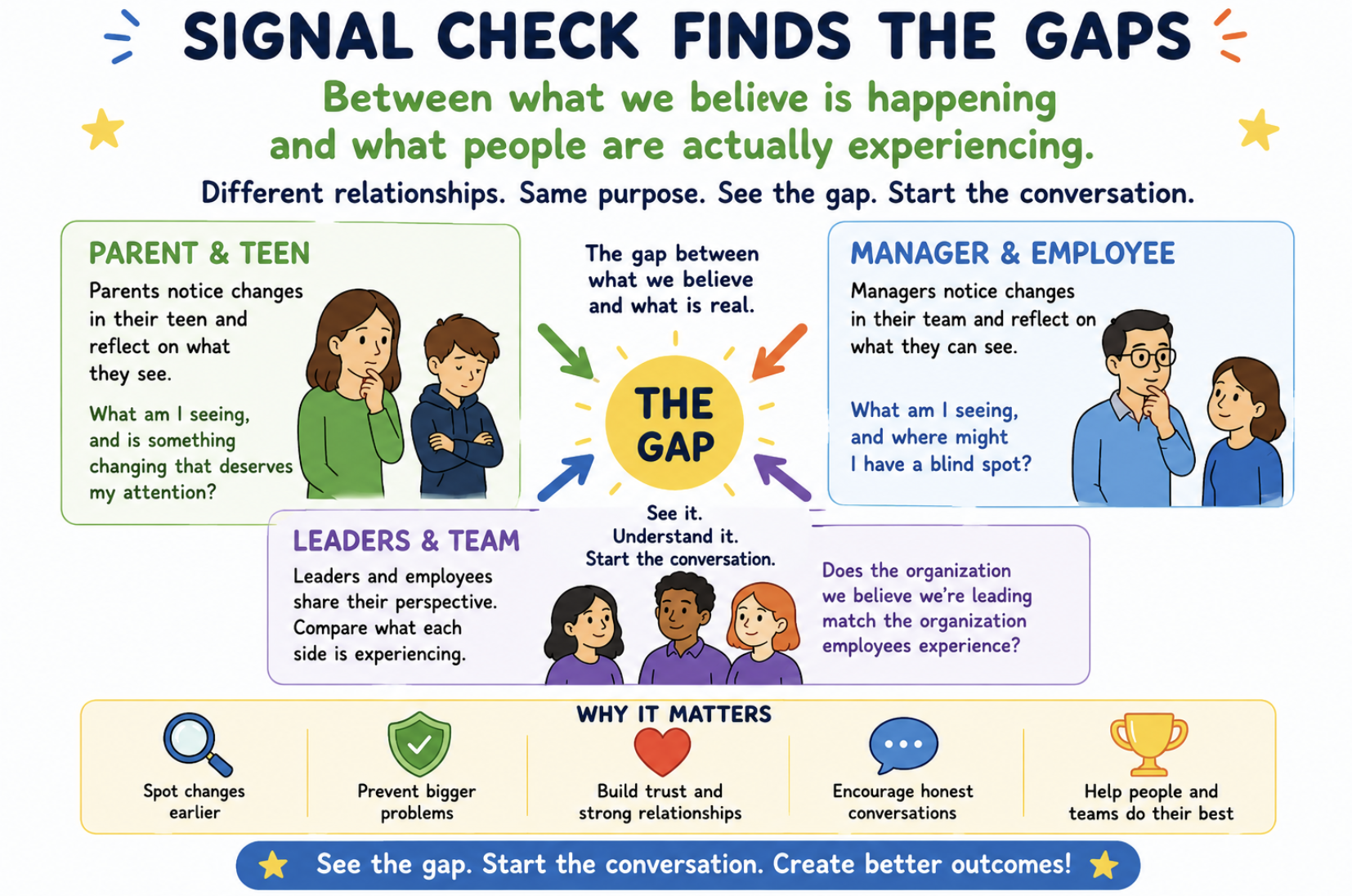
In each case, there is a potential gap.
A gap between perception and experience.
A gap between what we think we know and what may actually be happening.
A gap between how strong a manager believes a relationship is and how safe the employee actually feels inside it.
A gap between the company executives think they are running and the company employees experience in the trenches.
Those gaps matter.
Because large gaps can hide problems.
Trust can weaken.
Communication can suffer.
People stop sharing.
Managers miss important signals.
Employees disengage.
And sometimes people leave.
That is what a Signal Check was built to help uncover.
What Is a Signal Check?
Signal Check is an early awareness system.
It is built around a simple idea:
Before we can respond to a problem, we need to recognize that a gap may exist.
There are three Signal Check perspectives:
Teen Signal Check.
Manager Signal Check.
Culture Signal Check.
Each looks at a different relationship.
Each can provide useful information on its own.
Teen Signal Check asks:
"What am I seeing in my teen, and is something changing that deserves my attention?"
Manager Signal Check asks:
"What am I actually seeing in my people, and where might I have a blind spot?"
Culture Signal Check asks:
"Does the organization our executives believe they are leading match the organization employees say they are experiencing?"
None of these tools diagnoses mental illness.
They don't replace therapists.
They don't turn managers into counsellors.
They don't turn parents into mental health professionals.
They help us notice.
And sometimes noticing is where the important conversation begins.
Teen Signal Check: Is This Normal, or Should I Be Paying Attention?
This is the most personal part of Signal Check for me.
Parenting a teenager comes with enormous uncertainty.
Your child becomes quieter.
Their sleep changes.
Their friends change.
School performance drops.
Their mood seems different.
They stop doing something they used to enjoy.
They spend more time alone.
They stop talking to you.
Something feels different.
But teenagers change.
That is normal.
So how does a parent know when normal teenage behaviour becomes something worth paying closer attention to?
That is the question behind Teen Signal Check.
It helps parents step away from a single moment and look for patterns.
What has changed?
How significant is the change?
How long has it been happening?
Is it one behaviour or several?
Is it getting better?
Is it getting worse?
Does this look like my child's normal baseline?
Or is something different?
Parents can get this wrong in both directions.
We can overreact.
We can also under react.
One parent may see a quiet teenager and immediately assume something serious is happening.
Another may see the same behaviour and say:
"They're 15. That's what teenagers do."
Neither assumption necessarily tells us what the teenager is experiencing.
Teen Signal Check creates a pause between observation and assumption.
It helps a parent ask:
"What am I seeing, and does it deserve another conversation?"
The Teen Gap
At its simplest, Teen Signal Check helps us explore the potential gap between:
What a parent believes is happening
and
What their teenager may actually be experiencing.
That distinction matters.
The purpose is not to prove the parent wrong.
It isn't to treat every difficult week as a mental health issue.
And it certainly isn't to diagnose a teenager.
The purpose is recognition.
Maybe the gap is small.
Your teen had a rough week.
Maybe there was an argument with a friend.
Maybe school has been stressful.
Things settle.
But perhaps several things have changed.
Sleep.
Friends.
Communication.
School.
Energy.
Interest in activities.
And the changes continue.
Now there may be something worth exploring.
Teen Signal Check helps a parent identify when the signal deserves more attention.
Manager Signal Check: What Am I Missing With My People?
Take the same idea into the workplace.
Managers see people regularly.
They see performance.
Attendance.
Communication.
Participation.
Reliability.
Team interactions.
Energy.
And over time, good managers develop a sense of what is normal for the people they lead.
Then something changes.
A normally engaged employee becomes quiet.
A dependable person starts missing deadlines.
Someone stops contributing in meetings.
Communication becomes shorter.
Absences increase.
Two teammates who worked well together suddenly don't.
The easy response is to treat these as performance problems.
Sometimes they are.
But sometimes performance is the signal.
The more useful first question may be:
"What changed?"
Manager Signal Check helps managers examine what they are observing across their team.
Has something changed?
Is this isolated?
Is there a pattern?
How well do I actually know this person?
Would they tell me if something was wrong?
Do I know what they look like when they are doing well?
Does something here deserve a conversation?
Notice who is answering those questions.
The manager is.
That is the whole design. Manager Signal Check is a mirror the manager holds up to themselves. It's a private self-audit, not a scorecard on anyone else. It's built to help a manager see what they might be overlooking, and to give them the confidence to do something about it before it becomes a bigger problem.
That framing is deliberate. A parent noticing that their kid has gone quiet is care. A manager quietly building a file on an employee's behaviour is something else. So this tool never points at the employee. It points back at the manager. What am I seeing, and honestly, how much do I actually know?
The Honest Problem With a Self-Audit
Here is the obvious objection.
The manager is grading their own awareness.
So what stops a manager from handing themselves a perfect score?
Nothing, if the questions ask how they feel.
"Do you have a good relationship with your team?"
Of course they'll say yes. Most people believe they do. That belief is exactly the blind spot.
So the questions can't ask about feelings.
They have to ask for evidence.
Has anyone on your team brought you a personal problem in the last six months?
Can you name something real going on in each person's life outside of work?
If one of them were quietly struggling, who would text you at 9 p.m., and who would wait until it blew up?
Those are harder to fake.
Because you can either answer them or you can't.
And the blank spots are the finding.
If you land on someone's name and you've got nothing, that isn't a mark against you. That's the tool doing its job. It just showed you where you're not as close as you assumed you were.
Deliberate dishonesty was never the real risk here anyway.
Lack of awareness is.
A manager can genuinely believe their team trusts them, be completely sincere about it, and still be wrong. It isn’t necessarily they're a bad manager. Because nobody can see their own blind spots from the inside. That's what a blind spot is.
The point of the self-audit isn't to confirm what you already believe.
It's to show you where your belief and the evidence don't line up.
From Recognition to Conversation
Manager Signal Check helps a manager notice changes in their people and gets honest with them about what they actually know.
But recognition alone isn't enough.
The manager still has to talk to the person.
And that is where many managers freeze.
What am I allowed to ask?
What if I say the wrong thing?
Am I crossing a line?
What if they become emotional?
Should HR be involved?
What if they tell me something I don't know how to handle?
So sometimes the manager says nothing.
That is why Manager Signal Check connects directly to First Conversation Coaching.
Manager Signal Check asks:
"What am I seeing, and what do I actually know?"
First Conversation Coaching asks:
"How can I tell if one of my employees is struggling?” and “How do I have this conversation in a way that helps the person feel supported and safe?"
This is also where a self-audit gets its teeth. A form on its own can still flatter you. A live conversation, practised out loud with someone watching, catches the blind spot in real time. You hear yourself reach for the wrong thing. You feel where you freeze. That's a sharper mirror than any score.
The manager's job isn't to diagnose.
It’s to notice.
Ask.
Listen.
Support.
And understand where their responsibility ends and another resource should begin.
Why the Manager Relationship Matters Financially
This isn't simply about people feeling good about their manager.
Poor workplace relationships have consequences.
When trust weakens, people communicate less honestly.
When communication becomes guarded, problems stay hidden longer.
Team relationships can deteriorate.
Engagement can suffer.
Eventually, retention risk can grow.
Gallup has reported that 42% of employees who voluntarily left their organization believed their departure could have been prevented.
And employee turnover is expensive.
Depending on the role and seniority, widely cited estimates put replacement costs at roughly 50% to 200% of an employee's annual salary.
Take someone earning $80,000.
At 50%, you could be looking at approximately $40,000 in replacement-related costs.
At 200%, $160,000.
Then consider everything that number may not fully capture.
Lost knowledge.
Recruiting.
Interviewing.
Training.
Lost productivity.
Team disruption.
Customer relationships.
The impact on everyone who remains.
So when an organization discovers a manager who genuinely doesn't know their people as well as they thought, that isn't "soft stuff."
There can be a very real business consequence.
First Conversation Coaching teaches managers how to identify the issues and how to have those sensitive conversations that bring your team closer and not more distant.
Culture Signal Check: Does Leadership See the Company Employees See?
Now move from the manager relationship to the organization.
Ask executives:
Do employees trust leadership?
Is communication strong?
Do people feel safe speaking up?
Are managers approachable?
Do employees know where to get mental health support?
Do people feel valued?
Does our company have a healthy culture?
Leadership may answer positively.
Now ask employees the same underlying questions.
What happens when the answers don't match?
That is the Culture Gap.
This is the one place in Signal Check where we measure both sides directly. The executives answer. The employees answer. Then we look at the distance between them. Managers also participate.
Culture Signal Check measures organizational congruency.
Does the organization leadership believes it runs resemble the organization employees actually experience?
Because a company can have excellent policies and a poor employee experience.
You can have a great EAP.
Strong benefits.
Therapy coverage.
Mental health training.
Wellness programs.
Beautiful corporate values.
And employees who are still afraid to speak honestly.
The Distance Matters
Imagine executives rate communication 9 out of 10.
Employees rate it 8.
Relatively narrow gap.
Now imagine executives rate communication 9.
Employees rate it 4.
That is a different problem.
The interesting number isn't simply the employee score.
It is the distance between leadership perception and employee experience.
Executives:
"Our employees trust leadership."
Employees:
"Leadership doesn't listen to us."
Gap.
Executives:
"Our people feel psychologically safe."
Employees:
"Speaking honestly could hurt my career."
Gap.
Executives:
"Our managers have strong relationships with their people."
Employees:
"I keep my head down and say what's safe."
Gap.
Executives:
"Our employees know where to get mental health support."
Employees:
"I wouldn't know where to begin."
Gap.
Narrow gaps suggest stronger alignment between perception and experience.
Large gaps identify areas that deserve investigation.
And sometimes the biggest risk is that leadership has no idea the gap exists.
Confidentiality Is Non-Negotiable
There is a condition attached to the Culture side of this.
Employees need to feel safe answering honestly.
If an employee believes their individual answers can be traced back to them, the system fails.
People will protect themselves.
And frankly, they should.
So Culture Signal Check uses aggregated reporting. Leadership sees the pattern, not the person. For example:
Leadership perception of trust: 8.8
Employee experience of trust: 6.1
Gap: 2.7
Leadership perception of psychological safety: 9.0
Employee experience: 5.2
Gap: 3.8
Now we have something useful.
Leadership's biggest blind spot may have nothing to do with policy.
It may be psychological safety.
That can be addressed.
This Is Where the Gap Awareness Calculator Comes In
Culture Signal Check identifies where executive perception and employee experience differ.
Manager Signal Check surfaces the blind spots a manager can find in their own awareness of their people.
The Gap Awareness Calculator helps make the culture differences visible.
Instead of giving an executive another generic culture score, we can begin showing something much more useful.
Here is where leadership and employees agree.
Here is where they don't.
Here is where trust appears strong.
Here is where communication may be breaking down.
Here is where psychological safety deserves attention.
That creates something organizations can actually discuss.
It’s something organizations can provide training for.
Three Signal Checks. One System.
This is where everything comes together.
Focus: Parent and teenager.
Question:
"Is what I'm seeing normal for my teen, or has something changed enough that I should pay attention?"
Purpose:
Recognition and earlier conversation.
Focus: The manager's own awareness of their people.
Question:
"What am I actually seeing, how well do I really know my people, and where might I have a blind spot?"
Purpose:
Self-awareness, relationship awareness, and identifying when a conversation may be needed.
Focus: Organization.
Question:
"Does the company leadership believes it has built match what employees actually experience?"
Purpose:
Identify organizational gaps in trust, communication, psychological safety, support, and culture.
Then we connect the tools.
Manager Signal Check leads to First Conversation Coaching.
Culture Signal Check leads to the Gap Awareness Calculator.
Teen Signal Check leads to parent recognition and better conversations at home through the Lifeline Parent Workshops.
Different relationships.
Different environments.
Same principle.
See the gap.
Why Teen Signal Check Belongs in the Corporate Conversation Too
There is another connection organizations shouldn't ignore.
Employees don't stop being parents when they arrive at work.
Imagine an employee whose 15-year-old has suddenly become withdrawn.
School is becoming difficult.
Their child isn't sleeping.
Communication at home has deteriorated.
The parent doesn't know whether they are overreacting.
They also worry they may be missing something.
They spend half the night searching online.
Then they arrive at work for a 9 a.m. meeting.
Their body is there.
Their attention may be somewhere else.
Companies don't need to solve their employees' family problems.
But they can give working parents better tools.
Teen Signal Check.
Parent education.
LifeLine Parent Workshops.
When Something Feels Off Online Parent Forum
Clear mental health resources.
Practical answers to three questions:
How do I know whether my teen is struggling or whether this is normal teenage behaviour?
How do I communicate with my child without getting them to shut down?
Where can I go when my teen or my family needs additional support?
Supporting parents is part of supporting employees.
Because home and work affect each other every day.
Signal Check Isn't Another Survey
Organizations already collect enormous amounts of information.
Engagement surveys.
Pulse surveys.
EAP utilization.
Absenteeism.
Turnover.
Benefits usage.
Performance data.
Signal Check shouldn't become another pile of numbers.
The purpose is different.
We are looking for gaps that deserve action.
Where does a parent think everything is fine while several things appear to be changing?
Where does a manager believe they know their people while the honest evidence says otherwise?
Where does leadership believe communication is excellent while frontline employees feel disconnected?
Where does everyone agree that trust is weak?
That last one matters too.
Because at the culture level, a small gap does not automatically mean everything is good.
Leadership and employees can agree that trust is low.
Agreement on a bad answer is still a bad answer.
So the Signal Checks measures different things depending on the relationship.
For a parent, it measures attention. Am I actually seeing what's in front of me?
For a manager, it measures awareness. Do I really know my people, or do I just believe I do?
For an organization, it measures two things. How strong the culture is, and how far apart leadership and employees are on that question.
That distinction is important.
The Bigger the Gap, the More Important the Question
Perfect alignment isn't realistic.
Parents and teenagers will see things differently.
Managers and employees will see things differently.
Executives and frontline employees will experience organizations differently.
That is normal.
The goal isn't zero gap.
The goal is awareness.
Because when the gap becomes large, we should stop assuming.
Ask.
Listen.
Understand.
Have the conversation.
Then decide what happens next.
We have spent enormous amounts of money and effort building resources for what happens after someone asks for help.
I think we need to get much better at what happens before.
Before the resignation.
Before the communication breakdown.
Before the employee disengages.
Before the manager gets blindsided.
Before the parent realizes their child has been struggling.
Before executives discover employees are experiencing a completely different organization than leadership believed.
Recognition comes first.
Why This Is Personal
I don't approach this simply as an entrepreneur building tools.
I approach it as a dad.
We lost my daughter Maddie when she was 14.
There are questions I will carry with me.
What did I miss?
What didn't I understand?
Was there a gap between what I thought Maddie was experiencing and what she was actually carrying?
Could I have asked different questions?
I can't go backwards.
And I would never suggest that a Signal Check could give a family certainty.
It can't.
Maddie's life deserves more respect than being used to make promises no tool can keep.
What I can do is take what her life taught me and help other people pay closer attention.
Help a parent pause and ask another question.
Help a manager notice when someone on their team has changed, and get honest about how well they actually know them.
Help an executive recognize that the company employees experience may be very different from the company leadership believes it has created.
That is why this matters to me.
See the Gap. Start the Conversation.
Teen Signal Check helps parents recognize changes in their teens.
Manager Signal Check helps managers see their own blind spots and notice changes within their team.
First Conversation Coaching helps managers know what to do when a conversation is needed.
Culture Signal Check identifies the gap between executive perception and employee experience.
The Gap Awareness Calculator helps organizations see the distance.
None of these tools has every answer.
That isn't their job.
Their job is to make something visible.
A change.
A pattern.
A blind spot.
A weak relationship.
A trust problem.
A disconnect.
A gap.
Once you can see it, you can do something about it.
Because the resignation letter isn't where the problem started.
The communication breakdown isn't where the problem started.
The employee disengaging isn't where the problem started.
And the difficult conversation at home isn't necessarily where the problem started either.
There were signals before that.
There were gaps.
The question is whether we could see them early enough to start the conversation.