The Parent No One Sees Barely Holding It Together

She Doesn't Sleep. She Doesn't Tell Anyone. She Goes to Work Anyway.
What do you do if your teen is tearing your family apart?
I know a few people in this exact situation right now. Facing something they never thought they'd have to face. It's more than bad behaviour. Self-harm. Drug and alcohol use. Stealing from the people who love them most.
As a parent, you get put in a position where the pragmatic answer is not one a loving parent can live with. The whole house shifts around the kid. The siblings watch. Some of them get quiet. Some get angry, at the sibling, at the parent, at both.
Before anyone reading this jumps to the easy answers. Tough love. Rehab. Call the police. Kick them out. From the outside, those answers sound clean. From inside the house, they aren't.
One mom told me: "If I throw my daughter onto the street, I'm okay with her being dead. And I'm not going to give up on her. I can't."
Now think about the rest of what she's carrying. Single mom. Executive job with real weight to it. Two other kids at home, already resentful of their sister and of their mom. She gets up. She goes to the office. She exceeds her targets. She manages a team. She smiles at the people in the elevator.
Nobody at work knows.
Whoever said parenting was the hardest job in the world was not thinking about this.
She reached out to me after reading some of what I've written about Maddie. She recognized parts of her story in mine. The one difference that matters is her daughter is still alive. There is still a version of this where her daughter turns it around and gets to have a normal adulthood. That door is still open for her. It’s closed for me.
This is why I do what I do. It's for Maddie.
These parents are the ones nobody sees. They don't want a spotlight. They don't want acknowledgment. What they want is to wake up, walk down the hall, and see their kid breathing in their bed before they leave for work. That's the whole prayer. That's the whole day, in one moment.
Then they walk into the office and smile. Nobody knows they were driving around at 3 a.m. looking for their daughter. Nobody knows they haven't slept a full night in weeks. Those stories don't get told at the water cooler. Or when someone walks into your office and asks, “How was your weekend?”
There's fear of judgment. There's shame. There's the private question every parent in this asks themselves: did I cause this? Am I a good parent? Would other people be handling this better than I am?
Some version of this parent is in your office right now. Somewhere in your building. On your team. In your last meeting. All they want is their kid to be okay.
If any of this sounds like you, I want you to know something. You’re not the only one. You’re not doing this wrong. The fact that you haven't given up, that you keep showing up for your kid and for your job and for the other people who need you, that isn't weakness. That's the version of strength that doesn't get named because it doesn't look like anything from the outside. It looks like a mom at her desk at 9 a.m. answering emails.
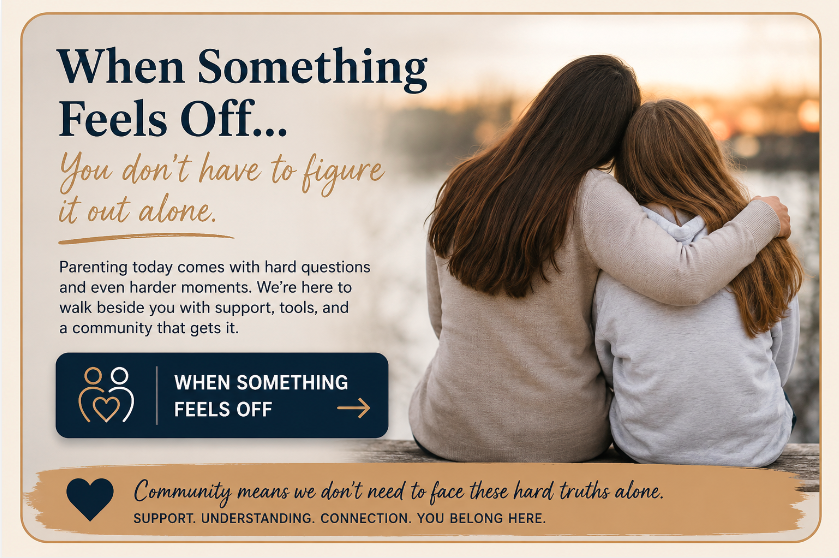
We built a space called When Something Feels Off for exactly this. It's a room. Other parents in something similar. Nobody gives you a script. Nobody promises to fix your kid. What we can offer is a place where you don't have to smile. Where you can say the truth out loud and not have someone flinch or reach for a solution before you've finished the sentence. Where the depth of what you're carrying gets met with people who understand it.
If you're the mom driving around at 3 a.m., if you're the dad sitting in the driveway before you go inside because you need one more minute, if you're the parent who has stopped talking about this because you're tired of the advice, there’s a room for you.
Ten years from now, I hope you and your kid are at a kitchen table telling stories about the years that almost broke you. Between now and then, you don't have to carry it alone.
For Maddie. June 28, 2000- April 11, 2015
Frequently asked questions
Am I making it worse by not being tougher?
You've probably heard some version of tough love a hundred times by now. From family. From friends. From strangers on the internet. Nobody can tell you the right dose of tough for your specific kid, in your specific house, with your specific history. Staying present is not the same as enabling. Loving them is not why they're struggling. You're allowed to hold your ground on some things and stay soft on others.
Should I tell anyone at work?
Nobody can answer this for you. Some parents find that telling one trusted person, one manager, one peer, changes what it feels like to walk in the door. Others find that keeping work as the one place nobody knows is what gets them through the day. Both can be right. You don't owe anyone your story. If you do choose to say something, you don't have to say all of it.
Is this my fault?
The parents who ask this loudest are almost always the ones who care the most. Whatever happened before now, you are paying attention now. That matters more than most things you're beating yourself up about. The question that helps more than "did I cause this" is "what does my kid need from me today."
My other kids are angry. At their sibling. At me. What do I do?
They're not wrong to feel what they feel. The whole house has been reshaped around the one who needs the most, and the others noticed. You can acknowledge that without apologizing for showing up for your struggling kid. Ten minutes of undivided attention with the ones who feel forgotten is worth more than a long speech about fairness. They need to know you see them.
How do I know when I'm the one who needs help?
The parents who need it most are usually the last to notice. If you've stopped sleeping. If you're numb where you used to feel things. If you've stopped reaching out to the people who used to lift you. If part of you has started to hope for something to give, in a way that scares you. Any of that means it's time to bring another person into this with you. A doctor. A therapist. A friend who has been through something like this. Being carried for a while is not a failure. It's what lets you keep carrying your kid.
Related reading from The MentorWell
The Dad Who Is Barely Holding It Together
For fathers carrying the same weight, and the employers who need to understand what their people walk through the door with every morning.
Why I Built a Private Community for Parents of Struggling Teens
More on When Something Feels Off. What it is, why I built it, and who it's for. A room where you don't have to smile.
Love Isn't Always Enough. That Truth Nearly Broke Me
Love is why you show up. Love alone won't teach you to see what's happening. Eleven years of hindsight on the gap between the two.
How to Navigate a Teen Mental Health Crisis Together
For the parent who reads this and says, I need something practical to do this week. Warning signs, framework, and a place to start.
The Question Nobody Asks
Most meaningful conversations begin after the first answer. Short piece on staying in the conversation a little longer than feels comfortable.