How to Navigate a Teen Mental Health Crisis Together
I wish I could tell you there is a perfect formula for knowing when your teenager is struggling.
There isn't.
Most of the parents I speak with don't miss the signs because they don't care. They miss them because the signs often look like normal teenage behaviour.
A kid who spends more time in their room.
A sudden change in mood.
Less interest in friends.
A little more irritability.
You tell yourself they're tired. Hormones. Stress. A phase.
Sometimes you're right.
Sometimes you're not.
One of the hardest things about parenting teenagers is knowing when to lean in and when to give them space. There isn't a handbook for that.
After losing my daughter Maddie, I spent a lot of time looking backward. I replayed conversations. I thought about things I dismissed because they didn't seem significant at the time.
Grief gives you perspective you wish you never had to earn.
What I know now is this.
Parents usually know when something feels different.
They can't always explain it.
They just know. In their gut.
That feeling deserves your attention.
One in five children and youth in Ontario experiences a mental health challenge. Most mental health conditions begin before adulthood. That means almost every family will face a period where someone they love is struggling.
The goal isn't to panic.
The goal is to pay attention.
The goal is to stay connected long enough to notice when your child needs more support.
Because when a teenager is struggling with mental health, your presence matters more than your perfection.
How do you know if your teen needs extra mental health support?
The hardest question parents ask me is this.
"Is my teenager depressed or just moody?"
Let me preface this, I’m not a mental health practitioner. My experience is the hardest kind: lived experience. Because there isn’t anything you won’t do to protect your child.
I wish there were an easy answer.
Typical teenage moodiness comes and goes. Serious emotional distress sticks around. It starts interfering with daily life.
Pay attention if your teen:
Stops seeing friends or pulls away from activities they used to love.
Starts sleeping all day or barely sleeping at all.
Has significant changes in appetite.
Seems angry or irritable most of the time.
Suddenly struggles at school.
Says things like, "Nothing matters anymore," or "I wish I wasn't here."
One sign on its own may not mean much.
Patterns matter.
Duration matters.
If these changes last more than two weeks, it is worth speaking to your family doctor or a mental health professional.
You don’t need certainty to start asking questions.
But I wanted to give parents a framework for understanding what they were looking at. It’s not a diagnosis, it’s an awareness tool for parents. Something that says “Pay attention to this.”
It’s called Teen Signal Check. It’s been used by more than 11,000 parents in the last 4 months.
It’s free. Take takes 3 minutes. 14 questions. Gender specific. It’s not clinical.
You get an easy-to-understand result with next steps. Green. Yellow. Red. To date, almost 50% of the parents got an important wake up call.
That’s why I created it. Parents were dismissing the signals. Now they aren’t.
The 5Rs framework for supporting your teen
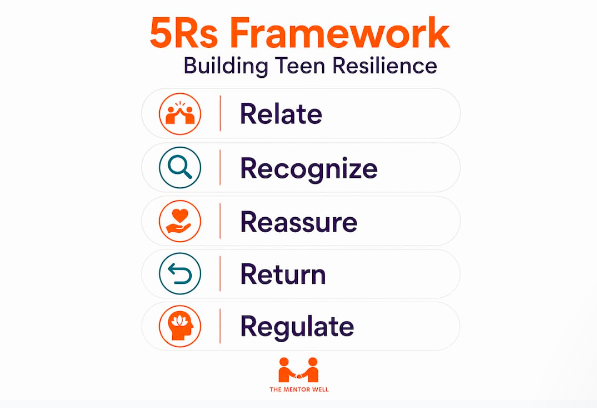
Over the years, I've learned that parents need something practical when things feel overwhelming.
That's why I appreciate the 5Rs framework.
Relate. Stay connected through small moments.
Recognize. Notice changes without judgment.
Reassure. Remind your teen they are loved and that you are not going anywhere.
Return to Routine. Predictability helps reduce anxiety.
Regulate. Manage your own emotions first.
That last one is often the hardest.
When our kids are hurting, we become scared.
And scared parents sometimes react instead of respond.
Your teen is paying attention to your emotional state, even if it doesn't seem like it.
Sometimes taking three slow breaths before a difficult conversation is one of the most important things you can do.
Keep the conversation open
The biggest mistake most of us make is trying to fix the problem too quickly.
Teens usually want to feel understood before they want advice.
Ask open-ended questions.
Listen more than you talk.
Validate what they're feeling before offering solutions.
And if your child doesn't want to talk, don't give up.
Connection is rarely built in one conversation.
It's built in hundreds of small moments where your teen learns that you are safe to talk to.
When should you seek professional help?
Early support matters.
If your teen's behaviour has changed significantly, if they seem hopeless, or if something simply doesn't feel right, reach out.
Start with your family doctor.
Talk to the school counsellor.
Explore therapy options.
And if you are worried about your child's immediate safety or they have expressed thoughts of wanting to die, call or text 988.
You do not have to figure this out on your own.
*if you’re in Canada, and your child is 17 years old or younger, we have an expedited referral program for diagnosis and referral in days or weeks, instead of months.
What I know now that I wish I had known then
I built The MentorWell after losing Maddie.
Well, almost 10 years after I lost Maddie. I was pretty much unable to function for the first decade after her passing.
I know what it feels like to wish for one more conversation.
I know what it feels like to wonder if there was something you should have noticed sooner.
But I also know this.
Most parents are doing more right than they realize.
You're here because you care.
You're reading this because you want to understand your child better.
Stay curious.
Stay connected.
Trust your instincts.
If something feels off, pay attention.
You do not need to have all the answers.
You simply need to keep the door open long enough for your child to walk through it.
FAQ
What is the 5Rs framework for teen resilience?
The 5Rs (Relate, Recognize, Reassure, Return to Routine, Regulate) is an evidence-informed framework that gives parents concrete daily actions to support their teen's emotional well-being during stressful periods.
How do I tell the difference between normal teen behaviour and a mental health crisis?
Red flags include social isolation, significant sleep or eating changes, persistent irritability, and expressions of hopelessness lasting more than two weeks. Typical moodiness passes quickly and does not disrupt daily functioning.
When should I call the 988 Suicide & Crisis Lifeline?
Call or text 988 any time your teen, or you as a caregiver, is experiencing emotional distress that feels unmanageable. The line is available 24/7 and supports situations beyond active suicidal crisis.
How do I start a conversation with my teen about their mental health?
Use open-ended questions, listen without interrupting, and validate their feelings before offering any advice. Teens are more likely to keep talking when they feel heard rather than managed.
What should I bring to my teen's first mental health appointment?
Write down specific behaviours you have observed, including dates, changes in sleep or eating, and any statements that concerned you. Detailed parental observations help clinicians build an accurate picture quickly.
Other Recommended Articles
When One Child Struggles: The Hidden Mental Health Risk for Siblings — THE MENTORWELL
For Maddie: Breaking the Silence Around Teen Depression and Why LifeLine Matters — THE MENTORWELL
For the Teen Who Doubts Themselves | Confidence Begins with EQ — THE MENTORWELL
We Don't Wait to Talk About Cancer. Why Wait for Mental Health? — THE MENTORWELL