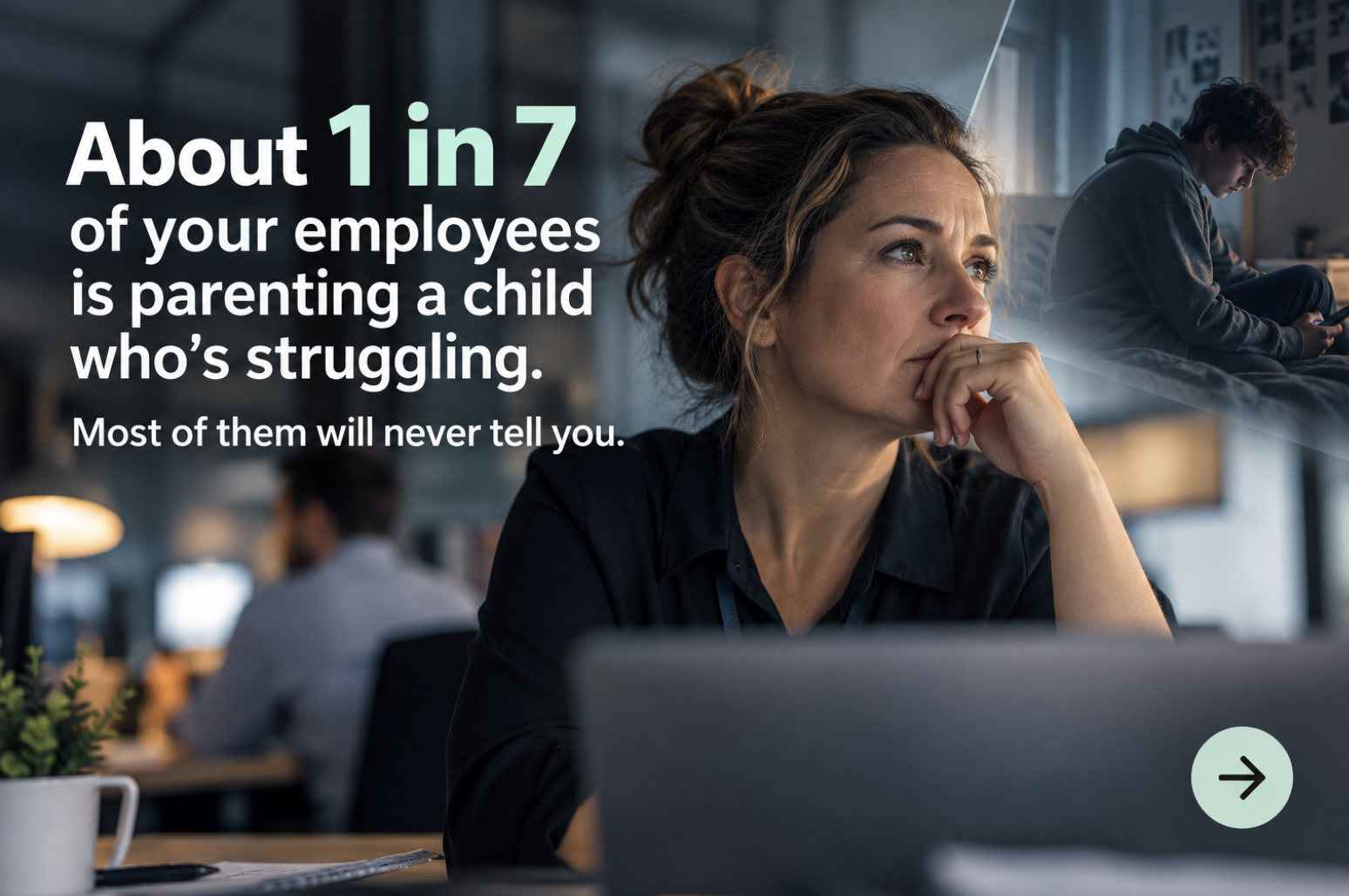
They Told a Stranger What They Haven't Told You
Chris Coulter's opening workshop slide with his personal email, showing one way to support employees with struggling kids.
The 30% I Can’t Stop Thinking About
I've been running LifeLine Parent Workshops for about six months. About 80% have been online. The rest have been in person.
At the start of every session, I give out my personal email.
Most people never use it. Some do. So far, more than 30 employees from companies across North America have written to me during or after a workshop. A few check me out on LinkedIn first. They read some posts, then send a DM.
They tell me things they haven't told anyone at work. Some of them have sat beside the same coworkers for ten years. They'd met me an hour earlier.
When I ask why, the answers are close to identical. They don't want to be judged. They worry that saying it out loud at work puts a target on their back. A few just say they're ashamed, which usually means they've carried it alone for a long time.
These are the people who don't walk into their manager's office or call HR. They're white-knuckling it. Heads down, getting through the day, hoping nobody notices.
The numbers don't land
I open every workshop with the data. Nearly one in four working parents, 22%, has a child with mental health challenges (Deloitte). About 65% of employees are parents (BLS). Put those together, and about one in seven of your employees is carrying this right now.
The room nods. It rarely moves anyone. If it isn't your kid, 15% sounds like somebody else's problem.
So we do the Teen Signal Check. Parents answer questions about what they've actually noticed in their own kid, and they get a colour.
Across my workshops, about half the room scores green. Thirty percent score yellow. Twenty percent score red.
Red usually isn't news
Parents who score red mostly know something's wrong already. If they didn't, they do now. By that point, my job is helping them get to the right help faster.
Yellow is where the surprise is
The yellow group is the one I think about most. They're the most surprised by their result. A lot of them had filed what they were seeing under normal teenage behaviour.
Here's how it plays out. Another parent describes something heavy going on at home. Someone in the yellow group thinks, my kid does that sometimes. Then they go back to their desk and wait, because they don't know what the next step is.
They still show up every day. Their work still gets done. Nothing about them would appear in any report you read.
That's the group you can still reach early.
Why early matters to me
I'm not a therapist. I'm a parent. My daughter Maddie died by suicide in 2015. That's part of why people write to me. I've been where they're afraid of ending up.
Most kids who struggle come through it. Parents in the middle of it can't feel that. Every day carries the fear that theirs might be the one who doesn't.
Most of the parents I meet, I'm meeting late. The time to reach them is while things are shifting quietly, before anything looks like a crisis. The Signal Check helps some of them see it. It doesn't reach everyone.
What this means if you run a company
You can wait. Some of these situations will settle on their own. Others won't, and by the time they reach you, they'll look like sick days, missed deadlines, or a resignation letter.
Or you can give your people enough to take what they're seeing seriously while it's still small.
If you want the business case, it's there to measure. Absence and retention are the obvious places to start.
Some of it won't show up in a report to your CEO. People remember who helped them when their kid was struggling. So do the people they tell.
Somewhere in your company right now, a parent is scoring yellow and doesn't know it yet.
If you want to talk about bringing LifeLine Parent Workshops to your team, start here.
FAQ
How many of my employees are dealing with a struggling child?
About one in seven. Deloitte found 22% of working parents have a child with mental health challenges, and about 71% of employees are parents or caregivers (Harvard Business Review). Most of them won't tell you, so the number you can see will be smaller than the real one.
Why won't employees tell their manager or HR?
The reasons I hear are close to identical. They're afraid of being judged. They worry it will put a target on their back. Some are ashamed. Many feel by sharing it will limit their ability to get promoted.
Many would rather tell a stranger they just met than a coworker of ten years.
How does parenting stress affect work performance?
Mostly it doesn't show, at first. Parents keep showing up, and their work still gets done. The cost comes later, as distraction, sick days, missed deadlines and sometimes a resignation. By then the easy chance to help has passed.
What happens in a LifeLine Parent Workshop?
Working parents hear what the data says, then take the Teen Signal Check to see what they've been noticing in their own kid. They learn how to use the EAP they already have. Most sessions are online; some are in person.
Why don't employees use our EAP?
Typical EAP use sits around 3 to 7%. Many employees think of it as a few sessions of general counselling, and some have had a bad experience. Almost nobody uses the part that helps most: having the EAP do the legwork of finding the right help. The workshop shows them how.
You May Also Like
What Happened Last Night Is Sitting in Your 9 A.M. Meeting What a hard night at home looks like the next morning at work, and why your managers rarely see it.
HR Can Build the Programme. HR Can't Make It Safe. Why employees only use support that the people at the top have made safe to use.
Every Company Value Has an "Unless" The gap between what a company says it values and what employees learn when they actually need help.