6 Things Parents Mistake for Laziness That May Be Something Else

“Why are you being so lazy?”
I’m guessing a lot of parents have said some version of that.
I have.
The homework sits unfinished. You’ve asked them twice to do something and somehow it still hasn’t happened.
It looks like laziness.
Sometimes it is.
Other times, something underneath it deserves a closer look.
I’ve learned this from my own life too.
There were times when my brain fog was out of control, or depression made it hard to think clearly. I could look at something I needed to do and have no idea where to start.
From the outside, someone could easily have wondered why I wouldn’t just get on with it.
Inside my head, the task felt enormous.
So before we call our kids lazy, maybe we should get curious about what we’re actually seeing.
Here are six things worth looking at differently.
1. Doing nothing after school
“I just want to chill.”
Fair enough.
Your kid has been at school all day. They’ve been sitting in classrooms, dealing with teachers, friends, expectations and everything else that comes with being a teenager.
They may genuinely need some downtime.
For one kid, that means gaming.
For another, it’s FaceTiming a friend.
That social connection matters. This is part of how teenagers maintain friendships today.
The problem starts when “I’m going to chill for a bit” turns into three hours and suddenly it’s 9:30.
Then the homework feels enormous.
Everyone gets frustrated.
Instead of immediately taking away the Xbox or the phone, work out a plan together.
Ask them:
“How much time do you think you need after school before you’re ready to get into your work?”
Maybe you agree on 45 minutes. Maybe it’s an hour.
The exact number matters less than having a boundary you both agreed to.
They get their downtime. You know there’s a plan for what comes next.
And because they helped create the rule, it feels less like something an adult imposed on them.
You’re also teaching them something they’ll need long after high school.
How to enjoy downtime without letting it consume the rest of their evening.
2. Procrastinating because the task feels too big
Sometimes the task simply feels overwhelming.
I know this one personally.
The bigger the task looked, the harder starting became.
Your teenager may experience something similar.
So make the task smaller.
Really small.
Find something they can finish in less than 10 minutes.
Open the document.
Answer one question.
Finish it and cross it off.
There’s something encouraging about seeing that you actually moved forward.
Completing small tasks can help build momentum.
Another option is the Pomodoro Technique.
Set a timer for 25 minutes and work on one thing.
Put the phone on Airplane Mode. Shut down social media. Give that task your full attention until the timer goes off.
We love to think we can multitask. In reality, constantly switching our attention can make it harder to get much of anything finished.
So if your teenager has an assignment that feels enormous, try asking:
“What could you finish in the next 10 minutes?”
Help them find that piece.
Then let them start there.
3. “I perform better under pressure”
I used to say this all the time.
I convinced myself I did my best work when a deadline was staring me in the face.
Eventually, I had to admit something.
It was a story I told myself to feel better about procrastinating.
I didn’t perform better under pressure.
Pressure finally forced me to start.
I hear teenagers say the same thing.
They leave an assignment until Sunday night. They study the night before the test. They wait until there’s almost no time left and suddenly get a lot done.
That can look lazy or irresponsible to a parent.
Get curious about why they need the pressure to start.
Maybe the assignment feels too big.
Maybe the deadline finally creates the urgency they couldn’t create earlier.
Help them experiment with starting earlier and much smaller.
Ten minutes.
One piece of the assignment.
The goal at first is simply to start before panic becomes the thing that starts them.
4. Giving up quickly
“This is too hard.”
“I suck at this.”
“Forget it.”
It’s easy to see that as unwillingness to work.
But listen carefully to what your kid is actually saying.
Sometimes giving up quickly has more to do with confidence than effort.
If they believe they’re going to fail anyway, quitting protects them from finding out.
This is where I’d resist jumping in and doing it for them.
Help them find a smaller win.
“What part do you know how to do?”
Start there.
Confidence often comes after doing something successfully.
Give them a chance to experience that.
5. Doing the bare minimum
This is the one I’d want parents to sit with.
Your teenager is capable of more.
You know it.
Their teacher knows it.
They probably know it too.
So why aren’t they doing it?
Sometimes kids protect themselves by holding something back.
Giving everything and failing can feel a lot worse than failing while telling yourself you didn’t really try.
That can look exactly like laziness from the outside.
So instead of:
“You could do so much better if you actually tried.”
Try getting curious.
“What makes you stop at good enough?”
You may get a shrug.
You may get “I don’t know.”
Give it time.
The answer may have very little to do with effort.
6. Dropping the things they used to love
The guitar hasn’t come out of its case in months. They quit the team. The sketchbook is at the bottom of a drawer.
From the outside, it can look like a kid who can’t be bothered anymore.
Sometimes interests change. That’s part of growing up.
But when a teenager drops something they loved and nothing takes its place, pay attention. Especially if it comes with more sleep, less time with friends, or a flatness you can’t quite name.
Of the six, this is the one least likely to be laziness.
Ask about it without turning it into a verdict.
“I noticed you haven’t played in a while. What changed?”
If all you get is a shrug, you’ve still let them know you noticed.
Compare them to themselves
There’s something I wish I had understood better when Maddie was alive.
I spent a lot of time looking for explanations.
What happened?
Why are you doing this?
I thought there had to be something I could identify.
Sometimes there was.
Other times, there were small changes I didn’t understand.
That’s why I think the word “lazy” can get us into trouble.
It gives us an answer before we’ve asked enough questions.
Your teenager will procrastinate. They’ll waste an afternoon. Sometimes they’ll simply choose the easier option.
They’re human.
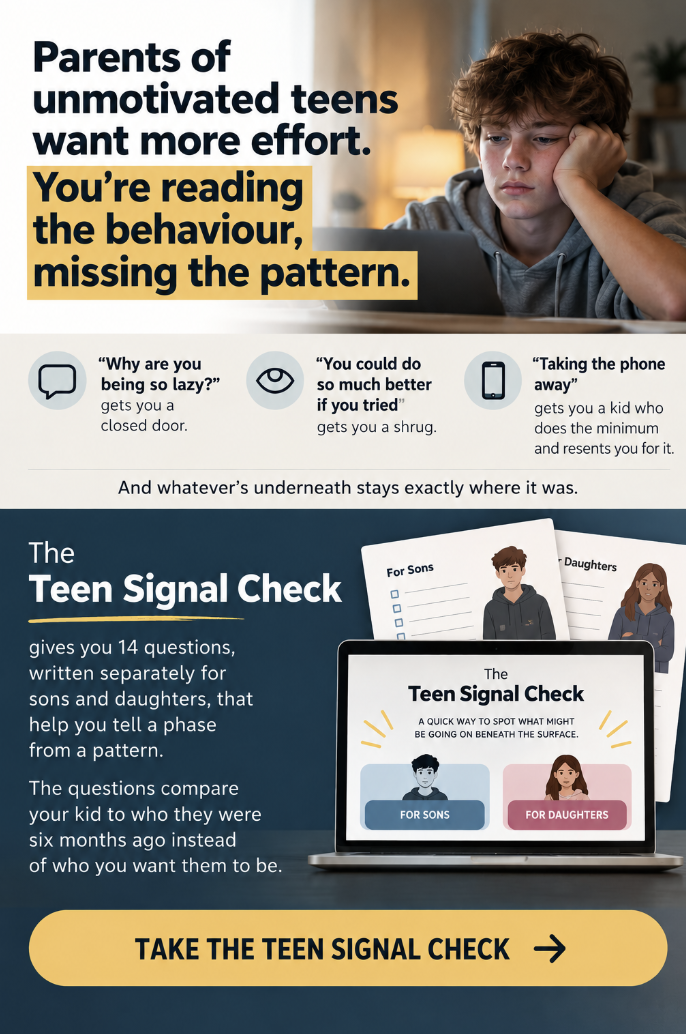
Pay attention when the behaviour becomes a pattern or when your kid starts behaving differently from the kid you know.
Compare them to themselves.
Six months ago, were they different?
Has something changed?
Your gut will often tell you when something feels off.
That’s when I’d get curious.
Because “lazy” describes what you’re seeing.
It tells you very little about why it’s happening.
FAQ
How can I tell if my teen's behaviour is normal or something more?
Compare them to themselves. Every teenager wastes an afternoon. What's worth noticing is a chEngagement comments
Is it normal for my teenager to need downtime after school?
Yes. They've spent the day dealing with classes, friends and expectations. The trouble starts when a short break turns into the whole evening. Agree on a time together, so the downtime has an end they helped set.
Why does my teenager leave everything to the last minute?
Often the task feels too big to start, and the deadline is the only thing that finally forces them to begin. Help them find a piece they can finish in ten minutes. Starting small, early, beats starting in a panic.
How do I help a struggling teenager who gives up easily?
Giving up fast is often about confidence more than effort. If they expect to fail, quitting protects them from finding out. Resist doing it for them. Ask which part they already know how to do, and start there.
My teenager stopped doing activities they used to love. Should I be worried?
Interests change, and that's normal. Pay closer attention when something they loved drops away and nothing replaces it, especially alongside more sleep, less time with friends, or a flat mood. Ask about it gently. If the change lasts or you're worried, talk to your family doctor. In Canada you can call or text 9-8-8 any time.
You May Also Like
Know Your Child's Normal Well Enough to See When It Changes The longer version of "compare them to themselves": how to know your kid's baseline well enough to notice when it shifts.
I Wrote the Warning Signs for Parents. Then I Counted 11 in Myself. For readers who recognized the brain fog in the intro. What happened when I held the same checklist up to my own life.
The Mental Health Checklist I Wish I Had When Maddie Was 14 Practical next steps for a parent who's noticed a change and isn't sure yet what it means.