
The Conversation Is Coming Either Way
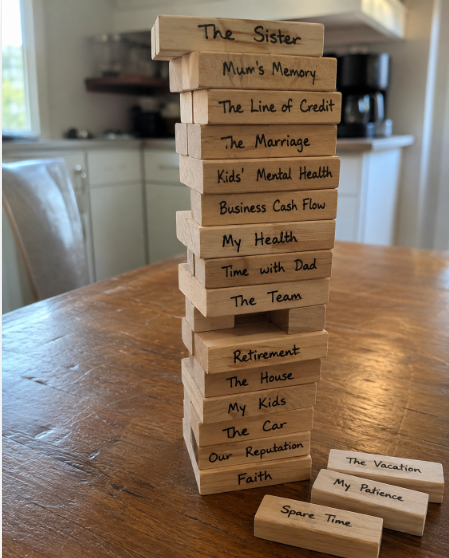
Read enough performance reviews and you start seeing the same sentence in different handwriting.
They have lost a step.
Ask when it started and nobody can tell you. There is no incident. No meeting where it went wrong. No date anyone can point to. The manager knows something changed. They just cannot say when, because there was no when.
We keep waiting for an event. It does not arrive as an event.
What they are actually carrying
We reach for the obvious one. The struggling teenager. Sometimes it is that.
It is also the collection calls that come in through the day, the ones they take in the stairwell.
It is the drive to the hospital with the parent whose body is slowly failing them. Or worse, their brain. The parent who used their name last month and did not this month.
It is the brother who has been addicted to crack for thirty years and is living at their parents' house, freeloading, because their mother knows that if she puts him out he will be dead inside six months. So nobody puts him out. Everyone just absorbs it, and your employee is the one who picks up the phone when their mother needs to talk about it at nine at night.
It is the marriage where the conversations have gone empty, and the question they cannot stop asking themselves is whether they are going to live inside that lie for the rest of their life or finally do something about it.
And then it is the sister. Stage four breast cancer, diagnosed five years ago. Five years of scans and waiting rooms and the phone ringing with news that could go either way. She died in March.
You qualified for three days.
Then you walked back into your office on the Thursday and picked your job up where you left it, as though the last five years had not happened. That is what the policy says the arrangement is.
None of this waits its turn. That is the part organizations never account for. These things do not start where the last one left off. They stack on top of one another, with less stability than a tower of Jenga, and a stack like that holds fine right up until the moment it does not.
That is what your employee is navigating right now, this week, while you are wondering why the last report came in late.
The 2 a.m. loop is why your 10 a.m. meeting goes the way it does
Worry does not keep office hours.
It shows up at two in the morning and it is not thinking about anything useful. It runs the same loop about the money, or the mother, or the marriage, and it runs it until about four.
The alarm goes at six thirty.
A person running on four hours of broken sleep is not a lazy person. They are a person whose judgment and patience and short-term memory have all quietly dropped, and none of that is visible from across a desk. They look the same. They sound the same. They will tell you they are fine and they will mean it, because this has been their baseline for so long that they have forgotten what the other thing felt like.
Decisions get more expensive
Everyone has a limited number of good decisions in them on a given day.
Your employee has already spent a chunk of theirs before they log on. Which specialist to call. Whether to tell their kid what the doctor said. Whether today is the day they say something to their spouse. Those decisions happened in a car at seven in the morning and nobody at work will ever know they were made.
What is left over gets spent on you. So the choices get more conservative. The obvious option beats the better option. The thing gets done rather than done well.
Nobody logs any of that. It just accumulates.
Nobody schedules a conversation about a three percent day
Here is why this stays invisible for so long.
The first signs are almost nothing. Someone reads the same paragraph twice. Someone who used to answer within the hour now answers by end of day, and end of day is still fine.
Every one of those moments sits inside the normal range of a human being having a slightly off day. A manager who raised it would look ridiculous. So nobody raises it.
Then it is a month of those. Then it is a quarter. Then it is a sentence in a review about losing a step, and by that point everyone involved has forgotten there was ever a version of this that was fixable with a question.
They are keeping it from you on purpose
The people carrying the most tell you the least. That is not an accident and it is not a character flaw.
They have made a calculation. They have decided that telling you costs more than carrying it, because somewhere along the way they learned that the workplace rewards people who appear to have nothing going on. So they perform having nothing going on, and they get worse at their job while doing it, and they watch you notice the second part without ever asking about the first.
This holds until one of two things happens. Either you decide they are not working out and you move them out. Or they sit you down and tell you what has actually been going on.
Either way, the next conversation is coming, and it is coming from you, their boss.
So the only real question is which conversation, and when
You are going to talk to this person. That part is settled.
You can have the conversation now, while they still have room to carry what they are carrying, and while the thing you are describing is a three percent day rather than a file. Or you can have it in eighteen months, with HR in the room and a script in front of you.
The second one has a price on it. Gallup and SHRM both put replacing an employee at 50 to 200 percent of their annual salary, and Gallup pegs the top of that range at leaders, which is exactly who this is happening to. Your most senior people are the ones parenting teenagers, driving to the hospital, and taking the call at nine at night.
You are choosing between helping someone and paying double their salary to start over with a stranger.
Most organizations make that choice by default, which is to say they never make it at all. They just wait, and then they pay.
How long are you willing to watch this before you ask a real question?

You May Also Like
What If Your Best Employee Is Carrying Five Major Life Challenges Right Now? The companion piece to this one. Your best employee looks fine, meets deadlines, answers email. What you cannot see is the child in crisis, the aging parent, and the grief that never left. On presenteeism, and what leaders can do without becoming a therapist.
The Avoidable Resignation Letter Most managers can name the exact moment they missed. A quiet one-on-one. A late message. A Friday afternoon where something felt off. What the Manager Signal Check finds before the window closes.
What Your Executives Believe About Your Culture and What Your Employees Actually Live Leadership sees one company. Employees live in a different one. How the Culture Signal Check measures the distance between them, and what the size of that gap predicts.
FAQ Section
How do I know if an employee is struggling with something personal? Usually you don't, and that is the problem this post describes. What you see is a gradual change with no start date: slower replies, more conservative decisions, work that gets done rather than done well. None of it is dramatic enough to raise on its own. The pattern is the signal, not any single day.
What do I say when an employee tells me something personal? Less than you think. The instinct is to fix it or to fill the silence, and both land badly. Acknowledge what they said, ask what would actually help, and be specific about what you can offer. The one thing to avoid is a well-meant reply that quietly ends the conversation, like moving straight to logistics or telling them about someone who had it worse.
Isn't this what our EAP is for? An EAP waits to be called. Check your utilization rate; most sit in the single digits. The people carrying the most are frequently the least likely to call, because reaching out means admitting something they have decided costs too much to admit. An EAP is a good thing to have and a poor thing to rely on.
What does it actually cost to replace an employee versus supporting them? Gallup and SHRM both put replacement at 50 to 200 percent of annual salary depending on the role, with leadership roles at the top of that range. Supporting someone through a hard stretch costs a conversation, some flexibility, and occasionally a referral. The arithmetic is rarely close, and almost no organization runs it.
Am I supposed to be their therapist? No, and you are not qualified to be. The job is narrower than that: notice the change, ask a real question once, and hear the answer without flinching. Then point toward help that is not you. That is a trainable skill, and it is what First Conversation Coaching exists to build.
