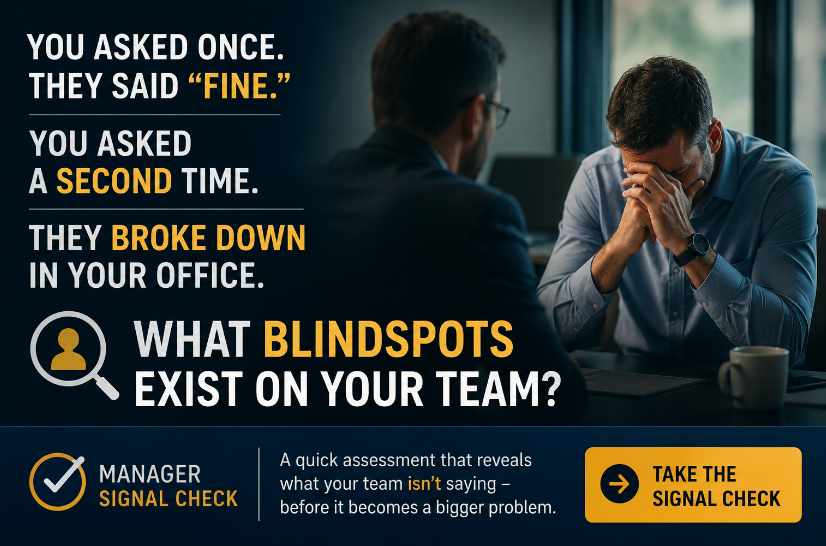
The Avoidable Resignation Letter

I have sat across from dozens of managers after someone on their team quit.
Not in the immediate aftermath, when the shock is still fresh and the logistics of backfilling a role take over. I mean weeks later, when the dust has settled and there is space to actually think about what happened.
If they’re really being honest, every single time, we find the moment.
The specific moment. One conversation, one message, one afternoon where something was there to be seen. And their team manager saw it. They registered it. And then they moved on, because they did not know what to do with what they were noticing.
That is a training gap. It’s not something that falls neatly into a manager’s training manual. It takes courage, awareness and stepping into the discomfort that few managers seldom roam.
Here is what those moments tend to look like.
A one-on-one where the energy was different. Subtly different. The person answered every question, hit every update, smiled at the right times. But something was quieter than usual. The manager noticed. Made a mental note. Asked about the project status instead.
A message that came in at 11 p.m. on a Monday night. Just slightly outside the norm for someone who typically kept regular hours. The manager responded the next morning with logistics. The conversation ended there.
A Friday afternoon where someone who was usually engaged seemed somewhere else entirely. The manager thought: long week. We have all had them. Let it go.
None of these moments looked like warning signs in the moment. That’s the point. They rarely do. They look like noise. They look like the ordinary friction of a demanding job and a full life. And so managers do what reasonable people do with noise. They filter it out.
Six months later, the resignation letter arrives.
Most of the managers cared deeply about the people on their teams. They just didn’t have a framework for acting on something as ambiguous as a feeling.
A feeling that something was off. A sense that someone was pulling back. An instinct that the energy in the room had shifted in a way that was hard to name and harder to bring up without seeming presumptuous or intrusive.
So they waited for something more concrete. Something they could point to.
By the time that something concrete arrived, the decision had already been made. The resignation letter was already written. The conversation that might have changed things had a six-month expiry date, and passed.
It is about giving managers permission to act on what they are already noticing. Because they are noticing. That is not the problem. The problem is that without a structured way to process those observations, most managers talk themselves out of acting on them.
Do I get to ask them that question? Is that appropriate as a boss?
Here’s the better question to ask yourself, is it wrong to care about your people and want to be supportive?
They don’t want to make someone uncomfortable by raising something that might turn out to be nothing.
So they wait. And the window closes.
The Manager Signal Check was built for exactly that gap.
It’s ten questions that help a manager take what they are already sensing about someone on their team and turn it into something they can act on. A reason to check in and permission to ask.
It takes 5 minutes. It is free. And it works best before anything is obviously wrong.
Because by the time something is obviously wrong, you are usually already behind.
The Manager Signal Check is one of four diagnostic tools in the MentorWell Signal Check ecosystem. Built for managers, HR leaders, and organizations that believe retention starts long before the exit interview.