What Your Executives Believe About Your Culture and What Your Employees Actually Live
I Lost a Job Because I Told the Truth About a Broken Culture.
I know what it feels like when speaking up puts a target on your back.
I lived it.
I joined a company after closing my office furniture business. I came from somewhere built on trust, honesty, and genuine care for the people inside it. My business partner created that environment. I didn't fully appreciate what we had until I walked away from it.
Walking into this new organization felt like stepping into a different atmosphere entirely. Flat. Guarded. Tense in a way nobody named out loud but everyone felt the moment they arrived each morning.
Meetings happened. Decisions got made. And the unspoken rule was clear to everyone who had been there long enough to learn it.
Comply. Don't challenge. Don't ask the question that makes leadership uncomfortable.
I didn't follow that rule.
I came from a place where raising a concern was a sign of engagement, not insubordination. Where pushing back on a decision meant you cared about getting it right. Where trust between leadership and employees wasn't a value on a poster. It was how things actually worked.
In this company, trust didn't exist in the same way.
Confidential information that should have protected employees was shared without appropriate safeguards. Procedures that existed for good reasons were bypassed when they became inconvenient. When I raised concerns about what I was seeing, the response wasn't a conversation.
It was consequences.
Suddenly I was outside things I'd been included in before. Conversations shifted when I walked into a room. The warmth that existed in my first weeks quietly disappeared.
I had a target on my back. Because I had done the one thing that culture couldn't tolerate.
I told the truth.
I stayed as long as I could. The ethical breaches eventually made it impossible. The choice became simple and brutal.
Leave or get fired.
I left.
And I spent a long time afterward thinking about what made the difference between that place and the one I came from. What creates a culture where people speak up versus one where they learn not to. What it costs a company when its best people go quiet. And what it costs when those same people eventually walk out the door.
That thinking is what eventually became the Culture Signal Check.
The gap nobody sees from the top
Here's what I've learned since then.
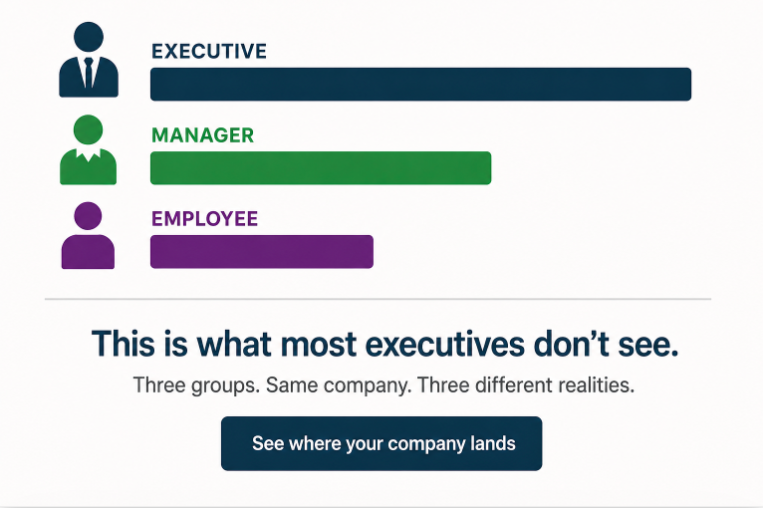
Most executives don't know this gap exists in their own organization. The gap is genuinely invisible from where they sit.
Leadership experiences a company where people seem engaged, meetings run smoothly, and turnover feels like a normal cost of doing business.
Employees experience a company where speaking up feels risky, managers are too stretched or too afraid to have real conversations, and the unspoken rule is to leave your whole self at the door and just do your job.
Both groups are describing the same company.
That distance between those two realities is where your best people quietly decide to leave. They update their resume, take the recruiter's call, and one morning hand in their notice and tell you it was an opportunity they couldn't pass up.
You never find out what actually happened.
What congruence actually looks like
When executives, managers, and employees describe their culture in broadly similar terms, something important is happening.
It means what leadership believes is actually being felt on the ground. That the values on the wall match the behaviours in the meeting room. That managers have the skills and the permission to show up as whole human beings and create space for their teams to do the same.
Employees in congruent cultures don't just stay longer. They perform differently. They bring ideas to the table because they believe those ideas will be heard. They raise concerns before they become problems because they trust that raising a concern won't cost them anything.
They tell recruiters they already work for the best company.
Congruence isn't perfection. It's alignment. And alignment is the thing that makes everything else possible.
What misalignment actually costs
When the three groups describe their culture differently, you have a gap.
Sometimes it's a small one. Leadership is slightly more optimistic than managers. Managers are slightly more positive than employees. That's normal and manageable with the right attention.
Sometimes the gap is significant. Executives score their culture an eight out of ten the same week three people on their team are quietly updating their resumes. Managers describe an open door policy that employees experience as decoration. Leaders talk about psychological safety in all-hands meetings while employees sit in silence calculating the risk of saying the wrong thing.
That gap has a price tag.
Replacing an employee costs between 50 and 200 percent of their annual salary. That's recruitment fees, lost productivity, onboarding time, institutional knowledge walking out the door, and the ripple effect on the team left behind.
A mid-level manager earning $90,000 costs you between $45,000 and $180,000 to replace.
Multiply that by last year's turnover and ask yourself honestly how much of that was preventable.
But the financial cost is only part of it.
The deeper cost is what happens to the people who stay.
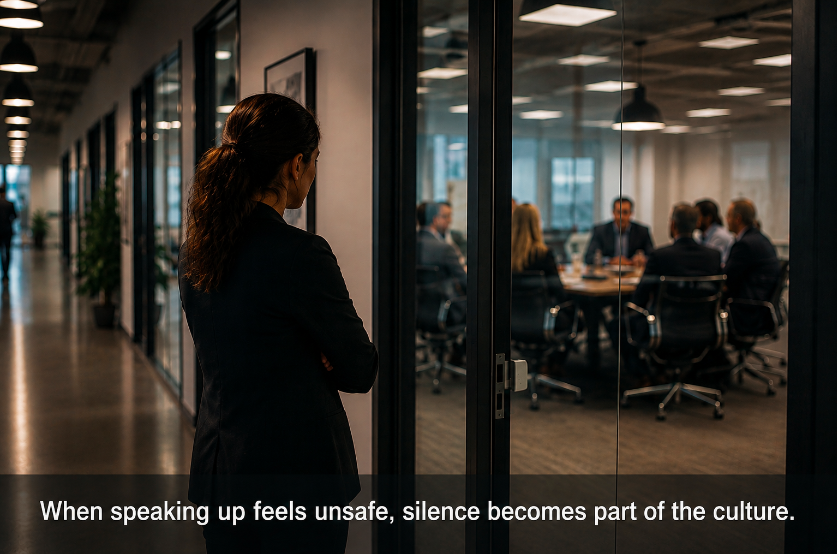
When employees learn that speaking up has consequences, they stop speaking up. Bright ideas stay unshared. Problems that could have been caught early quietly compound. The energy in the room goes flat. People show up, do enough to stay employed, and spend their discretionary effort somewhere else.
That's a culture problem. And it won't show up clearly on any standard engagement survey because the people who could tell you the truth have already learned not to.
What the Culture Signal Check measures
This is a gap diagnostic.
25 questions across six categories. Leadership behaviour. Employee experience. Psychological safety. Communication quality. Support when life gets hard. And culture in action.
None of the questions ask whether you have policies. Every question asks what actually happens.
Three groups complete it independently. Executives. Managers. Employees. Each answering the same questions from their own lived experience of the same organization.
You're not looking for agreement. You're looking for disparity.
Where the three groups align, you have something worth protecting. Where they diverge, you have something worth understanding before it becomes something you can't fix.
Results come back as Green, Yellow, or Red.
Green means your perception and reality are broadly aligned across all three groups. You're doing something right. The work now is protecting and building on it.
Yellow means patterns are shifting. A meaningful gap has opened between what leadership believes and what employees are living. This is the zone where early action makes the biggest difference. It is also the zone most organizations wait out too long.
Red means the gap is significant. Your culture is costing you people and you may not be seeing it yet. This is the time to act, not the time to commission another engagement survey.
What happens after your results
The Culture Signal Check is a starting point, not an endpoint.
If your results show a Yellow or Red signal, we have a conversation about what the data is telling you and what to do next.
If the gap is showing up in how your managers communicate, how they handle difficult conversations, how equipped they are to support a team member who's struggling, that conversation leads to First Conversation Coaching. Practical training that gives your managers the skills to have the conversations that keep people.
If the gap is showing up in how your working parents feel supported, how much of themselves employees feel they can bring to work, how the whole person is valued rather than just the function, that conversation leads to LifeLine Parent Workshops. A programme that addresses the part of your employees' lives that most workplace wellbeing programmes completely ignore.
If your results show Green across all three groups, you'll have something concrete to point to when your board asks how you know your culture is healthy. That's worth something too.
Either way you're better off knowing than guessing.
One more thing
The company I left eventually lost most of the people who had been there when I arrived.
Not in a dramatic way. One by one, quietly, over the course of a couple of years. Each of them taking the recruiter's call. Each of them citing an opportunity they couldn't pass up.
None of them telling the truth about why they were really leaving.
The executives, I suspect, never fully understood what happened. From where they sat, the culture was probably still an eight out of ten.
That's the gap.
The Culture Signal Check exists because that gap is measurable. Because you can know, specifically and honestly, whether what you believe about your culture matches what your people are actually living.
And because knowing is always better than finding out too late.