You Can Worry About Your Teenager Without Telling Anyone

Why Parents Skip Suicide Prevention Talks
There was a sign-up sheet. That is the part I keep coming back to.
A while after I lost my daughter Maddie, a middle school asked me to come talk to parents about suicide prevention. Four parents signed up. The school called a few days out and cancelled it.
I wrote about that. A lot of people read it, somewhere past 300,000. Most of them landed where I did. The school got it wrong. The parents were in denial. "That would never happen in our family," right up until it does.
I have had six months to sit with that post. I owe those parents a correction.
Denial was the wrong word. Here is what I missed.
A sign-up sheet is not private. Your name goes on a list in the front office. The admin assistant sees it. Maybe another parent sees it walking past. And once your name is on there, a question hangs in the air that you cannot take back. Why did they sign up for the suicide talk?
That is a lot to ask of a parent on a weekday night. Not necessarily the talk. The being seen deciding you might need it.
So let me say this plainly, because I got it wrong the first time. The four who signed up were the ones willing to be watched paying attention. Plenty of others were paying attention too. They just did it where nobody could see them.
That is the group nobody built anything for.
I didn’t figure this out in the abstract. I watched it.
I run these sessions for companies now, whole rooms of working parents. Early on I noticed something. So I started changing how I open them. I tell people up front that we are going to talk about hard things, and that if they would rather keep their camera off, I respect that completely. When we get to questions, I tell them they do not have to raise a hand in front of the people they sit next to every day. Email me instead. I will answer anything, with nobody watching.
There have been sessions where I close my laptop, and by the time I check my phone, six parents have already emailed me privately.
Six. In a room where almost nobody raised a hand.
That’s what people are carrying. Quietly, with shame, certain they are the only one. And they will reach out, but only if you build them a way to do it without an audience. Take that away and they stay underground. Give it to them and they come forward. Same parents. Different door.
I know this because I would have been in it. If someone had run that talk when Maddie was twelve, I am not sure I would have put my name down. Mostly because signing up felt like saying something out loud that I wasn’t ready to say. That my kid might be one of them. That I might be that parent. So you tell yourself you'll catch the next one, and you go home, and you load the dishwasher.
Here’s what took me too long to learn.
Awareness doesn’t need an audience. You don’t have to sit in a school gym to pay attention to your own child. Most of what matters happens in a parked car, or in the ninety seconds before the headphones go back in.
Your kid says "I'm fine." Most of us stop there. The whole thing lives in whether you ask one more question after that. Not an interrogation. One question. "You've seemed a bit flat this week. Is it school, or is it something else?" Then you sit in the quiet and let it be awkward for what feels like an eternity.
It is about nine minutes and a willingness to not fill the silence.
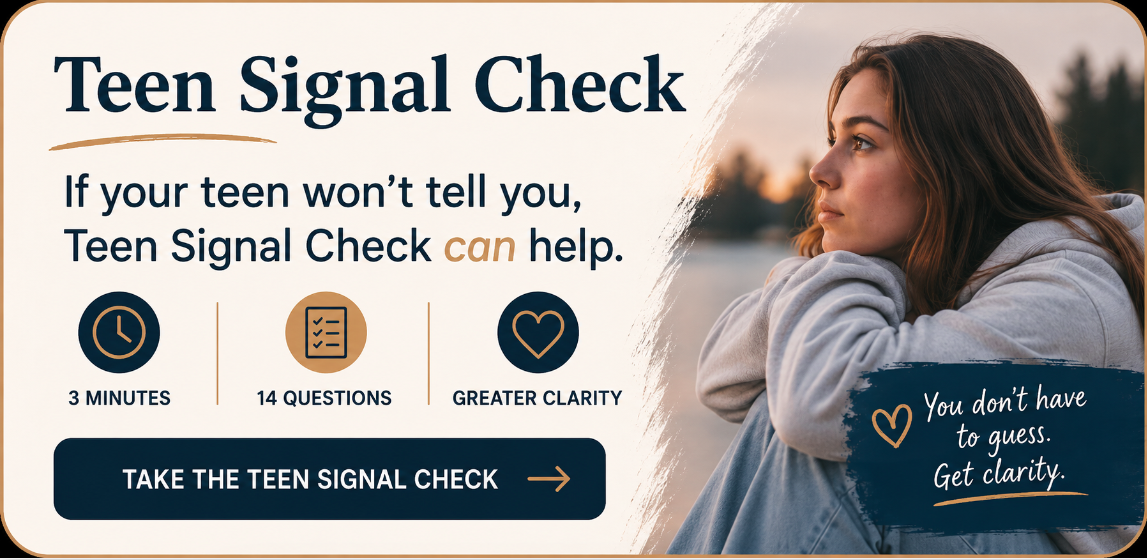
If you’ve been quietly worried and you don't want to announce it to anyone, that is exactly the point. The Teen Signal Check takes about three minutes. You do it on your phone. Nobody sees your name. It will not diagnose your kid. It might make you sit up a little straighter about something you have already been noticing.
The parents who skipped my talk were never the problem. The problem was that the only door we gave them had their name taped to it.
I’ve spent the years since building doors without names on them. Cameras off. Questions by email. A two-minute check nobody has to know you took. Every time I do it, people come forward who would never have raised a hand.
So if you're the one quietly worried, this is me telling you: you can pay attention to your child without telling a single person. Start there. The rest can stay between you and your kid for now.
If you or your teen needs help right now, call or text 988. Free, confidential, available 24 hours a day.
FAQ Section
Why do so few parents sign up for suicide prevention talks?
Most are not avoiding the information. They are avoiding being seen wanting it. A sign-up sheet puts your name on a list in the school office where other people can read it. That is a different decision than showing up to learn something.
How do I know if I'm overreacting about my teen?
You probably are not. Parents rarely invent concern out of nothing. What they do is talk themselves out of something they already noticed. If you have been circling the same worry for a few weeks, that is worth paying attention to on its own.
When should I worry about my teenager's behaviour?
One change on its own usually means very little. Patterns matter more. If something has held for a few weeks, if it is showing up in more than one part of their life, or if your gut keeps returning to it after you have explained it away, that is the point to look closer.
Can I look into this without my teen knowing?
Yes. Nothing here requires you to sit your child down and announce that you are worried. The Teen Signal Check runs off your own observations, on your own phone. Your teen does not participate and does not need to know you took it.
What do I say when my teen says "I'm fine"?
Ask one more question, then stop talking. Specific beats general. "You've seemed a bit flat this week. Is it school, or is it something else?" Then let the silence sit for a few seconds instead of filling it.
You May Also Like
Teen Suicide Warning Signs Parents Miss. See what spawned this popular post and became my largest-seen post this year.
The 7 Questions Parents Ask Me in Private
The questions parents send me when nobody else is watching. If this article described you, this is the direct follow-up.
We Never Saw the Warning Signs: A Parent's Wake-Up Call
The original post about the cancelled talk, written before I understood why those parents stayed away.
When Something Feels Off With Your Teenager
For the parent whose gut has flagged something and who keeps talking themselves out of it.