People wonder. Most of them are too polite to ask.
It comes out sideways. Someone will say they admire what I'm doing, and there's a pause, and I can hear the question underneath it. She died in 2015. At some point doesn't a person move on.
Here's the answer nobody expects. When I write about Maddie, I'm with her. That's not a figure of speech and I'm not going to dress it up into one. It's the closest thing I've got. An hour at the keyboard with her is an hour I wouldn't otherwise get.
Everything else that follows is true. It just came later.
She's my daughter.
Nobody asks parents to stop mentioning their living kids. You can talk about your son's hockey season for eleven years and nobody thinks you're stuck. But there's a quiet expectation that a dead child gets a shorter runway. A year, maybe two, and then you're supposed to be careful about bringing her up because it makes the room go strange.
I've got three kids. Zac, Sawyer, and Maddie. I've always had three kids. I'll have three kids when I'm eighty. Two of them are here and one of them isn't, and all three of them are mine, and I'm proud of every one of them.
That alone is enough. Everything after this is extra.
She was an ordinary kid, and that's exactly why she matters.
This is the part parents tell me. They come up after workshops, or they email me later that night, and it's some version of the same sentence. She sounds like my daughter.
She left me hours of video. She had no idea she was leaving me anything. She was just a kid alone in a room with a camera, performing for an audience of nobody, doing bits that were never meant to be seen by another human being. Trying to nail the Cup Song, over and over. Running through her accents, which she had a lot of and which varied in quality. Singing Justin Bieber to an empty room. I watch them and I still laugh. Not a sad laugh. The regular kind.
That's her. Not the version in the presentation. The girl doing a routine for nobody.
Every interview I do, every podcast, the first question is about Maddie. Almost without fail. More than one interviewer's told me my face changes when I start talking about her. I know it does. I don't try to stop it.
What comes back to me most from other people is her kindness, which is a word that's been worn flat by overuse, so let me be precise.
A girl dropped her books in a crowded hallway. Maddie picked them up and then walked her to her next class, which is the part that gets me, because anybody can pick up books. There was a girl on her swim team who other kids weren't always careful with, and Maddie made a point of her. Not in a big way. Just steadily, the whole season.
I did not know that until after.
She had no interest in who you were supposed to sit with. Cliques never got any traction with her, and I don't know where that came from, because most fourteen year olds are drowning in that stuff.
Here's the one that undid me. After she died, a lot of her friends came to us, and more than I could count told us the same thing. Maddie was their best friend. Not a good friend. Their best one. They meant it, all of them, separately.
She had a way of making you the only person in the room. Apparently she did it for a lot of people, and none of them knew about the others.
One more, and it's the one I keep turning over.
She spent time in a youth psychiatric unit. Twice.
If you've never been inside one, the thing to understand is that arriving is the worst part. Families come through that door frightened and embarrassed and completely lost. The kid especially. Nobody knows where to look.
Maddie made herself the greeter.
Nobody asked her to. She'd see a new kid come in with their parents, and she'd walk over, say her name, start talking. Show them where things were. Make it a place with people in it instead of a hallway.
She was fourteen. She was in there for herself. And she was working the door.
I'm prouder of that than of anything else she did. I also understand something about it now that I didn't understand then.
We weren't perfect, and you need to hear that.
We had stretches that were hard. We argued. There were doors that closed and days that didn't go well. Love was underneath all of it, and I'm still not going to sell you a version where the two of us floated through her fourteen years in some kind of understanding.
That matters if you're a parent reading this and thinking your relationship with your teenager is too rocky to count as close. It counts. Ours was rocky and it counted.
There are more stories about her than I can hold, and a new one still turns up every so often, years later, from someone I've never met. I tell them so other people can see her. Mostly I tell them so I can.
Statistics don't have faces. Maddie does.
Every parent I meet is running the same math without knowing it. The odds are good. Most teenagers come through this. It happens to other families.
All of that's true. I believed it too.
The trouble with odds is that they're describing a crowd, and you're not raising a crowd. You're raising one specific person who's got a name and a laugh and a way of coming down the stairs.
I can't argue a parent out of the numbers. I've tried. But I can put a face beside the numbers, and something happens in a room when I do. People cry in my workshops. Not because I'm trying to make them cry. Because for a moment they stop hearing about teenagers and start thinking about theirs.
If a parent goes home from that and asks their kid one more question than they were going to ask, then Maddie did that. Not me.
She's still working.
I've had families tell me their child's alive because of something they learned through Maddie's story. I don't say that lightly and I don't say it often, because it isn't mine to claim and I can't prove it.
But they told me. And I believe them.
So when people say The MentorWell's my work, I let it go, but it isn't quite right. I do the logistics. I show up on the calls. Maddie's the reason anyone stays on the call.
What it costs.
I should be honest about this part.
Telling her story in front of a room isn't a neutral act for me. There are days I finish a session and I'm fine. There are days I close the laptop and sit in the car for twenty minutes before I can drive.
It's almost never the session that does it. It's after.
Somebody hangs back. They wait until the room clears, and then they tell me about their kid. Sometimes it's a story that ended well, and they want me to know that, and I'm glad. Sometimes they tell me about someone they lost. A child. A brother. A friend they still think about every day.
Some of those end in a hug. Some of them end in a look that lasts about two seconds and says everything. If you haven't lost someone, I cannot explain that look to you. If you have, I don't need to.
Then they go back to their desk, and I go out to my car.
That's where it lands. Sometimes I'm smiling. Sometimes I'm not. I've never once driven away from one of those unaffected.
None of it happens without Maddie. She's the reason that parent felt safe enough to stay behind, and she's the reason I know what to do when they do.
Would she want this?
I say she would. I've said it in interviews. It's written on my website, probably in more than one place.
The truth is I don't know. She was fourteen. She never got asked. She's not here to tell me I'm getting her wrong, or that I'm using the picture she hated, or that I've turned her into someone more serious than she actually was.
So I try to hold it carefully. I try to keep her a person and not a lesson. When I catch myself flattening her into a message, I stop and put something back in that's just hers, something that serves no purpose except that it was true about her.
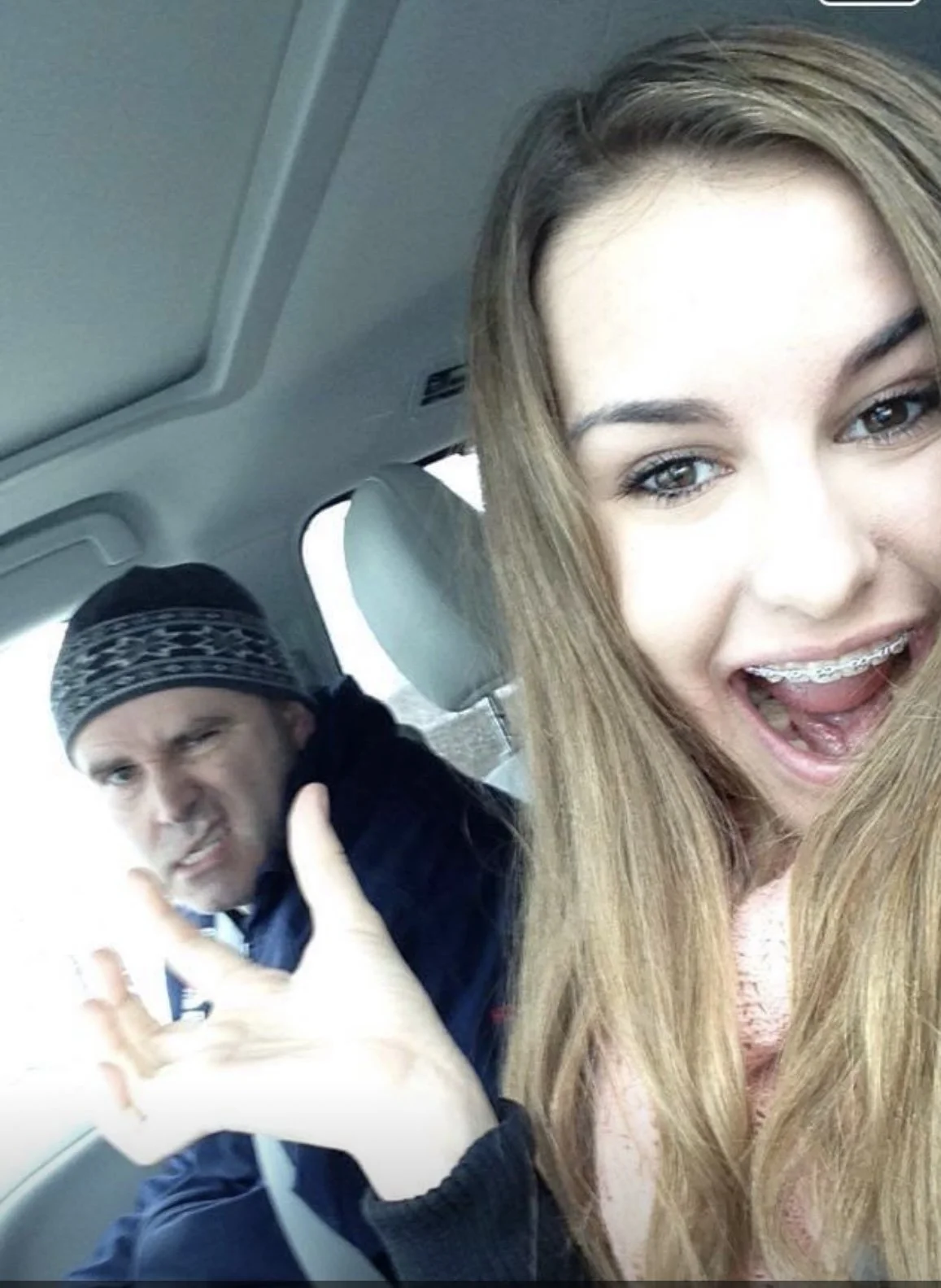
Here's one. We'd be driving, or standing in line somewhere, no reason at all, and she'd say "Selfie, Dad." That was the whole thing. Not a request. An announcement. Then a face, and my face doing whatever my face was doing, and then back to whatever we were doing before.
I've got a lot of those. They mean nothing. That's the point of them.
We watched movies together and she'd give me a thumbs up or a thumbs down as the credits started, no commentary, verdict delivered. She let me pick, because I usually got it right. Stand by Me got a thumbs up. That one we loved together, which is a different thing than watching something and liking it.
That's the discipline. She was a girl who liked ambushing her father with a camera and who trusted me to pick the movie. The work came out of her. She did not come out of the work.
You can say her name.
Here's the thing I didn't expect. People go quiet around me.
Not unkindly. They're being careful. Somebody will be mid-sentence about their own kids and then they'll catch themselves, and there's this small correction, and the conversation moves somewhere safer. I can watch it happen in real time. They've decided that mentioning her, or mentioning their own daughter's birthday, or asking me anything at all, would hurt me.
It's the opposite. Silence is what hurts.
When you go quiet around her name, what I hear is that she's become a subject rather than a person. And I understand why it happens. Nobody's taught how to do this. There's no script for asking a father about his dead kid, so people default to nothing, and nothing feels respectful from the outside.
So let me clear it up. Ask me about her. Ask what she was like. Ask what she found funny. Ask me what happened, if that's what you actually want to know, and I'll tell you or I'll tell you I'd rather not, and either way we'll both survive it.
You won't remind me. I promise you I hadn't forgotten.
That's part of why I write about her this openly. Every time I say her name out loud in a room, I'm handing everyone in that room permission to say it back. Not just about her. About whoever they're carrying and haven't mentioned in years because somebody once changed the subject on them.
The awkwardness is real, and it isn't anyone's fault. But curiosity's the better instinct. Follow it.
So that's why.
Because she's my kid. Because parents see themselves in her. Because a face does what a statistic can't. Because she's still helping people and I'm not going to take that away from her.
And because when I write about her, I get an hour with her.
I couldn't do this work without her. That isn't a tribute line. It's a description of how it functions. She isn't the story I tell in the workshop. She's the reason there's anyone standing at the front of the room.
Just like Zac and Sawyer, I'm proud of everything she's done.
Maddie Coulter. June 28, 2000-April 11, 2015.
Still my copilot. Still on the calls. Still doing more good than I am.
If you or your teen needs help right now, call or text 988. Free, confidential, 24 hours a day.
FAQs
What do you say to a parent who has lost a child?
Say their child's name. Ask what they were like. You don't have to find the right words, and there aren't any. Most bereaved parents would rather hear something clumsy than nothing at all.
Is it okay to mention a child who died?
Yes. The worry is usually that you'll remind them, and that isn't how it works. They hadn't forgotten. What you're actually doing is giving them a chance to talk about someone they think about constantly and rarely get to mention.
Why do grieving parents keep talking about their child?
Because talking about them is one of the few ways left to be with them. It also keeps them a person rather than an event. For some parents it's the closest thing to time together that's still available.
What if I say the wrong thing?
You probably will at some point, and it's survivable. Most people who've lost someone can tell the difference between an awkward attempt and indifference. The attempt is what registers.
How long is too long to still be grieving?
There isn't a point where it stops being appropriate. Grief changes shape, it doesn't expire, and the expectation that someone should be finished by a certain date is something the rest of us invented for our own comfort.
You May Also Like
The 7 Questions Parents Ask Me in Private
The things parents ask when nobody else is listening, and why they wait until the room clears.
When Something Feels Off With Your Teenager
For the parent whose gut has flagged something and who keeps talking themselves out of it.
We Never Saw the Warning Signs
What I missed with Maddie, written for the parents who are where I was.