Teen Suicide Warning Signs Parents Miss: Why "It Won't Happen to Us" Is Dangerous
"My child tried to take their life. We didn't see the warning signs coming."
By the time I hear from a parent, they're usually past prevention. They're in crisis, and everything about the conversation has changed shape.
I've heard that sentence enough times now that I've stopped hearing it as a statement about the child. It's a statement about what the parent was able to see, and what nobody ever taught them to look for.
Four Parents Signed Up. The School Cancelled It
About a year after Maddie died, a middle school invited me to speak to their parents about youth suicide prevention. She was 14 when we lost her.
A few days before the event, the school called. Four parents had signed up. They cancelled it.
I wasn't angry. I was heartbroken.
I've thought about that phone call for years, and what I've landed on isn't about the school. A principal looking at four names on a list, with a room booked for eighty and forty other things happening that week, makes a reasonable decision. I'd probably have made it too.
What I keep returning to is the assumption underneath it. Four names got read as four families who needed it, and everyone else was fine.
It wasn't four families
Here's what I knew even then, and couldn't have proven.
Before that talk, I ran a teen mental health programme called HowAreYouFeeling.org. We gave 500 parents access to the same suicide prevention content their kids were already watching. Free. No sign-up sheet, no room to walk into, nobody watching them do it.
Fewer than five per cent opened it.
Four parents wasn't an anomaly. It was the number.
And it isn't a measure of how many families needed it. It's a measure of how many were willing to be seen needing it. Putting your name on a list, in a school, next to the words teen suicide prevention, where another parent might see it and wonder why, is a different act from wanting the information.
I've talked to more than 2,500 parents since to know what was in that building. Some of them were worried about their kid that week. A few had already been to a doctor. At least one had a child who wasn't okay and no plan for what to do about it, and no intention of announcing that in a sign-up sheet.
They didn't stay away because they didn't need it.
That would never happen in our family
That's the other sentence. I understand it completely, because I said it too.
It feels safer to believe your child is fine. It feels responsible to trust the relationship you've built with them. Neither of those is denial exactly. They're closer to how you believe the floor will hold when you put your foot down: assumptions that sit underneath everything and never get examined, because examining them would mean living differently.
Assumption is not the same thing as awareness. That distinction has cost me a lifetime of heartache.
What I was actually watching for
Nearly 40% of teens will experience a significant change in their mental health during adolescence, according to Northwestern Medicine. Most of them won't say so directly.
What I didn't understand at the time is that distress doesn't announce itself in the language we're taught to expect. Changes in personality or behaviour often have nothing obviously to do with suicide. Sadness, withdrawal, irritability, anxiety, exhaustion or apathy can all signal something, according to the Child Mind Institute. Warnings can be direct, like "I want to die," or indirect, like "everyone would be better off without me." Sleep changes. Eating changes. Recklessness that doesn't fit them. Pulling back from things they used to care about.
Most parents look at that list and see ordinary adolescence, because a lot of the time that's exactly what it is.
The thing worth paying attention to isn't the single behaviour. It's duration and direction. A bad week is a bad week. Six weeks moving the same way, in more than one part of their life, is something else. That's the distinction nobody hands you, and it's the one that does the work.
What I missed
Maddie wasn't a quiet kid. She was funny and sharp and people remembered her after one conversation. She could fill a room and usually did.
Which is exactly why I missed it.
I was watching for a teenager who had gone silent. I was watching for the version of my daughter who had stopped being my daughter. She never became that. She stayed herself right up until she couldn't.
She didn't tell me what she was carrying. She decided I had enough to deal with, and she was protecting me from it.
I've now heard some version of that from hundreds of parents. It isn't rare. It's the norm, and it inverts the thing most of us rely on. The closer a kid is to you, the more effort they'll put into keeping you from worrying.
The warning signs were there. I just didn't know what I was looking at.
If you're reading this and something has been bothering you
Most parents who contact me aren't in a crisis. They're somewhere quieter and harder to describe. Something has shifted at home. They can't point at it. They've asked, been told it's nothing, accepted that, and it hasn't settled.
That's the position this is written for.
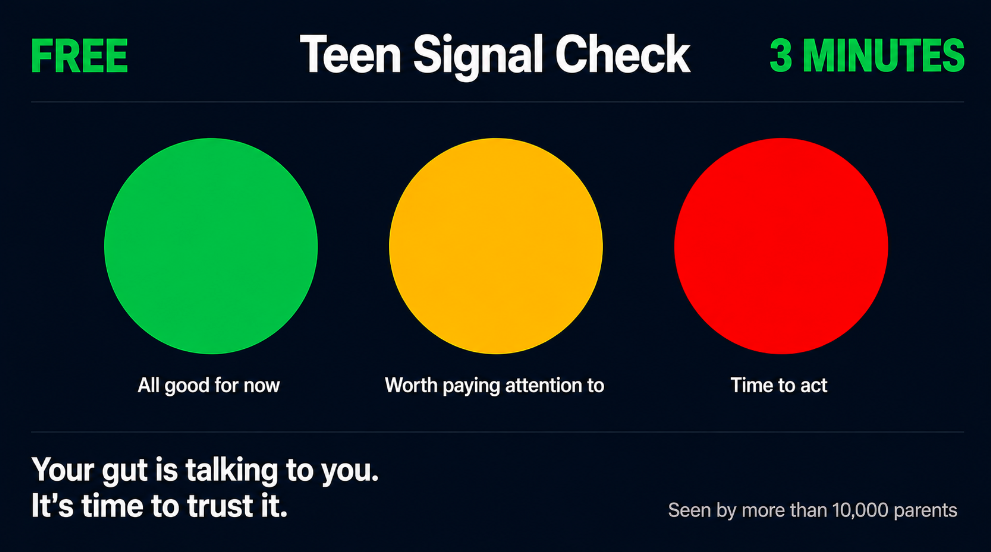
The Teen Signal Check was built for exactly that gap. Fourteen questions, gender specific, about three minutes, free, and nothing you enter goes anywhere. It doesn't diagnose your child and it isn't a substitute for a clinician. It gives you language for what you're already noticing, and a clearer read on whether it's worth acting on.
More than 12,000 parents have taken it. Roughly half get a result confirming their instinct was worth trusting.
They weren't overreacting. They were early.
Being early is the only real advantage any of us get.
If you or your child is in immediate crisis, 9-8-8 is available across Canada and the US by call or text, any hour.
FAQ
What are the warning signs of teen depression?
Sleep changes, appetite changes, pulling back from things they used to enjoy, irritability, exhaustion, and a flatness that doesn't lift when something good happens. Most of that also describes ordinary adolescence, which is the problem. What separates the two is duration and direction. A bad week is a bad week. Six weeks moving the same way, showing up in more than one part of their life, is a pattern worth acting on.
My teen seems happy and social. Should I still be watching?
Yes. The warning signs list most parents have read describes a stage where a kid has stopped managing how they appear. Before that stage there's another one that can last a long time, and in it some teenagers get louder rather than quieter. More social, more helpful, more capable. Maddie was that kid.
When should I worry about teenage behaviour?
When something has changed from your own child's baseline and stayed changed. The useful comparison isn't your teenager against other teenagers. It's your teenager now against your teenager six months ago.
Why won't my teenager tell me something is wrong?
Frequently because they're protecting you. Teenagers hide more from the parents they're closest to, not less, because a kid who loves you and knows you worry will manage what you see. That inverts what most of us assume about closeness, and it's the single hardest thing I've had to accept.
What should I do if I've noticed something but I'm not sure?
Start by writing down what you've actually seen, with dates. Vague worry is hard to act on and hard to raise with a doctor. The Teen Signal Check does that structuring for you in about five minutes, free and private. Then have a low-pressure conversation, side by side rather than face to face. You don't need certainty to start.
You May Also Like
What Maddie Taught Me About the Warning Signs I Wasn't Looking For
She was funny, sharp, and impossible to miss in a room. Why the kids who stay loud are the hardest ones to read, and what the standard list leaves out.
The Assumption That Nearly Cost Me Everything
I believed my daughter would tell me if something was seriously wrong. What that belief was actually doing, and the question worth asking instead.
The Kids Who Never Cause Problems Worry Me the Most
Every parent has a mental list of the child they worry about. The high achiever who never needs anything isn't on it, and that's exactly the problem.
REVISED POST from January 18,2026