The Numbers Tell You What Happened. Your People Could Tell You Why
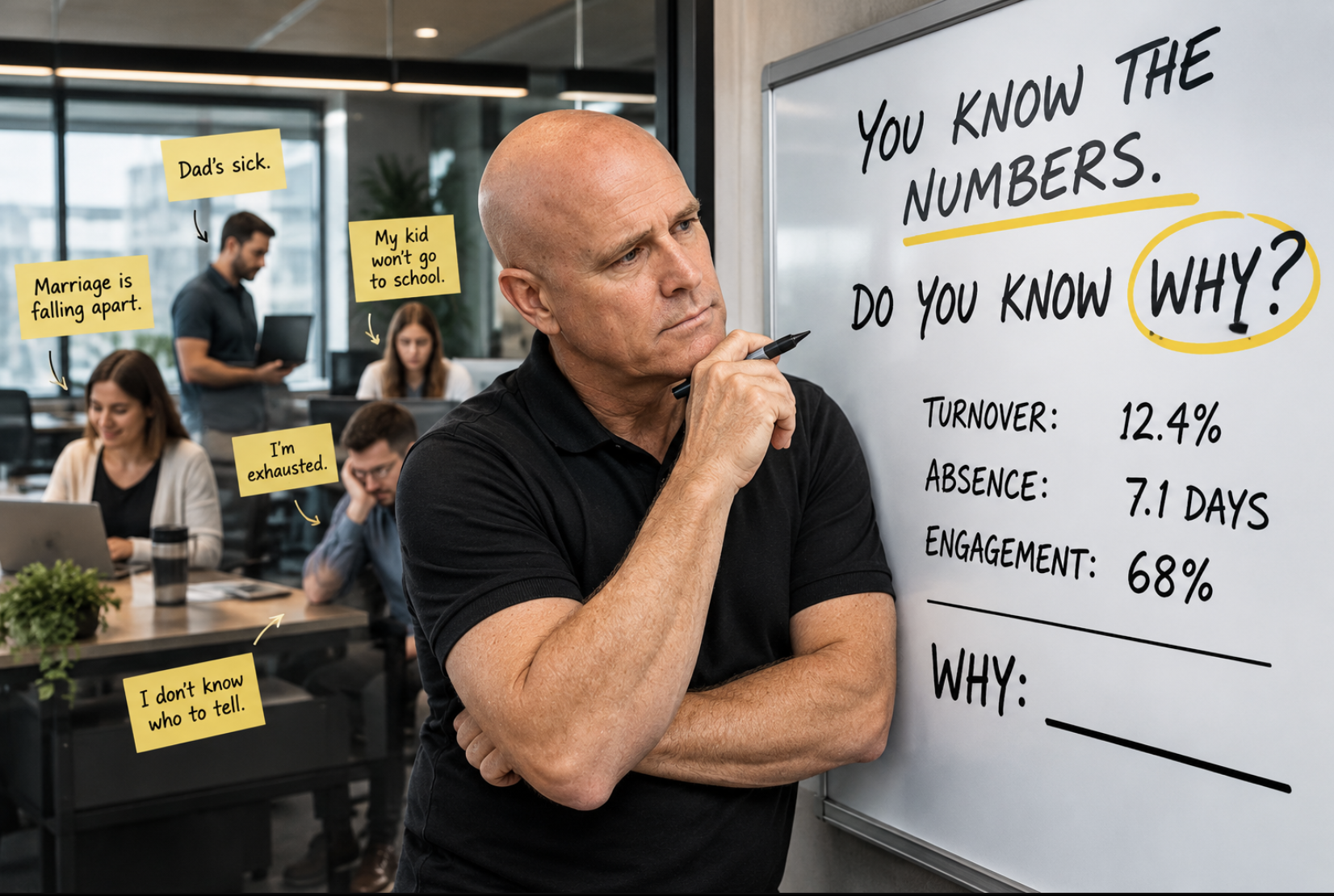
Image created by ChatGPT
You know your turnover rate to one decimal place. You know absence days by department, quarter over quarter, benchmarked against your sector. You know your engagement index, and you know which two teams pulled it down last cycle.
All of that is accurate. Most of it would survive an audit.
Now the second column. Why any of those numbers moved. That column is empty, and in every meeting I have ever sat in, somebody fills it with a guess. Usually compensation, because compensation is the one variable in the room that everyone knows how to move.
The reason is not missing from your organization. It is sitting at a desk two floors down.
What a metric actually is
Turnover counts people who already decided. Absence counts days already gone. Engagement captures how someone felt midweek you picked for scheduling reasons rather than for any reason connected to the people answering.
By the time a number moves, you are reading history.
History is the cheapest thing your organization collects. The expensive part is the account of why, and that account exists in full. Somebody has it.
The information is already in the building
Your EAP utilization is probably sitting somewhere around four percent. The share of your workforce carrying something significant outside of work at any given moment is closer to ten times that number. I use the conservative end of that range on purpose, because the argument does not need the high one.
Four percent and forty percent.
Behind that second number is a person whose father cannot manage the stairs anymore and who is driving four hours every second weekend. A fourteen year old who stopped going to school in February and still is not going. Somebody whose test results came back three weeks ago and who has not said it out loud at work, because saying it out loud at work feels like handing over a reason to be written off.
Every one of those people could describe their own situation to you in about one sentence. They know exactly what is happening to them. They are not confused about it and they are not in denial about it.
The account is not missing. It is unspoken.
So the question stops being how you find out. It becomes why nobody says anything.
Why people who could tell you don't
They are not silent because they distrust you personally. Most of them probably like you.
They are silent because they watched what happened to a colleague who became complicated. The scope quietly narrowed. The stretch assignment went to somebody with fewer things going on. Nobody was cruel about it and nobody wrote anything down, which is precisely what made it legible to everyone watching. They have a mortgage and a read on the room, and the read is usually correct. Silence is the rational play.
Then there is the manager, who is also doing the only thing anyone trained them to do.
Output slips. The camera goes off in a meeting where it used to be on. Answers get shorter. So the manager documents it, has a conversation about expectations, and sets a check-in cadence. Every one of those steps is defensible. Every one of them is in a handbook somewhere. Not a single one of them asks a question that could surface what is actually going on.
That manager is not negligent. They were handed a performance script and a wellbeing poster and told to use their judgment.
I had someone who worked for me a number of years ago, I swear she had more dentist and doctor appointments than anyone had ever declared. I found out years later, her thirteen year old son, had been in and out of psychiatric wards for the past two years.
The only reason I found out, she had been reading my blog posts about Maddie, and wanted to let me know that was the reason she had missed so much time when she worked for me.
Evidently, I was not very approachable or compassionate back then.
And underneath both of those, the plainest cause. Nothing in a normal workweek creates a moment where any of this could come up. One-on-ones are status meetings. The all-hands mentions wellbeing once in October and then the calendar goes back to normal. If an employee wants to raise it, they have to volunteer it into a vacuum, unprompted, with no idea what happens next.
None of that is malice. It is what happens when a system is built to record outcomes and nothing is built to hear causes.
Downstream questions and upstream questions
A downstream question sounds like this: why did we lose four people from that team last quarter?
That question produces a report.
An upstream question sounds like this: what did those four people know in April that nobody above them knew until September?
That question produces a change, because the answer is almost always structural. They did not know where to go. Their manager was decent and had never once been shown how to open that conversation. There was nowhere for it to surface, so it did not surface, and then it became a resignation, which your systems record beautifully.
Most executive teams are certain they would already know this about their own organization. That certainty is the thing worth testing.
The questions are narrower than you think
The reason leaders avoid this ground is that it feels intrusive, and that instinct is correct. Nobody wants their manager asking about their marriage. It would be an overstep and it would also be useless, because they would lie.
The useful questions are structural rather than personal.
Do you know where to go if something outside of work started affecting your work? Would you tell your manager, and what would you expect to happen if you did?
An employee can answer both of those honestly without disclosing a single private fact. And the answers tell you more about your organization than any engagement index will, because they describe the conditions people are working inside rather than the mood they were in on survey day.
Emotional intelligence in a leadership context gets discussed like a personality trait. In practice it is much more boring. It is asking a question you might not like the answer to, and then not punishing the answer.
Test the certainty
Here is the version of this I run.
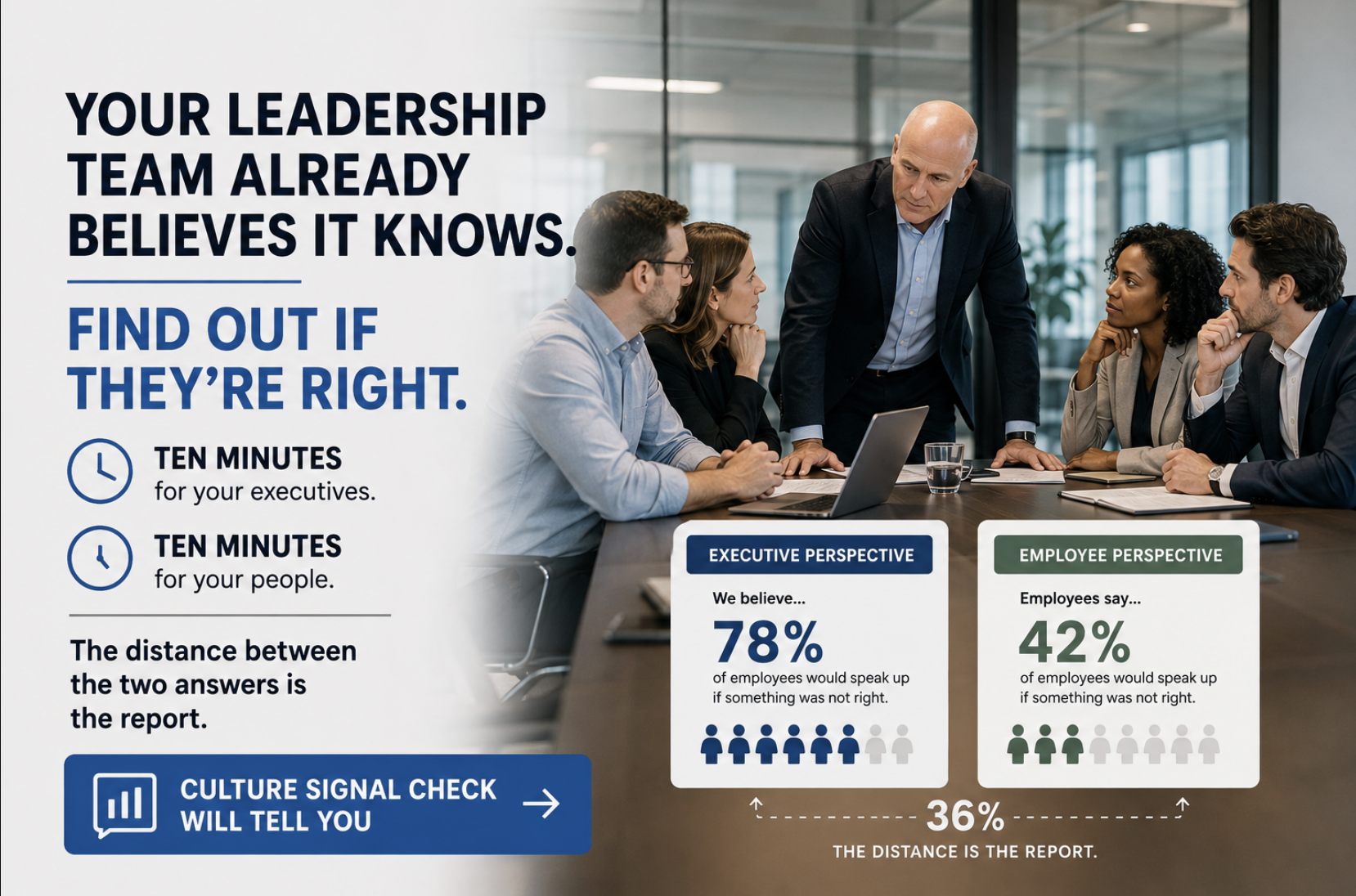
Before anything goes to employees, your leadership team makes predictions. Individually, in advance, written down. What percentage of our people will say they know where to go when something outside of work starts affecting their work? What percentage would raise it with their manager?
Then we ask the employees.
The distance between the two sets of numbers is the finding. That is the whole design of the Culture Signal Check, across five dimensions: speaking up, the manager relationship, being noticed, knowing where to go, and life outside work.
It survives a boardroom because it is falsifiable. Somebody guessed right or somebody did not, and there is very little room to reinterpret that in the direction you were already facing. Most culture data arrives as a score and gets read by everyone as confirmation of what they already believed.
Nothing reports below a cell size of seven. No individual response is visible to a manager, an executive, or to you.
What this does not solve
You will still be surprised. Some people will leave for reasons no instrument would have surfaced, and sometimes the answer really is compensation. This gives you conditions, not a complete picture of your workforce, and anyone selling you the complete picture is selling you something.
What it does is shorten the delay between when something starts and when you hear about it. Right now that delay is measured in quarters.
Your numbers are not wrong. They are just an account of what happened, written after the fact, by a system that was not in the room.
The account of why already exists, in full, held by the people the numbers are about.
Your people are not withholding the answer. Nobody has built them a place to say it.
FAQ
We already run an engagement survey. Why add another instrument? Engagement measures how people feel about the organization. The Culture Signal Check measures whether they know where to go, whether they would raise something, and whether anything outside work is currently affecting their capacity. Those move independently. Teams with strong engagement scores lose people every quarter.
Isn't asking employees about life outside work intrusive? It would be if you asked for details. These questions are structural. Do you know where to go. Would you tell your manager. What would you expect to happen if you did. An employee answers all three honestly without disclosing a single private fact.
What stops a manager or executive from seeing individual answers? Nothing reports below a cell size of seven. Individual responses are never visible to managers, executives or HR. It is a reporting constraint rather than a policy commitment, which means nobody can request an exception.
How is this different from the Manager Signal Check? The Manager Signal Check is a private self-assessment. It shows an individual manager their own blind spots and the results belong to them alone. The Culture Signal Check measures the organization and reports in aggregate. The two data sets never cross in either direction.
What do we actually do once we have the gap? The largest gap usually sits on knowing where to go, which is a communications and manager capability problem rather than a benefits problem. That tends to be welcome news, because it is considerably cheaper to fix than most people expect.
You May Also Like
We Gave 500 Parents Free Help. Fewer Than 5% Opened It. The experiment behind the four percent figure in this post. Every barrier removed, no cost, no gatekeeping, and the number came back the same. What EAP utilization is actually measuring, and what reaches the ninety-five percent it was never built to find.
I Was Still Hitting My Numbers. Sort Of. The same year written from the inside. The work went out, the deadlines got met, and it was taking five times as long to get there. What a manager saw instead, and the one signal that moved before anything else did.
How Well Do You Actually Know Your Team The individual version of the same test. Managers are most confident about the people they have known longest and least informed about the one who never causes a problem. A ten minute self-assessment that nobody else sees.