Grief Doesn't Get Smaller. You Get Larger Around It
The Questions Nobody Asks Out Loud, And the Ones They Always Do
Over ten years, parents who have lost a child find their way to me.
Different circumstances. Different cities. Different children. Different ages. But the same questions, arriving in almost the same order, carried in almost the same voice. A voice of someone who has been awake at 3 a.m. with something too heavy to put down and nowhere safe to set it.
I know that voice. I've used it myself.
This post is for those parents. And it's for anyone who loves someone carrying this. It could be a spouse, a sibling, a friend who lost a child and hasn't been the same since, and who you don't know how to reach.
I'm not going to tell you it gets easier. I'm going to tell you the truth. Which, if you're living this, is what you actually need.
The first question: When does the pain become less intense?
This is the one people ask first. Usually quietly. Usually with a kind of apology in their voice, as if hoping for relief makes them somehow disloyal to the child they lost.
It doesn't.
The honest answer is that the pain doesn't get smaller. What changes, although slowly, unevenly, without announcement, is you. You get larger around it. You build a life that holds the loss rather than one that tries to exist without it. The waves still come. You get better at knowing when they're building. You learn, eventually, to let them move through you instead of trying to stand against them.
There will be a moment, and you won't see it coming, where you realize you went a whole afternoon without it sitting on your chest. That's your nervous system learning, against its will, that you can survive this.
It took me longer than I expected. It will probably take you longer than you want. Be patient with that. The timeline belongs to you and to no one else.
The second question: The guilt
Nobody asks this one directly. They approach it sideways. They say things like I keep going over it or I can't stop thinking about what I missed or I know it's not my fault but.
That last part. That but.
I want to say something clearly: there is almost always guilt. In almost every parent I have spoken with who has lost a child. Whether they saw the signs or didn't. Whether they got their child help or couldn't. Whether they were present or absent, attentive or overwhelmed, doing everything right or falling short.
Guilt is not a sign that you failed. It is a sign that you loved someone completely and your mind cannot stop searching for the moment where something could have been different.
I did the same thing. Maddie was seen by caring professionals. She was surrounded by people who loved her. And still I re-ran the tape. Still I found the moments I would go back to if I could. Still I asked myself what more I could have done.
I'm not going to tell you the guilt disappears. For most people it doesn't, not entirely. But I will tell you what I've watched happen, in myself and in other parents over time.
The guilt that keeps you frozen, that sits on your chest and tells you that you are responsible, that you should have known, that a better parent would have caught it, that guilt is not the truth. It is grief wearing the mask of logic. It is your love with nowhere left to go.
And slowly, when you let it, it changes shape. It stops being a verdict and starts being a question. Not why didn't I but what do I do now with what I know. That is the moment guilt becomes something you can work with. Something that, eventually, points forward instead of back.
The third question: They want to give back, but they don't know how
This is the gentlest of the four questions and the one that carries the most quiet hope inside it.
Parents who have lost a child often feel a pull, sometimes early, sometimes years later, toward doing something that honours who their child was. They don't know what it looks like. They don't know if they're ready. They don't know where to start.
My answer, every time, is this: be patient. Be open. It will find you.
I know that can sound like a platitude. It isn't. It's what actually happened to me.
I didn't sit down and design The MentorWell. I followed what kept coming toward me. The families who reached out. The gap I kept seeing. The question I kept being asked by parents who were lost and frightened and had nowhere to go. I kept showing up to that, and eventually it became something.
Purpose after loss doesn't announce itself. It doesn't arrive with clarity and a plan. It arrives quietly, usually disguised as something you're already doing. It’s a conversation you keep having, a person you keep helping, a question you keep being the one who knows how to hold.
You don't have to find it. You have to stay open long enough for it to find you.
And it doesn't have to be big. It doesn't have to be public. It doesn't have to look like anything other than one conversation with one person who needed someone who understood, and found you.
That is enough. That has always been enough.
The fourth question: The one that doesn't always get asked out loud
I want to sit with this one carefully. Because this question doesn't always come directly. But on some level, in my experience, almost anyone who has experienced a traumatic loss, if even for a moment, in the darkest part of it, has found themselves somewhere near it.
Did you ever feel like you didn't want to be here anymore?
Yes.
Not a plan. Not a crisis in the way it might sound. But the weight of a world that had lost its shape. Moments where continuing felt like the harder choice. Where the absence was so complete that presence itself felt effortful in a way that's hard to describe to anyone who hasn't been there.
I'm telling you this because I think the silence around it does more damage than the thought itself. When you're in that place and you believe you are the only one who has been there, that nobody who has survived grief intact has ever stood near that edge. The isolation compounds everything. You add shame to an already unbearable weight.
So I want you to know: it is more common than anyone says. And it does not make you weak. It does not make you a bad parent or a bad person. It makes you someone who loved deeply and lost completely and whose nervous system was doing the only thing it knew how to do. It was looking for a way out of pain it had no framework for.
What brought me back was not one thing. It was an accumulation. My sons, who needed me to still be here. The slow, reluctant sense that Maddie's story might mean something beyond the loss. If I stayed, I might be able to do something with it. The work that started to find me, quietly, before I had a name for it.
And people. People who didn't try to fix it or explain it or rush me through it. People who just stayed.
If you are in this place right now, if you are reading this and that question isn't abstract for you, if it's present and real and heavy. I want to ask you to reach out to someone before you close this page.
Because you are not meant to carry it alone. And because the people who need you, who will need you, even if you can't see them clearly right now, are real.
If you need support right now:
Crisis Services Canada: 1-833-456-4566 (24/7)
Canada Suicide Prevention Service: Text 45645
International resources:iasp.info/resources/Crisis_Centres/
Mental Health Line 988
Please reach out. To a line, to a person, to me. But reach out.
What I want you to know
These four questions don't have clean answers. I've lived inside them for ten years and I still don't have clean answers.
What I have is this: the pain changed shape. The guilt became a question instead of a verdict. The purpose found me when I stopped looking for it and started staying open. And the darkest moments, the ones I couldn't have imagined surviving, eventually became the ground I stand on to help someone else find their footing.
That is not a happy ending. It is something more durable than that.
It is a life built honestly around loss. It’s one that makes room for grief and meaning at the same time, because it turns out they are not opposites. They are, eventually, the same thing.
You are not alone in this. You never were.
In memory of Maddie Coulter. June 28, 2000 — April 11, 2015.
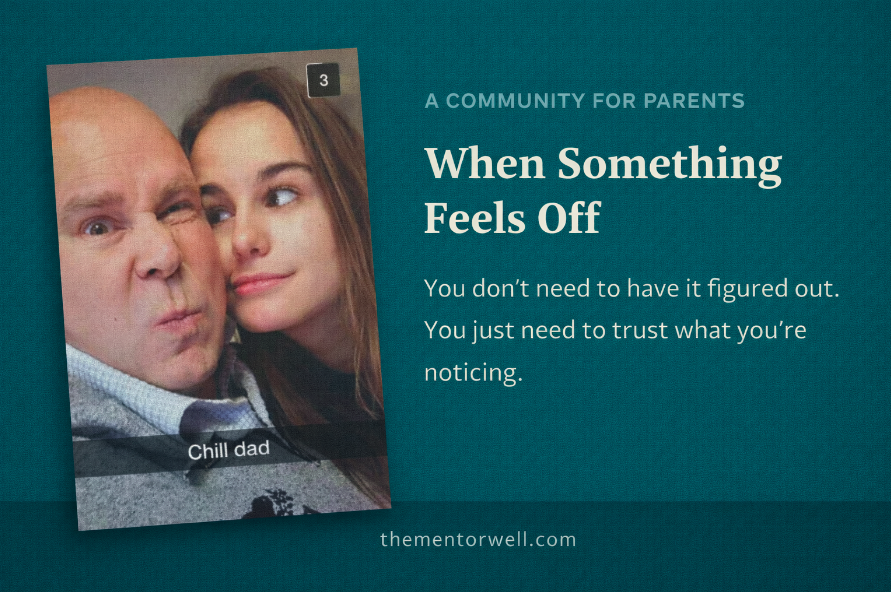
If this resonated and you're looking for a community of parents who understand, not just parents of children who are struggling, but parents who have experienced loss, you are welcome in When Something Feels Off. It exists for exactly this.