The Inbox Diaries — Episode 2. "I Haven't Told Anyone at Work"

“If you lead people, read this slowly.”
Every week, strangers send me things they haven't told anyone else. This is what they're saying.
She messaged me privately.
Not in the comments. But privately.
Because her employer, in her words, "frowns upon certain replies." Because positivity and support, and I want you to sit with this, is, almost verbatim, "not the company way."
She agreed with everything I'd written. She wanted me to know it resonated. But she couldn't say so where anyone could see.
So she whispered it.
That message told me everything I needed to know about the state of psychological safety in too many workplaces. And it reminded me of something I've never fully talked about until now.
When Maddie was struggling, I told no one.
Not at work. Not friends. Only family and my girlfriend at the time knew what we were going through.
I was the consummate "I'm fine."
Every day I showed up. Every day I performed competence. Every day someone asked how I was doing and I smiled and said fine and moved on before they could ask anything else.
I told myself I was protecting Maddie. Her privacy. Her dignity. I didn't want people looking at her differently or treating our family like something broken.
And that was true.
But it was also something else.
I wasn't sure it was safe to tell the truth. I wasn't sure people would know what to do with it. I wasn't sure I wouldn't become the person in the room that everyone felt uncomfortable around. The one with the difficult home life. The one who made things heavy.
So I kept it contained. Neat. Professional.
And I carried it alone.
Here's the problem with that kind of silence.
It is exhausting in a way that sleep doesn't fix.
You are running two lives simultaneously. The one everyone sees, functional (at least optically), present, reliable. And the one nobody sees, terrified, scattered, barely holding the edges together.
The gap between those two versions of yourself grows wider every day you don't speak. Until you can't remember which one is real.
I went through entire meetings without retaining a single word. I sat in front of my computer some days and just stared. Not thinking. Not working. Just existing in the space between what I was supposed to be doing and what was actually consuming me.
I was there in body. That was about all I could offer.
And nobody knew. Because I was very, very good at looking fine.
The woman who messaged me is good at it too.
She's been doing it for years. Not because she's weak. Because she's rational. She watched what happened when a colleague was honest about a personal struggle in a meeting. She watched the room shift. She filed it away.
Don't be that person.
That decision, made in a single moment of observation, has kept her silent through years of one of the hardest things a parent can navigate.
She is not a remote case.
She is in your office right now.
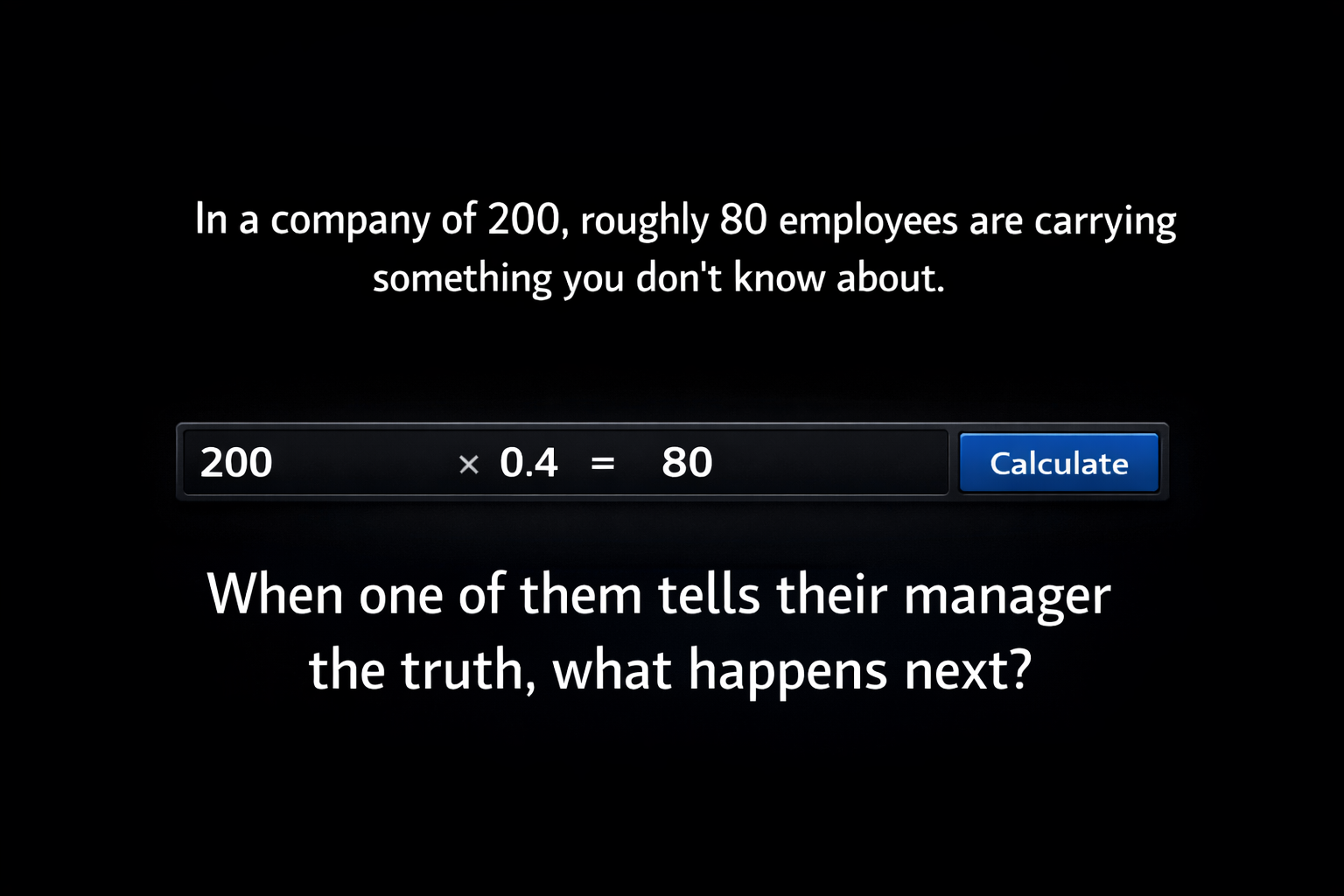
In a company of 200 people, roughly 30 employees are navigating a child's mental health crisis today.
Most of them have told no one at work.
Mostly because everything they've observed tells them that being honest has a cost. That the culture says "we support our people" but the room shifts when someone actually needs support.
They are showing up. Making decisions. Leading teams. Presenting to clients.
And they are running two lives at once.
That cost shows up in your numbers. In productivity. In retention. In the slow, quiet disengagement of your most loyal people. You just can't see it because they're too good at looking fine.
The gap isn't intention. Every HR leader I speak to genuinely wants to support their people.
The gap is execution.
When an employee finally works up the nerve to say something hard, most managers don't know how to respond. Because nobody ever taught them how. So they default to process. To referrals. To "let me know if you need anything" and a topic change.
And the employee makes a note.
Don't be that person.
Culture is not a policy. It's not a poster on the wall or a slide in an all-hands presentation.
It's what happens in the thirty seconds after someone says something real.
That thirty seconds is where trust is built or broken. Where an employee decides whether this is a place they can be human, or a place they need to keep performing.
Most companies are failing that thirty seconds. Not out of cruelty. Out of unpreparedness.
That's fixable.
But only if you're willing to admit the silence exists first. And want to be better.
If you're a parent carrying this alone right now, you don't have to keep performing fine. The When Something Feels Off community is free, private, and built for exactly where you are.
If you lead people and you recognize what I've described in your organization, the thirty seconds after someone shares something hard is a skill. It can be taught. That's what First Conversation Coaching is for.
If you want to know what your silence is actually costing your company, start with the ROI calculator. The math is harder to ignore than the feelings.
Your people are watching what you do next.The Inbox Diaries publishes every Friday. If someone in your network is carrying this alone, share it.