She Checked If Her Daughter was Breathing. Then She Went to Work

Supporting Employees Raising Teens in a Mental Health Crisis
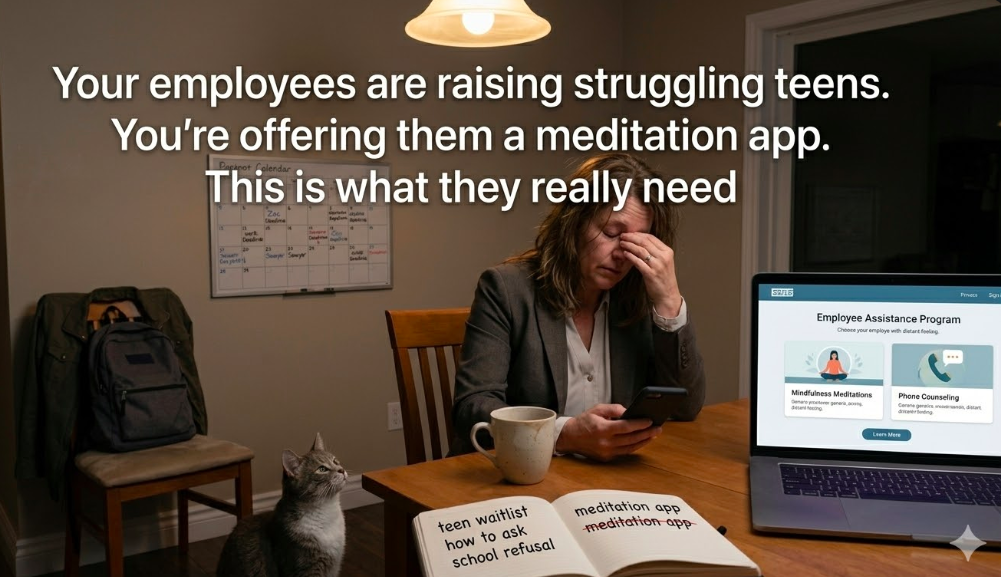
There’s an employee in your company right now who checked if her daughter was breathing before she left for work this morning.
She’s on time. She’s prepared. She’s in the meeting, nodding at the right moments, answering emails, leading her team.
Her phone is in her pocket. There are messages from the school she hasn’t opened yet.
She hasn’t told anyone. She hasn’t told her manager, HR, or the colleague she eats lunch with every day.
She is not an exception.
In a company of 200 people, roughly 30 employees are navigating a child’s mental health challenge right now. Today. Sources tell us almost 1 in 4 working parents is dealing with an emotionally struggling child. That number holds across industries, across income levels, across job titles.
These employees include your highest performers and your quietest sufferers. And most of them believe the workplace is not a safe place to talk about it.
Why They’re Not Telling You
It’s not because they don’t want help. It’s because they don’t believe help is available without consequence.
They’ve watched what happens when someone brings personal struggles to work. The subtle shift in how they’re perceived. The conversations that stop when they walk in. The performance review that mentions “focus” more than it used to.
So they perform fine. Convincingly. Every day.
They manage a crisis at home and a career at work and they do both at full intensity because they believe they have no other choice.
Here’s what that looks like from the inside: you’re sitting in a quarterly planning meeting and your mind is replaying last night’s argument with your 15-year-old. You’re presenting to a client while calculating whether the school counsellor has called back yet. You’re smiling at a team lunch while your chest is tight because your kid hasn’t texted in 9 hours and that’s not normal.
That’s not distraction. That’s survival.
What It’s Actually Costing You
I’m not going to sugarcoat this part. If you lead people, the cost of parenting stress in your organization is real and it’s measurable. You’re just not measuring it.
Presenteeism is the big one. The employee is at their desk but they’re not there. Their body showed up. Their mind is at home. The work gets done, but it takes longer, requires more revisions, and lacks the edge it used to have. Multiply that across 30 employees in a 200-person company and you start to see the drag on your entire operation.
Absenteeism shows up as “personal days” and “doctor’s appointments” that are actually school meetings, therapy drop-offs, or crisis calls. Nobody flags it because nobody knows the reason.
Turnover is the most expensive. Your best people don’t leave because of the job. They leave because they can’t sustain performance while carrying something this heavy with zero support. They go somewhere that feels less demanding, or they burn out and disappear. Either way, you lose institutional knowledge, team stability, and the cost of replacing them.
In a 100-employee company, roughly 14 employees may be dealing with a struggling teen right now. If even 3 of them leave this year because they couldn’t hold it together, and the cost of replacing each one is conservatively 6 months of their salary, you’re looking at a number that would fund a year’s worth of parent support programming several times over.
The math isn’t complicated. The gap is that nobody’s doing it.
What EAP Doesn’t Cover
Let me be clear. EAP is not the problem. It serves a purpose. For employees dealing with general stress, relationship issues, or short-term counselling needs, it’s a reasonable starting point.
But for a parent whose teenager is self-harming, refusing school, or withdrawing from everything that used to matter, 3 to 6 sessions of general counselling doesn’t cut it.
EAP doesn’t teach a parent how to talk to their teenager without shutting them down. It doesn’t help them recognize whether what they’re seeing is normal teenage behaviour or something that needs attention. It doesn’t connect them with other parents navigating the same thing. And it doesn’t give them a framework for when and how to seek help for their kid.
Most EAP utilization rates hover around 5 to 8 percent. Not because employees don’t need support. Because the support doesn’t match the problem.
The gap between what EAP offers and what a struggling working parent actually needs is where families fall through. That’s the space we work in.
What Actually Helps
I talk to parents every week who are carrying this. And I talk to HR leaders who want to help but don’t know how. Here’s what I’ve learned from both sides.
Normalize the conversation.
When leadership acknowledges that employees are parents first, something shifts. It doesn’t require a grand initiative. It starts with a senior leader saying, publicly, “We know some of you are navigating hard things at home. We see you. And we want to support you.” That sentence, said once, changes what people believe is possible.
Offer parent-specific support.
A generic wellness webinar about managing stress is not the same as a structured workshop that teaches parents what to notice in their teenager, how to communicate without escalating, and where to access resources. Specificity matters. Parents don’t need general advice. They need to know what to do with the specific situation in their house.
Train your managers.
If an employee walks into their manager’s office and says “my kid is struggling and I’m not okay,” does that manager know what to say? Most don’t. They panic, change the subject, or default to “have you tried the EAP?” That response, however well-intentioned, closes the door. First Conversation Coaching exists for exactly this moment. It’s not therapy training. It’s confidence training for real conversations.
Sustain it.
A one-time event doesn’t change culture. Ongoing resources, a parent community, regular check-ins, and visible leadership support over time is what makes employees believe the company actually means it.
The Conversation Your Company Isn’t Having
You have employees right now who are carrying something heavy. They’re performing well enough that you don’t see it. They’re quiet enough that nobody’s asking.
That silence isn’t a sign that things are fine. It’s a sign that your people don’t believe you can help.
You can.
Not by fixing their family. By creating the conditions where they don’t have to pretend everything is okay in order to keep their job.
That’s what psychological safety actually looks like. Not a poster in the break room. A workplace where a parent can be honest about what’s happening at home without fearing what it costs them professionally.
The companies that figure this out first will retain their best people. The rest will keep wondering why good employees leave.
Start Here
If you want to see what parenting stress might be costing your organization, take the Workplace Signal Check. It’s free. It takes 2 minutes. It won’t ask for your email. It will give you a clearer picture of what your team might be carrying.
→ Take the Workplace Signal Check
If you’re ready to do something about it, LifeLine Parent Workshops are how we help companies support the working parents who are carrying this quietly. Practical. Parent-specific. Built for the real world, not the break room.
→ Learn about LifeLine Parent Workshops
If someone in your network leads people and needs to see this, send it to them. Directly. Not as a share. As a message. That’s how this kind of thing actually lands.