Teen Mental Health at Work: What HR Leaders Need to Know

This is a leadership test.
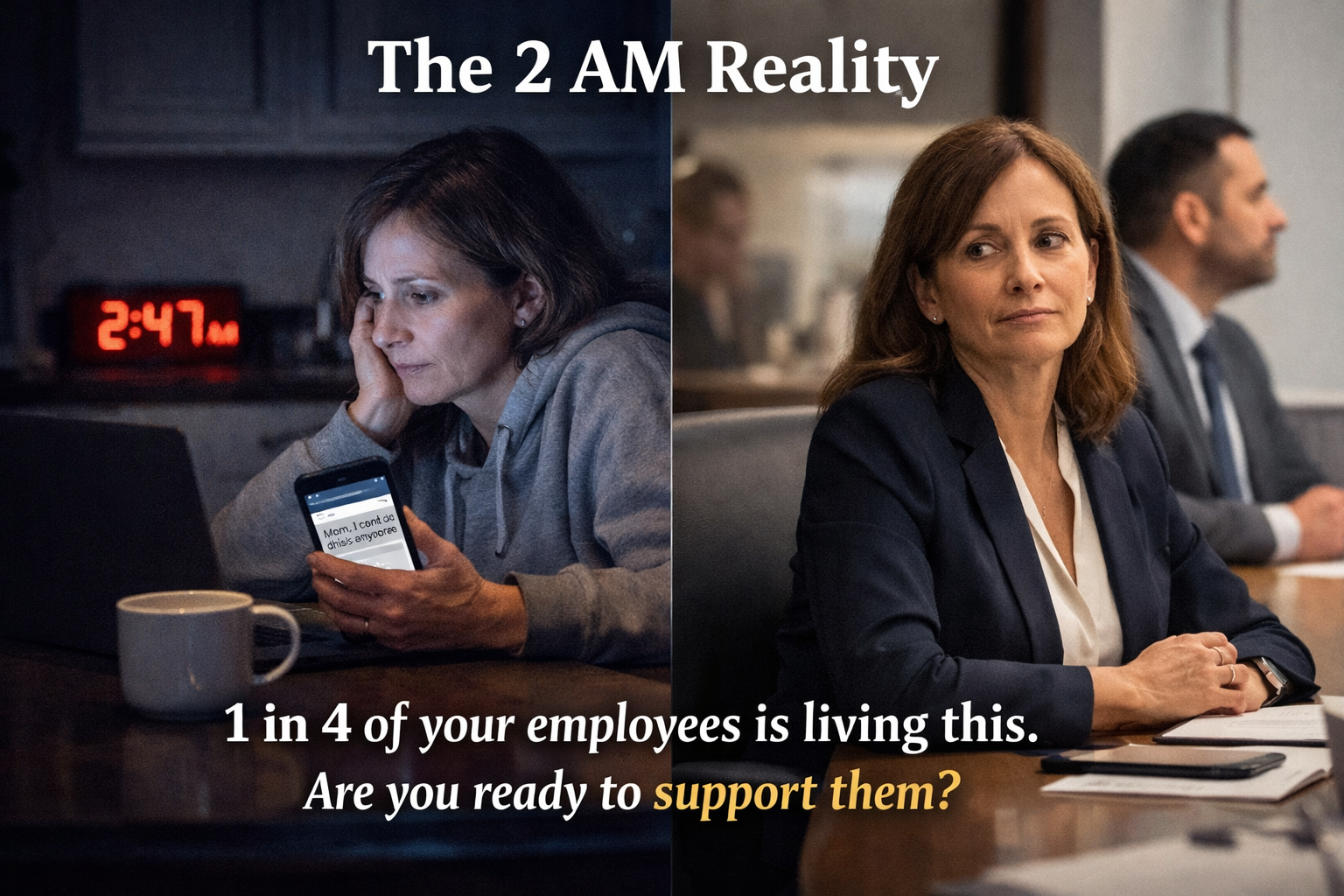
Right now, inside your company, parents are carrying something that is keeping them up at 2 a.m.
Their teenager is anxious. Depressed. Shutting down. Talking about hopelessness.
And that parent is expected to show up sharp, focused, strategic.
The Reality: Teen Mental Health Is Already Impacting Your Workforce
Roughly 1 in 4 working parents is navigating a teen mental health challenge right now. In a 200 person organization, that can mean 25 to 35 employees operating under sustained stress.
You do not know who they are.
They are still leading meetings. Still hitting targets. Still smiling on calls.
But their nervous system is lit up. Their sleep is fractured. Their focus is divided.
And they are watching you.
Is it safe to say my child is struggling? Will this cost me credibility? Will I be seen as unstable or distracted?
Your answer is not in your mission statement.
It is in your response when it becomes inconvenient.
Parenting a Teen in Crisis Is a Biological Storm
When a teenager is in crisis, the parent’s brain does not get sharper.
It narrows.
Fight, flight, or freeze.
They may overreact. They may shut down. They may try to fix everything in one breath.
This is biology. Not weakness.
And while that parent is trying to stabilize their home, performance at work quietly erodes.
• Focus drops • Memory slips • Patience shortens • Energy declines
They are still functioning. But not at full capacity.
Ignoring this reality does not protect your business. It weakens it.
Why This Is Personal for Me
I lost my 14 year old daughter, Maddie, to suicide.
I have lived the unthinkable.
In the decade since her death, I have had more than 2,000 conversations with parents navigating fear, confusion, and regret. Parents who saw signs and did not know what they were looking at. Parents who felt something was off and were told they were overreacting.
I built MentorWell because I refuse to let families walk into crisis unprepared.
This is not theory for me.
It is lived experience.
You Say You Value the Whole Employee. Do You Prove It?
Some companies will read this and think, "This is tragic, but not our role."
You will say you care about the whole human. As long as it does not affect productivity. As long as flexibility does not impact the quarter.
Your employees will feel that boundary immediately.
They will go quiet. They will manage alone. They will update their LinkedIn profile quietly too.
Loyalty mirrors loyalty.
But here is the opportunity.
If you support someone through the hardest season of their life, you earn something far deeper than retention.
You earn allegiance.
They become your loudest champions. They tell recruits. They tell clients. They tell partners.
Not because you marketed yourself as employee centric.
Because you proved it when it cost you something.
Getting Ahead of the Crisis: What Proactive Support Looks Like
MentorWell exists in the space between "everything is fine" and emergency intervention.
We focus on preparation, not reaction.
We provide:
• Education on early warning signs in teens • Direct communication tools for hard conversations • Access to emotionally intelligent mentors for youth • Parent clarity coaching and small group workshops • Clear support pathways beyond a generic EAP link
This is not therapy. It complements clinical care when needed. It strengthens families before panic takes over.
When parents are steadier at home, they are steadier at work.
When they feel treated with dignity, they show up differently as leaders and contributors.
Yes, turnover drops. Yes, engagement rises. Yes, presenteeism decreases.
But those are outcomes.
The starting point is compassion.
This Is Not for Every Company
I do not want to work with everyone.
If your first question is ROI, we are not aligned.
If your first instinct is, "No one on my team should have to carry that alone," then we should talk.
This is about building organizations where people feel human, not managed.
Where support is given because it is right. Not because it is strategic.
The strategy will follow.
A Call to HR Leaders and CEOs
If you lead people, this is your moment.
Audit your culture.
Ask yourself:
• Do we have clear processes when a parent needs flexibility? • Are managers trained to respond without panic or judgment? • Do we offer real support, or just a benefits link? • Have we thought about teen mental health before it walks into our office?
If the answer is no, you are already behind.
You cannot control every outcome in a family’s life.
But you can control whether your workplace becomes a place of safety or silence.
And your employees will remember which one you chose.
If you are ready to get ahead of this instead of reacting to it, let’s have a real conversation.
Not about optics.
About responsibility.
Ready to support your team before crisis hits? Schedule a 20-minute leadership conversation with our team. No pitch. Just clarity on what proactive support actually looks like. [Book Your Leadership Call]