How to Listen to Your Teen Without Pushing Them Away
How to listen to your teenager without pushing them away, and why "fixing" their problems makes them stop sharing
I recently caught up with a friend. We hadn't spoken in months.
It wasn't because of any falling out. It was because I needed distance.
The last time we spoke, I was sharing a difficult situation I was going through. Before I could finish, he jumped in with a stream of advice.
"You need to do this. Have you tried that?"
I know he meant well. But I didn't need advice at that moment. I needed someone to sit with me in what I was feeling.
Instead, I felt judged. Unheard. Like I hadn't spent any time thinking about it. Honestly, I felt insulted.
That conversation stuck with me. Not just because it pushed me to take space from a friend, but because it reminded me of something I see parents do with their struggling teens every single day.
And before you say "No, I never do that". Yes, you likely do.
Why Teens Stop Talking to Parents: The Fix-It Problem
When your teen shares a struggle, how often do you jump into fix-it mode?
They mention a bad grade. You launch into a lecture about studying.
They talk about a friend issue. You tell them what they should have said.
They express feeling overwhelmed about school, social pressure, or mental health. You start problem-solving before they've finished the sentence.
Here's what happens:
They stop talking. Not because the problem went away. Because sharing it made things worse.
The good news is they shared something with you.
The bad news is it will be some time before they share with you again.
Teen Communication Mistakes Parents Make
I made this mistake too.
I still recount making a comment on my son's Instagram account.
He blocked me the next day.
He still hasn't let me follow him since. I think it's a long-running joke with him now.
There must be a statute of limitations as a first offender, right?
This is one of the most common parenting mistakes when it comes to teen mental health and communication: trying to fix instead of listening. It’s likely why I’m asked this question more than any other of my 2000+ parent conversations, “How can I get my child to communicate with me, without shutting them down?”
What Teenagers Actually Need From Parents
When your teen comes to you with a problem, they're not asking you to solve it.
They're asking you to witness it.
To acknowledge that what they're experiencing is real and hard.
To show them that struggle doesn't make them broken.
Teens need parents to:
Listen to teenagers without interrupting
Validate their feelings without minimizing
Be present without agenda
Create a safe space for honest conversations
When you rush to fix, you send a message: "This feeling is uncomfortable and we need to make it stop."
When you sit with them in it, you send a different message: "You can handle hard things. And I'm here while you figure it out."
How to Talk to Your Teen: Conversation Scripts That Work
Next time your teen shares something hard, try these parent-teen communication strategies:
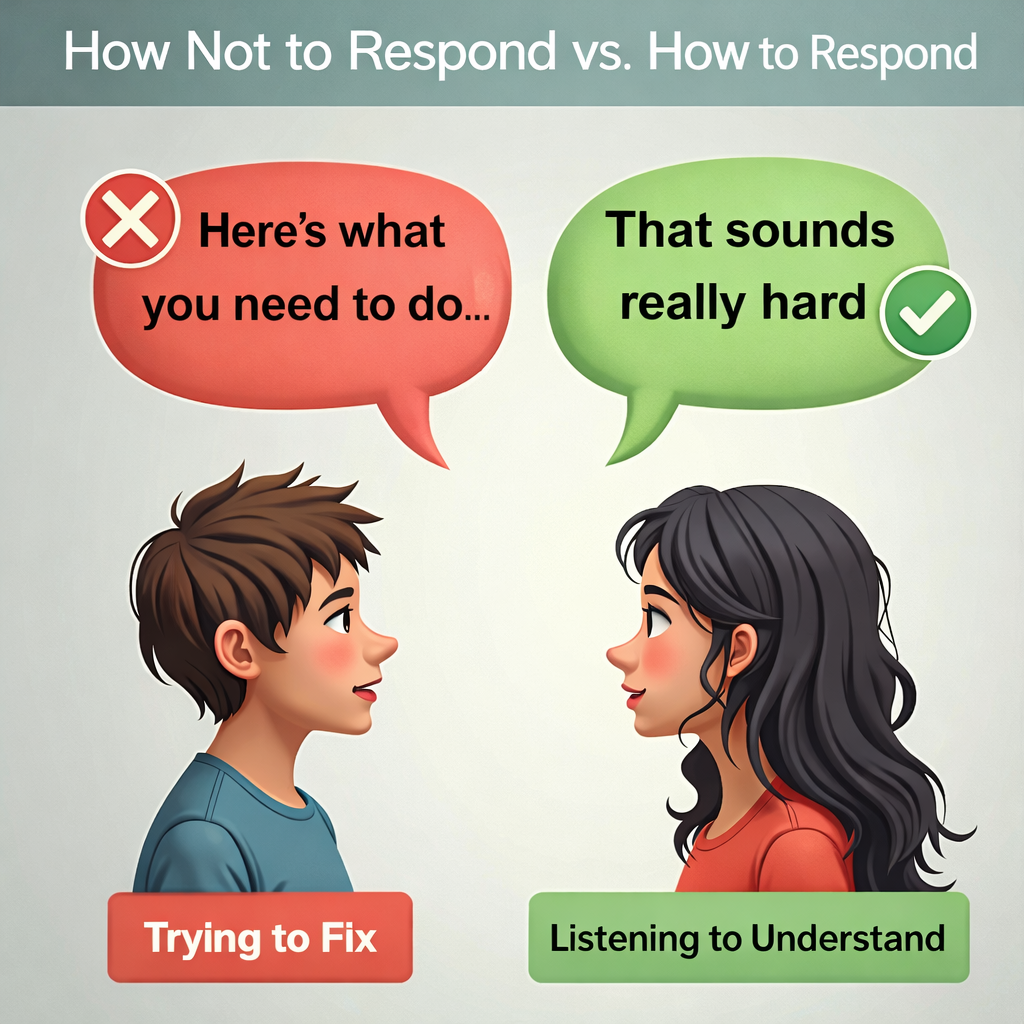
Instead of: "Here's what you need to do."
Try: "That sounds really hard."
Instead of: "Have you tried this?"
Try: "Tell me more about that."
Instead of: "When I was your age..."
Try: "How are you feeling about it?"
Instead of: Offering solutions.
Try: "What do you think you want to do?"
Conversations about teen mental health don't require hammers, saws, and screwdrivers.
They require love, patience, and compassion.
Teen Mental Health: Why Parent Support Matters Now
Your teen is navigating a world you didn't grow up in. Social media comparison. Academic performance pressure. Constant digital connection. Mental health challenges that feel impossible to name.
They need a safe place to process teen anxiety, depression, and stress.
If every time they share something hard, you turn it into a problem to fix, they'll stop sharing.
And when something serious happens, when they're truly struggling with mental health, they won't come to you.
Not because they don't trust you.
Because they've learned that sharing with you doesn't feel safe.
How to Listen to Your Teenager: A Simple Practice
This week, when your teen shares something, resist the urge to fix it.
Just listen.
Reflect back what you hear.
Ask one question: "What would be helpful right now?"
Sometimes the answer is advice.
Most of the time, the answer is just you. Present. Steady. Not trying to make it go away.
Warning Signs Your Teen is Struggling
If you're noticing your teen pulling away, becoming more distant, or shutting down when you try to talk, you're not alone.
1 in 4 working parents are navigating a teen mental health challenge right now.
Most of them are stuck in the same place: sensing something is off but not knowing how serious it is or what to do next.
Common warning signs of teen mental health struggles:
Increased isolation from friends and family
Changes in sleep patterns or eating habits
Declining grades or school avoidance
Irritability or emotional shutdown
Loss of interest in activities they used to enjoy
Parent Support for Teen Mental Health
That's exactly why I created When Something Feels Off, a parent support group focused on early warning signs of teen mental health issues, better parent-teen communication, and practical next steps.
What you get:
The Teen Signal Check: 2-minute assessment that answers "Is this normal teenage behavior or something wrong?"
The 7 Subtle Warning Signs guide for teen mental health
Conversation scripts for talking to teens about mental health without triggering shutdown
Monthly expert Q&As on parenting struggling teens
A community of parents navigating teen mental health challenges who understand your world and frustrations.
Join the parent support group: When Something Feels Off Parent Support Group
Because the parents who support their teens best aren't the ones who have all the answers.
They're the ones who know how to listen when it's hard.