Somebody Has to Notice First

Last week a mental health practitioner sent me a direct message. The short version: I have no right to offer parents an assessment tool, or advice, because I'm not a licensed practitioner.
I read it twice. Then I closed my laptop and went for a walk, because my first reply would have been the wrong one.
They're right about one thing. I'm not a licensed practitioner. I don't diagnose. I don't treat anyone, and I've never claimed to. What I have is lived experience. I'm a dad who lost his daughter, and I spent years replaying the things I noticed and talked myself out of. That's where this work comes from.
Where The MentorWell started
When I first pictured The MentorWell, it was a mentorship platform. Teens matched with an adult who had been through something similar when they were young and came out the other side.
That adult isn't their parent. That matters more than people think. A mentor has no emotional stake in how the kid turns out, the way a parent does. A mentor doesn't take the phone away or set the curfew. For a lot of teens, that's what makes it safe enough to talk.
Confidentiality holds it together. Our mentees sign a confidentiality agreement with us. They can share our conversations with their parents if they want to. They don't have to. We only break that confidence if we believe a young person's safety is at risk.
I've had parents ask me, more than once, "Can I use this to find out what's going on with my kid?" My answer is always the same. Only if their safety is at risk. Otherwise the trust breaks, and then nobody's talking to anybody.
What I didn't see coming
Parents started treating us as an alternative to therapy. We aren't one. Mentorship and therapy do different work, and I'm careful about that line. Mentorship can sit alongside therapy. It can't replace it.
Then I noticed a pattern that made me step back. Families were finding us late. The kid was already struggling badly, sometimes in crisis or close to crisis. Those kids needed a therapist. A mentor was the wrong fit, at least for then. Maybe later.
I kept thinking about it. Most of those parents had seen something months earlier. They just didn't know it was worth acting on.
That's the gap I set out to close.
Why the Teen Signal Check exists
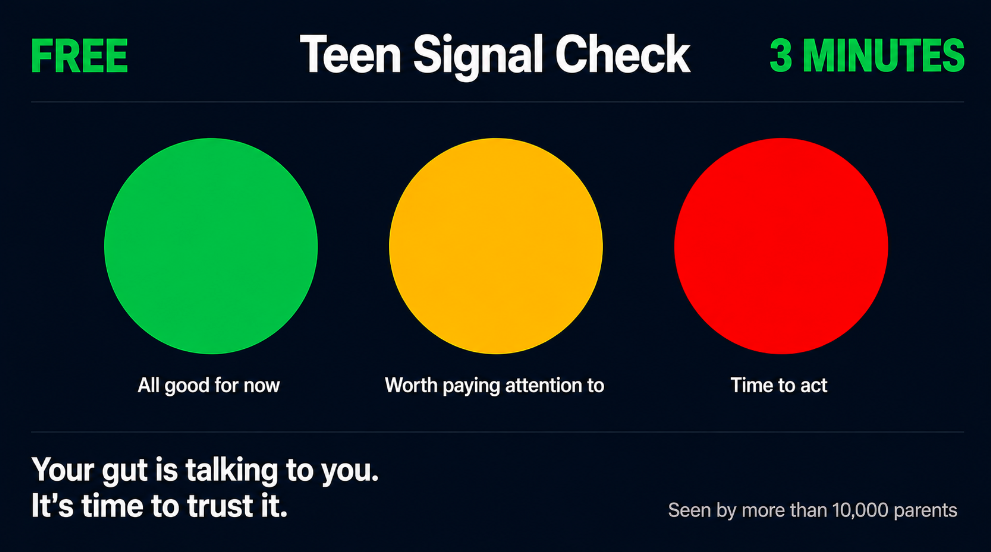
The Teen Signal Check asks parents what they're noticing at home. Sleep, mood, friends, pulling away, the things that shift slowly enough that you stop seeing them. It doesn't diagnose your child. It reflects back what you're already seeing, so you can decide whether it deserves more of your attention.
More than 12,000 parents have taken it.
About half come back green. Good, for now. Keep paying attention, because things shift with teenagers, and they will.
About 30% come back yellow. Something's there. Those families are often a good fit for mentorship, and for a closer look.
About 20% come back red. For those parents, the next step is a conversation with a professional. Soon.
Read that part again. When the stakes are highest, the tool sends parents to practitioners.
The LifeLine Parent Workshops
The Signal Check tells a parent something might be there. The workshops help them do something with it.
The first session asks the question nearly every parent I meet is quietly carrying: is my kid struggling, or is this just being a teenager? Parents take the Teen Signal Check right there in the room. The yellow results surprise people most. Those are often the parents who have been calling it normal teenage stuff for months.
The second session is about talking. I open with the oldest exchange in any house with a teenager. "How was your day?" "Fine." Then I ask the room where that conversation goes next.
Fewer than 10% of parents get it right. That's no knock on them. Most of us respond the way our own parents did, or the exact opposite on purpose. We fix. We interrogate. We reassure too fast. Each of those works sometimes. Very few of them keep a teenager talking.
So we practise. There's a lot of laughing in those sessions, which surprised me at first. Parents walk in braced for a lecture and leave feeling like they're in good company.
I give out my personal email at the start of every workshop. More than 30 parents have written to me during or after, sharing things they haven't told anyone at work.
What the tool can't do
Is the Teen Signal Check foolproof? No. Nothing is.
Some things nobody sees coming. That's true for parents, for mentors, and for the best clinicians out there. Mental health doesn't come with guarantees, and I'd never offer one.
But a lot of what parents miss was visible all along. It's just hard to read when you're living inside it. Over the last 10 years I've had more than 3,000 conversations with parents who said some version of the same thing: I saw it, I just didn't understand what I was looking at.
That's who this is for.
It's been almost 12 years since Maddie started struggling. Every time I sit down with a parent, I'm asking myself one question. What would have helped our family, if I'd understood more of what I was seeing back then?
The part I'm proudest of
Some of the people sharing the Teen Signal Check most are therapists. They send it to the parents of the teens they work with. They tell me it gets parents paying attention in a way a pamphlet never did.
That tells me we're on the same side.
Awareness and diagnosis are different jobs. Practitioners do the diagnosis, and they're trained for it in a way I never will be. Awareness has to happen earlier. At the kitchen table. In the car. In the quiet after a bedroom door closes a little too hard. If nobody helps parents get there, more kids go unnoticed for too long.
To the practitioner who messaged me
I understand the concern. There's a lot out there dressed up as mental health care, and being careful about that is part of your job.
So here's an offer. Take the Teen Signal Check. Look at the questions, the wording, what we tell a parent when the result comes back red. If you see something that could mislead a parent, tell me. I'd rather fix it than defend it.
I want parents getting to your door sooner. That's the whole idea.
You may also like
"Fine" Is the Answer We Taught Our Kids to Give Us Why teens default to "fine," and the questions that get you further than that.
6 Things Parents Mistake for Laziness That May Be Something Else The behaviours that look like a teen not trying, and what they can sometimes point to instead.
She Used to Tell Me the Number Why teens often can't explain a mood change, and a better way to ask about it.
FAQ
Is the Teen Signal Check a diagnosis? No. It asks you what you're noticing at home and reflects it back as green, yellow or red. It helps you decide how much attention something deserves. Only a qualified professional can diagnose your child.
How do I know if my teenager is depressed or just moody? From inside the house, it's hard to tell. Pay attention to how long it's lasted, whether it's spreading into sleep, school and friendships, and whether your gut keeps coming back to it. The Signal Check helps you sort what you're seeing. A professional can tell you what it is.
When should I get professional help for my teenager? If your Signal Check comes back red, book a conversation with a professional soon. The same goes for changes that have lasted weeks and show up in more than one part of their life. If you're ever worried about your child's immediate safety, call or text 9-8-8 or call 911.
Does my teenager need a therapist or a mentor? They do different jobs. A therapist assesses and treats. A mentor offers a trusted adult who isn't a parent and has been through something similar. Teens who are struggling badly need therapy first. Mentorship can come alongside it, or later.
Who are the LifeLine Parent Workshops for? Parents of teens, usually offered through their employer. Session one helps you figure out whether your teen is struggling or going through normal adolescent stuff. Session two is about keeping the conversation going after "fine."