"Fine" Is the Answer We Taught Our Kids to Give Us

The second session of my LifeLine Parent Workshop is called "How do we talk to our teens without shutting them down?" Session one is focused on “Is my child struggling or is this normal adolescent behaviour?”. Session two is about what you say once you have.
It opens with a question every parent in the room has asked a thousand times.
"How was your day?"
I ask what their kid says back. Nobody has to think about it.
"Fine."
"Good."
Then I ask what they say next. That's usually when the laughing starts, because the parent on their left does the same thing. So does the one on their right.
Here's where it tends to go.
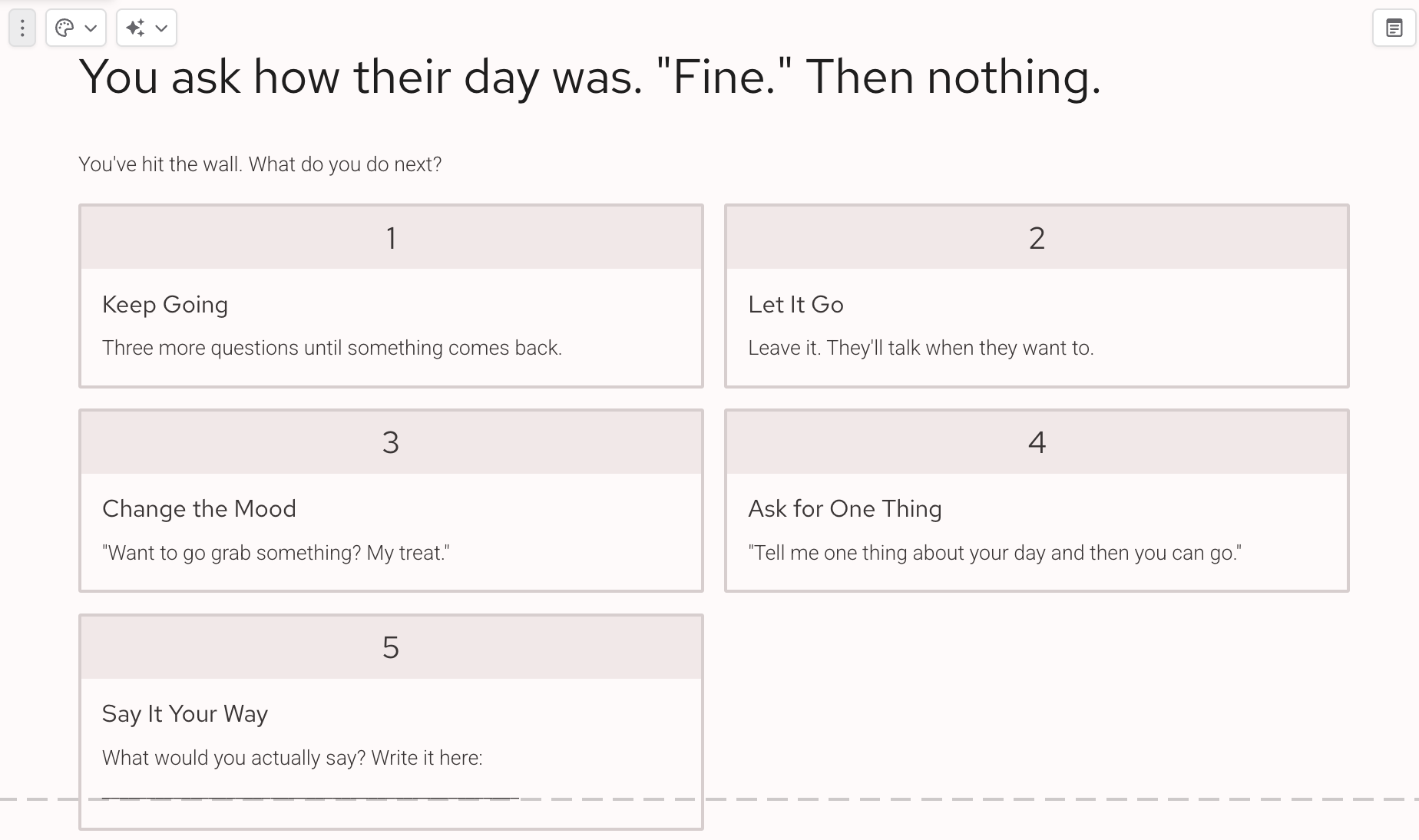
1. You keep going.
"Fine how? What happened in math? Who'd you sit with at lunch? Did you get the chem test back?"
"I don't know. It was fine."
Four questions. One word.
2. You take it.
"Good. Glad to hear it."
Part of you is relieved. Fine is fine. You go back to the dishes. If something did happen today, it's going upstairs with them.
3. You change the mood.
"Want to go grab something? My treat."
Sometimes the car ride opens something up. A lot of the time you get a Tim's and the same one-word answers on the way home.
4. You ask for one thing.
"Tell me one thing about your day and then you can go."
You'll get one thing. It'll be the safest one they've got. "We had a sub in French." Then they're gone, because you said they could go.
5. You let it go.
They'll talk when they want to. So you say nothing. They take that as the end of it. Tomorrow you ask again. "Fine."
A lot of us are saying exactly what our parents said to us. Some of us are doing the opposite, on purpose, and still getting "fine."
My mom was a number one. I'd say "fine" and get three questions before I'd put my bag down. My dad was a number two. "Fine" was good enough for him.
I managed to land on a third one. I was a number four. "Give me one thing." Some nights my kids gave me something just to keep me happy. Other nights I got the eye roll.
In my rooms, fewer than one parent in ten has a next line that keeps it going. Saying that out loud used to feel like a confession. Now it gets a laugh. You look around and realize the parent beside you has been hearing "fine" for two years too.
Here's what I think is going on.
"How was your day?" stopped being a real question a long time ago. We say it at the door. We say it to the neighbour over the fence, to the guy at the coffee machine, to a friend we run into at Costco. "How's it going?" "Good, you?" Nobody expects more than that, and most of the time nobody wants more.
Our kids have heard us use it that way their whole lives. So they answer it the way it's asked. "Fine" is the right answer to a greeting.
Every one of the five things above works sometimes. When what you want is the real answer, the first job is letting them know you're actually asking.
Some of that is the words. More of it is how you say them. Sit down. Put the phone face down. Wait longer than feels normal.
And some nights, ask something they haven't heard a thousand times.
When my kids were small, I'd ask for their rose and their thorn. Between five and eight, I barely had to ask twice. After that, it depended on their mood and how long I kept at it.
This is the teenage version.
"What was the hardest part about being you today?"
Then, once they've answered or shrugged:
"What was the best part?"
Thorn first this time, so they finish on the rose. I wouldn't spring it on them the second they walk in. The car or late in the evening usually goes better.
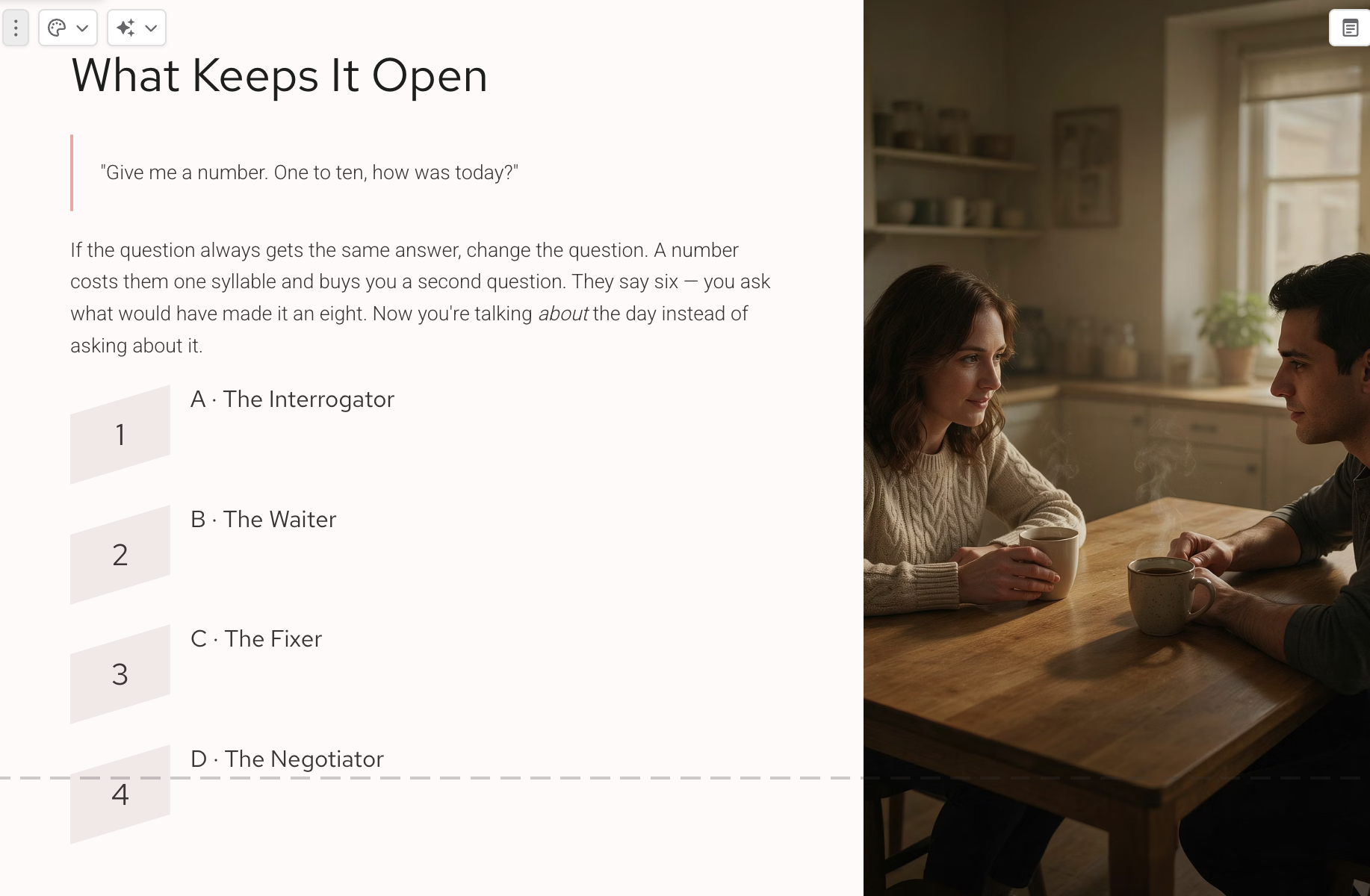
The other question that has worked well and have a lot of parents who have adopted it, “On a scale of 1 to 10, how was your day?” If they answer six, the obvious next question is, “What would’ve made it an eight?” It keeps the conversation going without shutting them down. It gives you context.
Even then, the best question you've got will sometimes get a long sigh and "Dad, really?"
That's fine. They still heard you ask.
What do you say after "fine"?
FAQ
Why does my teenager only say "fine"?
Usually because "How was your day?" sounds like a greeting, and "fine" is the right answer to a greeting. Your teen has heard all of us use it that way for years. It's often less about shutting you out than about answering the question the way it was asked.
How do I talk to my teenager without them shutting down?
Start by showing you're really asking. Sit down, put the phone face down, and wait longer than feels normal. Then try a question they haven't heard a thousand times, and let them answer before you fix, question or reassure.
Is it normal that my teen won't talk to me?
A lot of one-word answers is common in the teen years. It's worth a closer look if it comes with other changes, like sleep, friends, grades or things they used to love. The Teen Signal Check can help you sort out what you're seeing.
What questions get a teenager to open up?
Parents in my workshops have had the most luck with "What was the hardest part about being you today?" followed by "What was the best part?" Another is "On a scale of 1 to 10, how was your day?" followed by "What would've made it an eight?"
What if my teen rolls their eyes at a better question?
Expect it sometimes. A sigh and "Dad, really?" still means they heard you ask. Keep asking on the nights that feel right, and let the rest go.
You May Also Like
How to Listen to Your Teen Without Pushing Them Away: what happens when listening turns into fixing, and how to stay in the conversation instead.
Why Teenagers Stop Talking to Their Parents (And What Actually Helps): the reasons teens go quiet, and what tends to bring them back.
My Teenager Won't Talk to Me: 6 Ways to Help Them Open Up: practical ways to make talking feel easier for a teen who's pulled back.