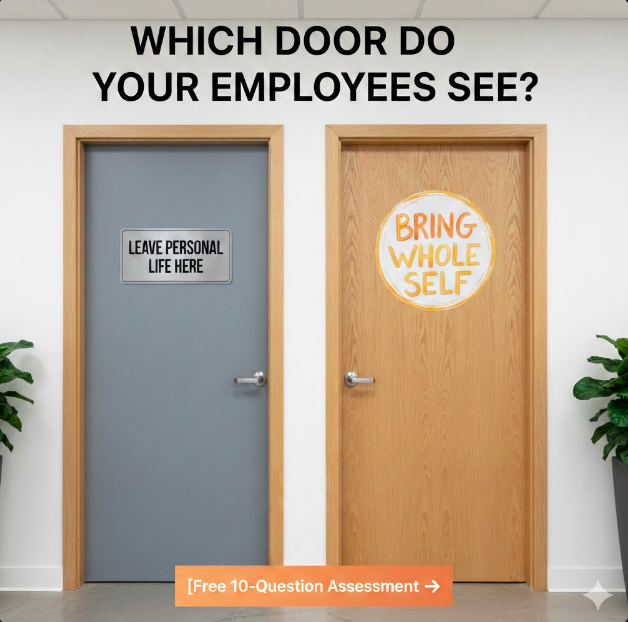
Your Competitor Just Became the Company Parents Choose Over You

Only One Wins the Talent War
Let's be clear about something:
Not every company should offer support for parents with struggling adolescents.
If your culture is "leave personal life at the door". Own that. If your model is "we pay for productivity, not problems", say it out loud. If you believe family struggles should be handled privately. Be explicit.
Just know what you're choosing.
And know what the companies choosing differently are getting.
The Two Companies Competing for the Same Talent
There are two types of companies hiring from the same talent pool as you. They look similar on paper. They offer competitive salaries, good benefits, strong culture statements. But they're fundamentally different in one way that's starting to matter more than you think.
Type A companies say: "We support you during working hours."
Their culture maintains professional boundaries. Personal life stays private. Performance is what matters. Handle your struggles off the clock. That's the deal.
The result? Employees hide problems until they can't anymore. Recovery takes longer because there's no support system. People leave when life gets hard. That’s exactly when you need experienced talent to stay. You lose them at their breaking point.
Type B companies say: "We support the whole human."
Their culture makes transparency safe, not career-limiting. Family struggles don't end careers. Temporary performance dips are understood as part of being human. Help is available before crisis hits.
The result? Employees ask for help sooner. Recovery is faster because they're not managing alone. People stay through hard times. Loyalty isn't transactional. It's earned through showing up when it matters most.
Neither approach is "wrong." They're just different.
But only one is becoming a competitive advantage for talent.
The Interview Question You're Not Prepared For
Here's what's changing: Parents are screening for this now.
Experienced parents with options. They’re the senior talent you want. And they’re are asking questions in interviews that most companies aren't ready to answer:
"What happens if my kid has a crisis?"
"Can I be honest about family struggles here?"
"How does the company actually handle employees going through hard times?"
Type A companies answer with: "We have an EAP and we value work-life balance."
Translation: Figure it out on your own. We hope you don't tell us.
Type B companies answer with: "Here's our parent support program. Here's what other employees have used when their teens were struggling. Here's our flexibility policy and exactly how it works. Here's how we've handled situations like yours before."
Translation: We've thought about this. You're not alone here.
Guess who gets the experienced parent with options?
Not you.
The Relief Factor That Changes Everything
Here's what most companies completely miss about family crises:
When employees hide their struggles, the stress equation looks like this:
Total Stress = Crisis itself + Hiding it + Fear of discovery + Managing completely alone + Extended timeline because no support exists
When employees can be transparent, it looks like this:
Total Stress = Crisis itself (with support, resources, and understanding available)
The difference? Relief.
Relief that they don't have to pretend everything's fine during the worst time of their lives. Relief that help exists. Relief that asking for it won't end their career.
That relief speeds recovery. It doesn’t make the problem disappear. Family crises don't work that way. But because it removes the additional stress of hiding, which allows people to actually focus their energy on solving the problem instead of concealing it.
Faster recovery means faster return to full performance. You get your employee back sooner. And they remember that you didn't abandon them when they needed you most.
That's how loyalty is actually built.
If You're Type A, At Least Own It
If you're committed to being a Type A company, be honest about it.
Say explicitly: "We expect employees to manage personal matters independently."
Then live with the consequences:
Higher turnover during family crises
Longer recovery times when problems inevitably surface
Lost senior talent to competitors who offer more support
A reputation as a place where you better not have problems
That's a valid choice. Some companies operate this way successfully. Just be honest about it with yourselves and your employees.
Don't say "we're like a family here" or "we support our people" while offering nothing when families actually need support. That creates cynicism, not loyalty.
If You Want to Be Type B, You Have to Mean It
Here's where most companies fail: They want to be seen as Type B without doing the work to actually be Type B.
They add a line to the benefits page. They mention "work-life balance" in recruiting materials. They tell employees "just let us know if you need anything."
Then when an employee's kid is in crisis, there's no actual infrastructure. No real support. No clear path forward. Just awkward conversations and vague encouragement to "take care of yourself."
That's worse than being Type A. At least Type A is honest.
If you want to actually be Type B, you have to build real infrastructure:
Parent support groups where employees can connect with others navigating teen mental health challenges, not just an EAP number nobody calls.
Parent Workshops to help identify earlier, and give employees an action plan before the problems arise
Teen mentorship partnerships that provide proactive support before crisis, not just reactive therapy referrals after hospitalization.
Explicit flexibility policies that are written down, widely known, and actually used without career penalty.
Manager training on how to respond when someone says "my kid is struggling" without making it weird or career-limiting.
Cultural permission to be human that's modeled from leadership down, not just stated in values documents.
Half-measures don't work. Either build real infrastructure or don't. But don't pretend.
This is what becomes your competitive advantage
The ROI Nobody's Calculating
Let's talk about what companies actually get when they commit to being Type B.
Retention increases. People stay through hard times because they remember being supported when it mattered. They tell others "this is a good place when life gets hard." Your attrition during family crises—which currently costs you senior talent at their most vulnerable moment—drops by 40% or more.
Recruitment improves. Parents choose you over competitors offering the same salary because you offer something more valuable: the knowledge they won't be abandoned when life gets hard. Word spreads. You become known as a company that actually means it when they say they support their people.
Performance recovers faster. When employees can be transparent, they move through crises faster. The relief of not hiding reduces total stress load. They return to full capacity sooner. You spend less time with people operating at 60% while pretending everything's fine.
Culture deepens. Trust becomes real when people can bring problems early instead of at breaking point. Loyalty stops being transactional and becomes genuine because you supported them when they needed it. People give their best work because they're not expending massive energy hiding their lives.
The math is straightforward:
Cost of parent support infrastructure: $3,000-$5,000 per impacted employee annually
Cost of not having it: $75,000-$150,000 per lost employee in turnover costs, plus $5,000-$10,000 in lost productivity per extended crisis, plus unmeasurable damage to culture and reputation
ROI: 10-30x
And that's just what you can measure. It doesn't count what you can't put in a spreadsheet: trust, loyalty, the reputation as a place that doesn't abandon people.
What could the numbers of affected employees actually look like? Consider this, 1 in 4 working parents is dealing with a struggling child right now. That translates to 1 in 7 of your employees. Do I have your attention yet?
Your Competitors Are Building This Right Now
Here's the competitive reality you need to understand:
Your competitors are building this infrastructure right now. Not all of them. Just the smart ones.
The ones who recognize that one in four working parents has a teen struggling with mental health. The ones who understand those parents are often your most experienced, valuable talent. The ones who know those parents have options and are choosing companies that won't abandon them when life gets hard.
You can lead on this. You can be the company parents choose because you've built real support infrastructure.
Or you can follow later, after your competitors have already captured that talent and built that reputation.
Or you can ignore it entirely and keep explaining why your senior talent keeps leaving during family crises.
This Isn't For Everyone (And That's Fine)
This approach is for companies who want to be Type B, not just say it, but actually build it.
Companies who understand that support equals retention equals competitive advantage. Companies willing to invest in real infrastructure, not just add words to a benefits page. Companies who see family mental health support as strategic differentiation, not charity.
This is for companies who want parents to actively choose them over competitors.
It's not for companies who want to look supportive without being supportive. It's not for companies who think "we have EAP" is sufficient. It's not for companies who believe personal life should stay completely private regardless of business impact.
If you're the second type, that's actually fine. Type A companies can be successful. Just own it. Don't waste time or energy pretending to be something you're not.
Your employees will appreciate the clarity. And the parents with options will make informed decisions about where to work.
The Real Question Isn't What You Think
The question isn't "Can we afford to build this?"
The question is: "Can we afford not to when our competitors are?"
The companies building parent support infrastructure aren't doing it because they're nice or charitable or have money to burn on feel-good programs.
They're doing it because it works. Because it's becoming a competitive requirement, not a nice-to-have. Because experienced parents are screening for it and choosing companies that have it.
You can lead on this. You can build real infrastructure and become the company parents choose. You can retain senior talent through the hardest moments of their lives and earn loyalty that lasts.
Or you can wait, watch your competitors do it first, and then scramble to catch up after you've already lost talent to them.
Or you can decide you're Type A, own that choice, and accept the consequences.
What you can't do is ignore this and expect to keep your best people when their lives get hard.
Because they have options. And increasingly, those options include companies that won't abandon them when their kid is in crisis.
Do you want to be the company that boasts about this infrastructure in place, or the one that tries to dodge the details?
The choice is yours. Just make it consciously.
Ready to Build This?
We work with companies who want family mental health support to be their competitive differentiator.
Not companies who want a vendor to check a box. Companies who want a partner to build real infrastructure.
Not companies interested in looking supportive. Companies committed to being supportive.
If that's you, let's talk. We'll show you what this looks like in practice, how other companies built it, what it costs versus what it saves, and how to implement it without disrupting your operations.
[Book a Strategy Session - For Committed Companies Only]
If it's not you, that's fine too. Just be honest about it.
Your employees will appreciate the clarity.
And the parents with options will make their decisions accordingly.