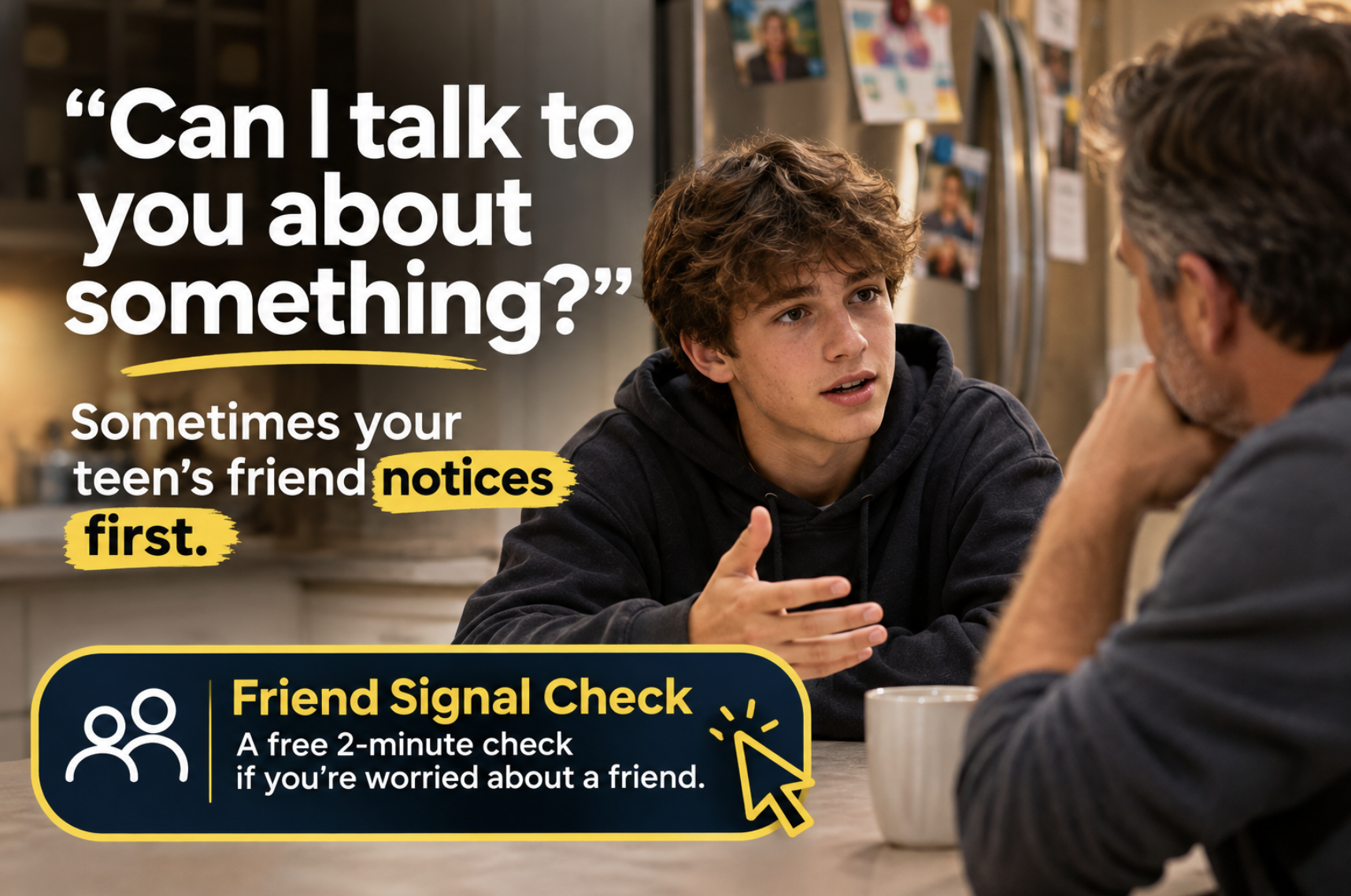
Your kid heads upstairs. Their friend doesn't.
They stay in the kitchen. They read the fridge magnets like there's going to be a quiz. They ask if you need help with the dishes, which no teenager in recorded history has ever asked.
You figure they need a ride home. Didn’t get enough to eat Or they want the Wi-Fi password again.
Then they say it. "Can I talk to you about something?"
And it's about your kid.
Kids tell kids first
Teenagers tell their friends things they'd never tell us. That's been true since before any of us were teenagers. Most of us did exactly the same thing.
I've spent the last couple of years building tools for parents. The Teen Signal Check has now been completed more than 18,000 times. It helps an adult look at a young person and notice what's changed.
Then my son Zac pointed out the obvious. On a call this fall, he said, more or less: ‘Dad, the Teen Signal Check is for adults looking at kids. The people who see it first are their friends.’
He was right.
So Zac, his brother Sawyer and I built the Friend Signal Check. It's short, because two minutes is about all the attention a teenager will give anything I make. It asks one question, really. ‘You good?’
Some of the kids who take it are going to get a result that worries them. Some of those kids are going to end up standing in a kitchen.
Maybe yours.
What it cost them to walk into your kitchen
That kid has probably been thinking about this for days. Maybe weeks.
They've rehearsed it. They've talked themselves out of it at least twice. They've pictured your kid finding out and never speaking to them again.
To them, this feels like betrayal. They're breaking a rule every teenager knows. You don't rat out your friends.
So they're standing there feeling like a traitor, while doing one of the most loyal things a friend can do.
They may approach your kid with some concern. Your kid may likely dismiss it. This is the brick wall they face.
Most kids who see a worrying result will want to sit on it. Wait and see. Maybe it gets better. Maybe they're wrong. That's a very human reaction. Adults do it all the time. I did it.
A red result asks a kid for one thing: tell an adult who can help. The kid in your kitchen did that. Their job is done.
Yours is just starting.
The next ten minutes
Thank them first. Before you ask a single question.
"Thank you for telling me. That took guts."
Then let them talk. Ask what they've seen. Keep it plain. "What have you noticed?" "When did it start?" "Has something changed lately?"
You'll want to ask twenty questions. Ask three. They're nervous, and in their head they're already halfway out the door.
Don't promise to keep it a secret. You can't keep that promise, and they'll remember the day you break it. Say something you can actually stand behind. "I'm going to be careful with this. I won't tell them it came from you unless I have to."
Then ask how they're doing. They've been carrying this alone.
If anything they tell you sounds like your kid isn't safe right now, act tonight. You don't need to be sure. You need to call. The crisis lines are in the first comment.
After the door closes
The friend leaves. You're still standing in the kitchen holding a tea towel.
Your first thought might be: I'd know. I'm their parent. I'd know.
Maybe. I thought I would too.
Your second thought might be about the friend. Are they being dramatic? Did they misread something? That's possible. Teenagers get things wrong. So do we.
Then comes the sting. A teenager saw something in your kid that you missed.
Let it sting for a minute. It says more about how much time they spend together than about what kind of parent you are. Kids show each other the parts they hide from us. That's how it's always worked.
Be grateful. Your kid has chosen great friends. You know now. That's the part that counts.
Talking to your own kid
This is the harder conversation. Plan it before you start.
Open with what you've noticed yourself. Small things count. "You've seemed pretty tired lately." "You haven't picked up your guitar in a while." If you look back and honestly can't think of anything, say so. "Someone who cares about you is worried, and I want to hear from you."
They're going to ask who. Decide your answer before you walk in.
"Someone who cares about you. That's all I'm going to say."
They'll hate that. Hold the line anyway.
If they work it out, and they might, they'll be angry at the friend. Stand up for the friend. "They came to me because they care about you. If you need to be mad at someone, be mad at me."
That friendship may be doing more for your kid right now than you are. Protect it.
Then mostly listen. You don't need to fix anything tonight. For a first conversation, it's enough that they know you see them and you're staying in the room.
Circle back to the friend
A few days later, find a quiet moment with that kid. Keep it short. No details.
"Thanks again. I talked to them. You did the right thing."
That kid may be lying awake wondering if they just wrecked a friendship. One sentence from you could let them sleep.
Somebody was paying attention.
Now it's your turn.
FAQ
What should I do when my teen's friend tells me they're worried about my child?
Thank them first. Then ask what they've noticed and when it started. Don't promise to keep it a secret, but do promise to be careful with it. If anything they say suggests your child isn't safe right now, act that night.
Should I tell my teen who told me?
Not if you can avoid it. Tell them someone who cares about them is worried, and leave it there. If your teen works it out, stand up for the friend. Their safety comes before anyone's secret, though, so if it ever comes down to one or the other, choose safety.
What if the friend is wrong or exaggerating?
They might be. Treat what they told you as information, not a verdict. Think about what you've noticed yourself: changes in sleep, friends, school or the things your teen used to enjoy. Teen mental health warning signs usually show up as several changes over a few weeks. A check-in costs you very little, even if the friend turns out to be wrong.
What if the friend says my child talked about not wanting to be alive?
Treat it as urgent, tonight. Ask your child directly. Asking about suicide doesn't put the idea in their head. Call or text 9-8-8 in Canada or the US for guidance on what to do next. If you think they're in immediate danger, call 9-1-1.
What is the Friend Signal Check?
A free tool from The MentorWell for young people who are worried about a friend. It takes about two minutes and doesn't ask for an email. My sons helped build it. The Teen Signal Check is the version for adults worried about a young person.
You May Also Like
My Sons Asked Me a Question I Couldn't Ignore
How a call with Zac and Sawyer led to the Friend Signal Check, a tool for young people worried about a friend.
If You Were Struggling, Wouldn't You Want Someone to Notice?
How to ask something deeper than "Are you okay?" when someone seems off.
I Pulled Over. My Son Finally Told Me
What helped a teenager finally talk, and how to stay calm when they do.