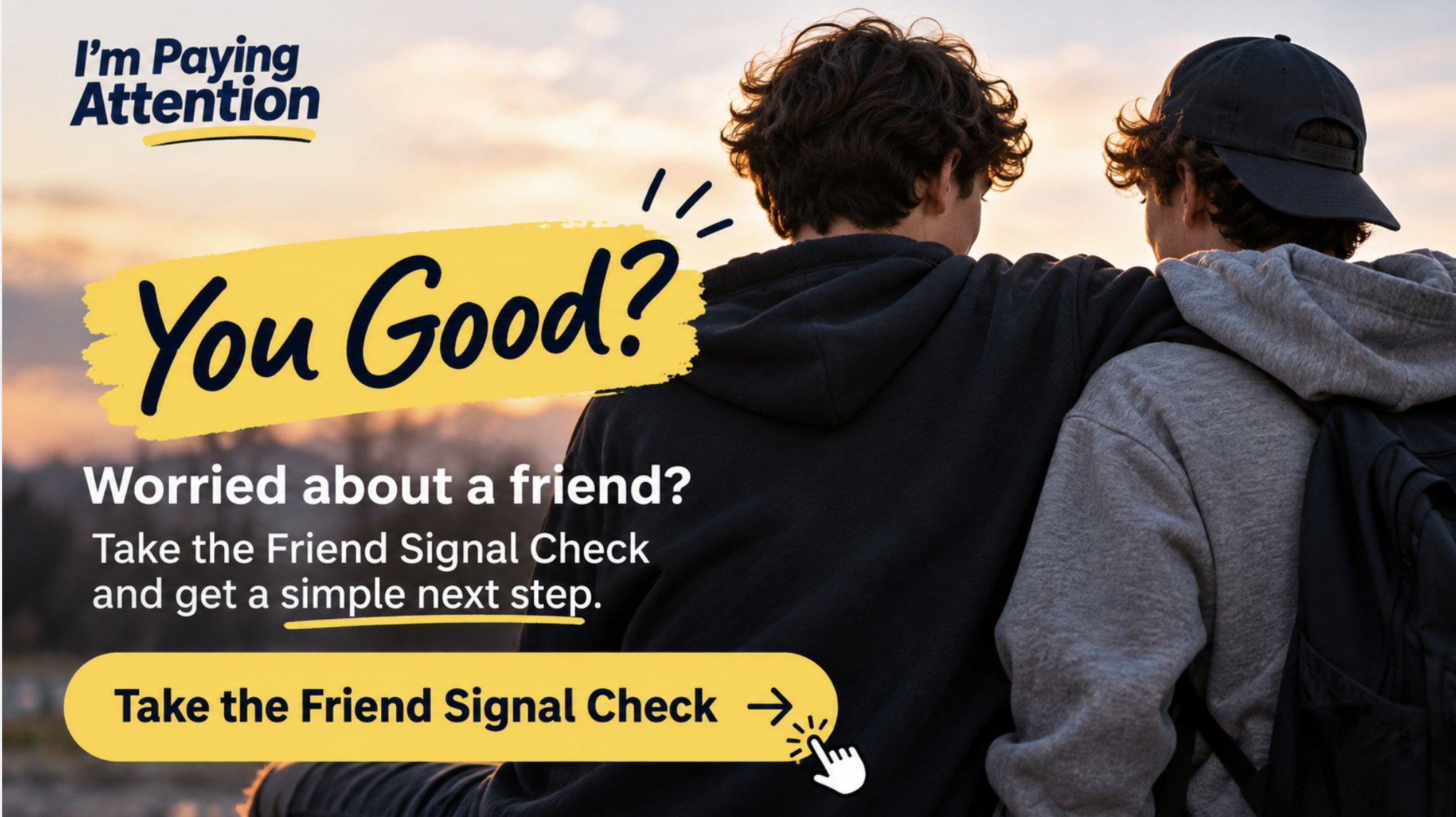
A few weeks ago I got on a call with my sons, Zac and Sawyer, to ask for their help. I'd just launched I'm Paying Attention, a campaign to get 100,000 families to take the Teen Signal Check, and I wanted their ideas on reaching more people. It was Sunday morning, and they may both have been feeling a little rough from the night before. I didn't want to compete with NFL football, because I know I'd lose.
Then Zac said this.
"Dad, your Teen Signal Check is great. But it's a tool for parents. Adults looking at their kid, or a kid they care about. What about friends? Something friends can use to see what's going on with their friends?"
I went quiet for a second. Partly because it was a great idea. Mostly because I'd already had it.
Two months earlier I'd started building exactly that. I got partway in, then shelved it, the way founders shelve things: with every intention of getting back to it and a growing pile of reasons not to.
My boys didn't care about my pile. They cared about their friends.
Who notices first
Here's what I keep hearing from school counsellors, coaches and the young people themselves. When a teenager starts having a hard time, a parent is rarely the first to see it. A friend is.
Friends see the plans that keep getting cancelled. They get the messages at two in the morning. They notice when someone who used to be loud in the group chat goes quiet, or when the jokes get a little darker than usual.
And most of them have no idea what to do with any of it.
I remember being 15. If something felt off with a buddy, the move was to say nothing and hope it was a bad week. Nobody taught us anything else. I'm not sure we've taught this generation much more.
That's the gap Zac was pointing at. Parents have the Teen Signal Check. Friends had nothing.
What we built
So we finished it. The three of us.
The Friend Signal Check is for anyone 14 and up who's quietly worried about a friend. It asks what they've been noticing. It gives them a result. Then it points them toward a sensible next step, which is often as simple as checking in, or telling an adult they trust.
The questions are completely different from the Teen Signal Check. They had to be. A parent looking at their kid notices different things than a 15-year-old looking at their best friend. There are fewer of them, too. A parent will give me three minutes. A teenager gives me two, tops, and I think that's generous.
The whole thing is built around two words teenagers already say to each other every day: “You good?”
Zac tested every question. He's not shy about telling his father when one misses, which is humbling and also exactly the point. It helps that he’s a market researcher. His notes tend to come with evidence
It's free. There's no email, no account, nothing to sign up for. A kid can take it on their phone in a hallway and nobody needs to know.
One thing to be clear about. It's an awareness tool. It doesn't diagnose anything, and it doesn't turn a 15-year-old into anyone's counsellor. It helps a friend notice what they're already noticing, and gives them a next step that isn't silence.
If you're a parent reading this
You don't need to take it yourself. Your teen might.
You could just send them the link with no speech attached. Something like, "Saw this, thought of you, no reason." Teenagers are allergic to lectures. They're a lot less allergic to a link.
The Teen Signal Check is still there for you. The Friend Signal Check is for them.
If you work with young people
This tool is new, and I want it scrutinized.
If you're a counsellor, therapist, physician, teacher or youth worker, I'd be grateful for 20 minutes of your honest opinion. Tell me which questions are vague. Tell me which ones would make a kid close the tab. Tell me whether the next steps would hold up if a teenager actually followed them.
What you send back will shape the first round of changes, and I'll share what we changed and why.
The part I keep thinking about
I've spent a lot of time telling parents to pay attention. My sons reminded me that their friends already are.
They just needed somewhere to put it.
If you think someone is in immediate danger, call or text 9-8-8 in Canada or the US, or your local emergency number.
FAQ
What is the Friend Signal Check?
It’s a free, anonymous check for anyone 14 and up who’s worried about a friend. You answer ten questions about what you’ve noticed, then get a colour result and a next step you can take this week.
How long does it take?
About two minutes. No email, no account.
Will my friend find out I took it?
No. Your friend doesn’t take it and doesn’t see it. The MentorWell only sees totals, like how many results came back yellow in a month.
What are the teen withdrawal warning signs friends notice first?
Often the small changes. Plans that keep getting cancelled. Going quiet in the group chat. Stepping back from a team, the gym or school. Jokes about not caring what happens to them. The check asks about change: what’s different about this person compared with how they usually are.
Is the Friend Signal Check a diagnosis?
No. It’s an awareness tool. It can’t tell you what’s going on inside your friend’s head. It helps you see what you’ve already noticed clearly enough to decide whether to act.
I’m a parent. How can I help a struggling teenager with this?
Send your teen the link with no speech attached. They may be the friend who notices first. For what you’re noticing in your own teen, take the Teen Signal Check.
What if my friend has said they want to hurt themselves?
The check stops before showing a colour and gives you who to call. In Canada and the US, call or text 9-8-8 any time. Young people in Canada can call Kids Help Phone at 1-800-668-6868 or text CONNECT to 686868. If someone is in immediate danger, call 911.
Where can I find youth mental health support in Canada?
9-8-8 and Kids Help Phone are free and open around the clock. A family doctor or school counsellor is a good next step when it isn’t an emergency.
I work with young people. Can I review it?
Yes, please. Use the practitioner review form linked in the article. Your feedback shapes the first round of changes. You can make suggestions HERE
You May Also Like
Teen Signal Check: for parents and other adults noticing changes in a young person. https://www.thementorwell.com/teen-signal-check
When Something Feels Off Parent Group: support for parents who aren’t sure what they’re seeing. https://www.thementorwell.com/when-something-feels-off-parent-group
Mentorship for Families: one-to-one mentorship for teens and their families. https://www.thementorwell.com/mentorship-for-families