You're Not Alone In This. You Just Haven't Found the Right Room Yet.

When Something Feels Off: What It Is, What It Isn't, and Why 125 Parents From Around the World Trust It
Most parents who find their way to When Something Feels Off say the same thing afterward.
"I wish I'd found this sooner."
There’s the simple, unexpected relief of being in a room where they didn't have to explain themselves from scratch.
Where they didn't have to perform.
Where they could just show up.
Why this group exists
I've spent ten years talking to parents who are carrying something they can't quite name. A shift in their child's behaviour. A distance that wasn't there six months ago. A feeling that something is off without being able to say what, or whether it's serious, or whether they're overreacting.
Most of these parents are carrying it alone. Because the people around them don't quite get it, and explaining it, again and again, to people who respond with platitudes or advice that doesn't land, becomes its own kind of exhaustion.
When Something Feels Off exists for that parent.
But here's what surprised me as it grew: it's not just for the parent who is already inside something hard. It's equally valuable for the parent who wants to stay ahead of it.
Two kinds of parents. One room.
One of our members, a former teacher, joined the group before she had any specific concerns about her son. She described her reasoning this way:
"When I was teaching at a grade that my son is similar to now, I had a lot of students who would open up to me and share alarming things about themselves. So I suppose I'm always looking for those things ahead of time. I would rather be on top of it and be aware and looking for red flags beforehand rather than after."
She came to stay ahead of it. To be the parent who notices early rather than the parent who wishes they had.
Another member came to the group already navigating real challenges with her teenager. What she found wasn't just support, it was perspective.
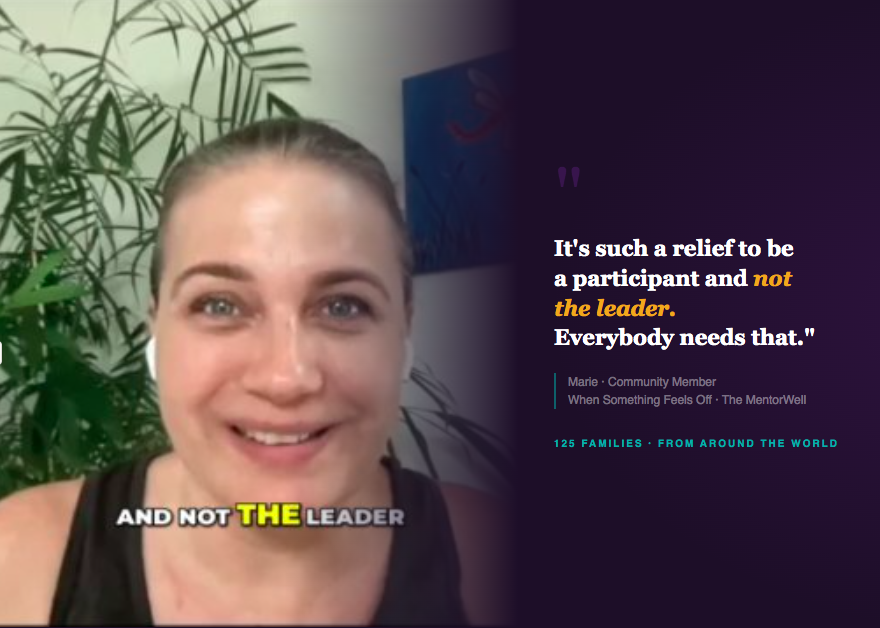
"I can just share where I'm at with my parenting questions about my teens, and it is just such a relief for me to be a participant and not the leader. Everybody needs that."
Two completely different entry points. The same room. The same value.
What it actually is
When Something Feels Off is a private, live parent support community. We meet regularly on calls. Between calls, parents share in the group, questions, wins, hard moments, things they noticed that week and aren't sure what to do with.
There are now 125 families from around the world inside it. Parents from different countries, different backgrounds, children of different ages, connected by one thing. The sense that something might be happening with their child, and the need for a space where that feeling is taken seriously.
The calls are honest. Not filtered. Not softened to make it easier for everyone else in the room. Just parents talking about what's actually happening, and what they're actually feeling about it.
One member described what keeps her coming back:
"It's that I trust that group. And that's really important. I trust that whatever I share stays in that group, and my question is always answered, and I get different perspectives from different people. You can always choose which perspectives are actually helpful to you."
Something else happens in that room that I didn't fully anticipate when we started. A quote came up in a recent call, shared by a member named Lu, that has stayed with me:
It's about being present. It's about the connection. It's about the depth of your relationship rather than the depth of the problem.
That's what this group keeps returning to. The connection. The relationship between parent and child that is still there, and that, with the right tools and the right perspective, can grow stronger even through the hard parts.
What it is not
It is not a crisis service. It is not therapy. It is not a place you come to only when things have already fallen apart.
It is not a forum of strangers throwing opinions into the void.
It is not a place where you are required to share, to participate, or to have anything figured out before you arrive.
One of our members said it simply:
"Sit on the sidelines for a little bit. Watch the game. Just see if you like it."
That is exactly the right way to arrive. You can listen for a call or two before you say a word. You can put a question in the group without attending a call. You can take what's useful and leave what isn't.
As Janice put it:
"Take what you can from it and leave what you don't need."
What happens when you're outside your own network
One of the most underrated things about a group like this is what happens to your perspective when you step outside your usual circle.
The people closest to you, your partner, your friends, your family, are too close to the situation to see it clearly. They love you. They're invested. That investment changes what they can offer.
Janice named this quietly in her testimonial:
"Sometimes when you're away from your own network, you see things a little differently."
That distance, the view from a room full of parents who don't know you, who have no stake in how you parent, who are simply sharing what they've been through, gives you something your own network can't. Clarity. Perspective. The ability to see your situation from the outside for the first time.
What surprised people most
When members reflect on what surprised them about the group, the answer is almost always the same.
The depth of what other parents are carrying.
Janice said it this way:
"Going into a group and seeing other people that are actually dealing with things that are much more significant than what I have, and not using it as comparison so much, but just recognizing people's struggles. People trying to maintain full-time employment and three kids and all of the stresses that come with life while raising teenagers. Coming into a group like that and seeing it and being around it, you see things a little differently."
There is something quietly powerful about witnessing other people's struggles without judgment. It doesn't make your situation smaller. It makes you feel less alone inside it.
And as Marie, another member observed:
"The depth of the challenges a lot of parents go through on their own for such a long time, until they find a group like this and realize they're not alone."
That is the moment this group exists for.
Who this is for
A parent of a child between 8 and 20 who senses something is shifting and isn't sure what to do with that feeling.
A parent who wants to be prepared before something goes wrong, not reactive after.
A parent who has been carrying something quietly and needs a room where they don't have to start the explanation from the beginning.
A parent who is strong for everyone else and needs somewhere to put that down for an hour.
A parent who took the Teen Signal Check and wants community alongside the awareness.
A parent who thought they were the only one going through this, until they found out they weren't.
As Janice said, even if you get a green on the Teen Signal Check, you can still benefit from having this room available to you:
"It's just that reminder again. That presence. Taking that extra minute to check in on your kid. We all mean well, but life gets busy sometimes."
Who this is not for
A parent in active crisis who needs immediate clinical support, we will always point you in the right direction, but this is not a substitute for professional care.
A parent looking for a place to vent without reflection, the group is warm and supportive, but it is forward-moving. We're here to get better at this together.
On the fence?
Janice had something direct to say to the parent who is hesitating:
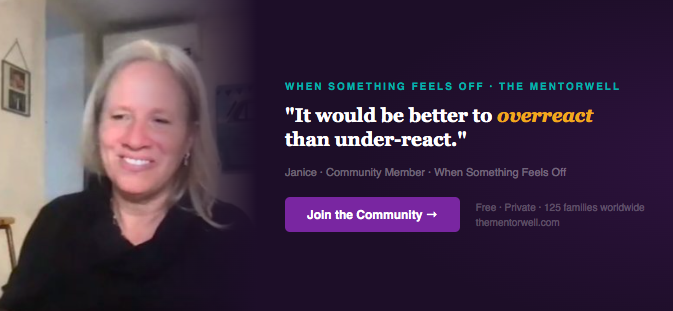
"It would be better to overreact than under-react. It's really just there. It's an opportunity you can take or not take."
You don't need a reason to join. You don't need a diagnosis, a crisis, or certainty that something is wrong. You just need a child between 8 and 20 and the honest sense that something feels slightly off.
Come and sit in. Listen for a call or two. See what speaks to you.
And if it is for you, and for most parents it is, you'll probably find yourself saying the same thing everyone else says.
"I wish I'd found this sooner."
When Something Feels Off is free to join as part of the LifeLine Home community. It's also available as a standalone parent membership.
Join us at thementorwell.com
💜
Chris Coulter is the founder of The MentorWell, a parent support and youth mentorship ecosystem built in memory of his daughter Maddie Coulter, June 28, 2000 — April 11, 2015.