If you're a parent, you'll probably never see a thread like that. You'll see a kid who was home on Friday night, ate most of a pizza, and seemed fine at breakfast.
The friend on the other end saw a lot more. The plan that fell through, again. The joke. Four days of silence after it.
Parents and friends are standing in different rooms. You get the version of your kid that comes down for dinner. Their friends get the version in the group chat, in the car, in somebody's basement at midnight. You just have different seats.
A few weeks ago I asked my son Zac to help me with a campaign. He's 24. I asked him what friends notice that parents miss.
His first answer was the friend who makes plans and cancels every time.
I've spent years thinking about the signs adults miss in teenagers. I wouldn't have put cancelled plans first. Zac didn't even hesitate.
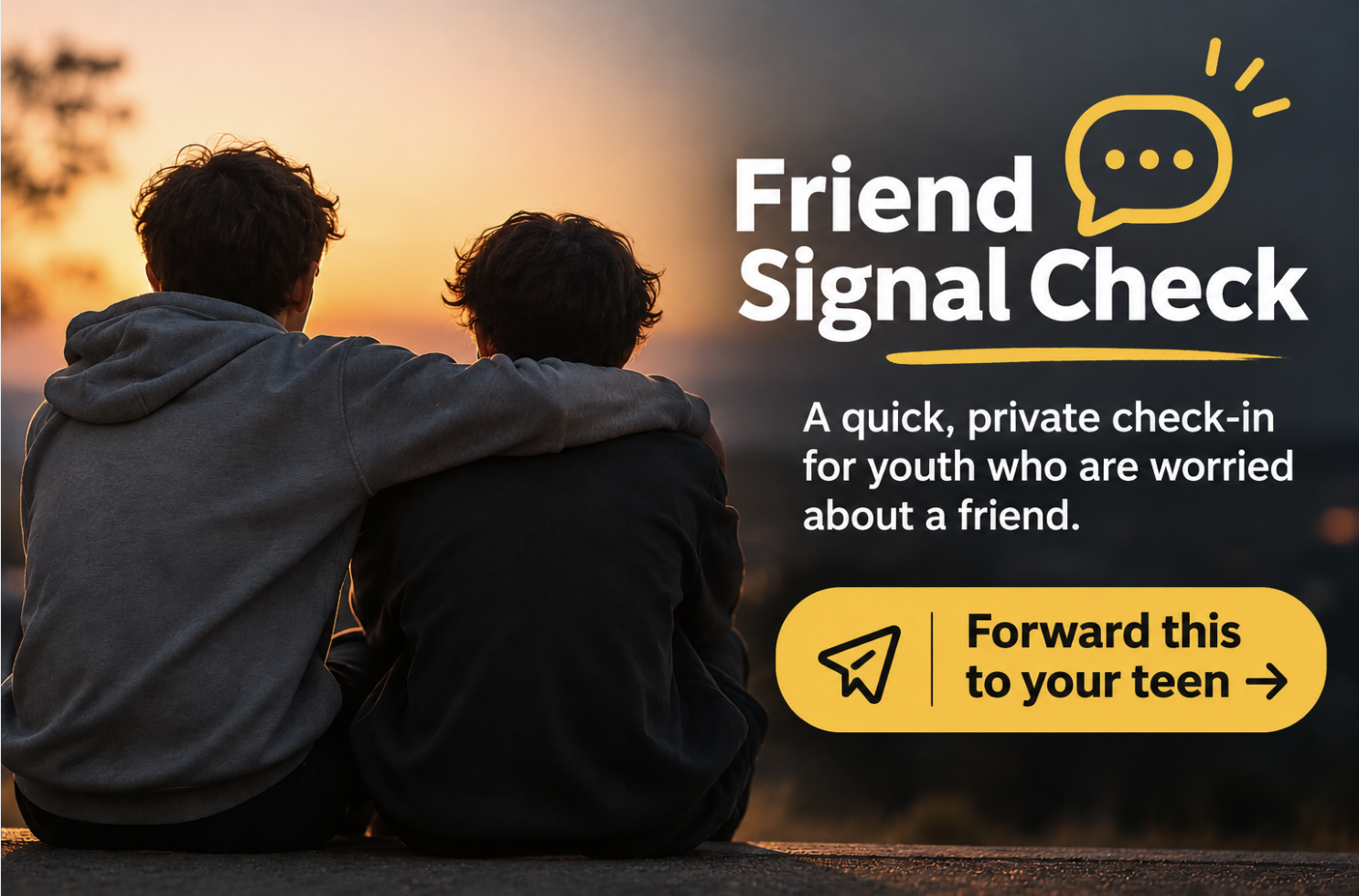
That conversation became the Friend Signal Check, ten questions for anyone 14 and older who's worried about a friend. Here are seven of those ten things. They run from everyday to heavier, the same order the check uses.
1. The plans that keep falling through
"Can't tonight. Next week for sure."
Then next week comes, and the same text arrives. Sometimes there's no text at all. Just silence on the day.
From your side, this looks fine. Your kid is home on a Friday night. Home feels safe. Nobody mentioned there was a plan in the first place.
A friend keeps count. They know it's the third time this month.
If you want a way in, ask about the plan instead of the mood. "Weren't you supposed to see Jordan this week?" is a lot easier to answer than "are you okay?"
2. The group chat goes quiet
Some kids live in the group chat. Memes all day. Opinions on everything. Then one of them goes quiet, and messages sit on read for days.
You'll miss this one completely. The phone never leaves their hand, and from the doorway, quiet and busy look exactly the same.
I'm 60. I'm still working out how a one-letter reply can start a fight. So I'm in no position to read the chat, and neither are you. Reading their phone is the wrong move anyway. A teenager who catches you stops telling you things, about themselves and about their friends.
Listen for names instead. If the friends they used to mention every day have dropped out of conversation, that's worth noticing.
3. More drinking or using than before
Plenty of teenagers drink. Friends notice when it changes. The one who now drinks before the party. The one who's always the last one still going.
This happens at someone else's house, after you've gone to bed. Teenagers are very good at walking through the front door looking sober. Most of us were, too.
If you raise it, keep it about change and safety. "You seem to be going harder than you used to. What's going on?" will get further than a list of consequences.
4. The risks that look like fun
Driving too fast. Driving after drinking. Picking a fight. Spending a whole paycheque in one weekend.
When this reaches you at all, it arrives as a funny story. Often the only person who knows the full version was sitting in the passenger seat.
Listen for the stories that end with "you had to be there." Ask one more question before you laugh. "Was that fun, or was that a bit scary?"
5. "I'm fine" sounds different to a friend
You've heard "I'm fine" every day since grade 7. At some point it stopped carrying any information.
In fairness, I'm Canadian. Our national answer to "how are you" is "not bad." We're poorly placed to judge.
A friend hears the same two words and catches more. The tone that's a bit off. The quick change of subject. The way they leave the room right after.
You can change the question. Ask about something specific in their week. "How did the shift go with the new manager?" gets a real answer far more often than "how are you?"
6. The joke that isn't quite a joke
"I'm dead inside." "Someone hit me with a bus." "I just want to disappear lol."
If you're over 40, this sounds alarming. If you're 17, it's Tuesday. This kind of humour is everywhere, and most of the time it's how young people let off steam.
That's exactly what makes this one hard. When everyone jokes about being dead inside, the friend who means it is hard to spot.
Friends can spot it, though. They notice when the joke comes up more often. When it stops getting a laugh. When it shows up at 2 a.m. with nothing funny around it.
You'll rarely hear these jokes. When you do, they'll sound like every other teenager you know. So leave the humour alone and watch for change in it. Is it more often? Darker? Has the laugh gone out of it?
The whole Friend Signal Check is built around that question.
7. "I'm just a burden"
"Sorry for being annoying." "You'd all be better off without me around."
Teenagers rarely say this to the people they think they're weighing down. Usually, that's you. So it goes to friends instead.
If your teen tells you a friend has been saying this, take it seriously. If you ever hear it from your own kid, tell them plainly that they matter to you. Skip the debate about whether the feeling makes sense. Stay in the conversation.
The three I left off
The check asks about ten things. I've covered seven. Here's what I left out, and why.
The first is stepping back from things that used to matter: the team, the gym, school, a job. Parents often do see this one. If you've noticed it, trust what you noticed.
The other two are too serious for a numbered list.
Friends often notice how someone seems after a hard stretch. Sometimes that includes a sudden calm, or giving belongings away. When that follows a difficult time, it deserves real attention.
And sometimes a friend hears something direct, about hurting themselves or ending their life. If your teen brings you something like that, it has moved past awareness. Help them get their friend to someone today. The Friend Signal Check pauses on that answer and shows who to call before any result appears. Asking someone directly about suicide does not put the idea in their head.
In Canada and the US, call or text 9-8-8, any time. Young people in Canada can reach Kids Help Phone at 1-800-668-6868, or text CONNECT to 686868. If someone is in immediate danger, call 911.
Where you come in
You won't see most of this. That's okay. Somebody close to your kid probably does.
The question is whether that person would come to you. Your teen, about a friend. Or a friend, about your teen.
Here's one way in. Send your teen the Friend Signal Check. Tell them the truth: "This made me think of you and your friends." Mean it. If it feels like a trick to get at them, they'll know, and you'll lose the side door.
If you're the one noticing changes, the Teen Signal Check is for you. More than 17,000 parents have taken it. Both are free, anonymous, and take about three minutes. They're awareness tools. They can't diagnose anything.
Somebody in your kid's life is already paying attention. Make sure they know where to find you.
FAQ
How can I tell if my teen is depressed or just moody?
Look for change, and for how long it lasts. One bad week is common. Several signs together, lasting a few weeks, is worth a conversation and maybe a professional opinion.
Should I read my teenager’s phone?
Usually not. If they find out, they tend to stop telling you things, including things about their friends. Listen for which names have stopped coming up.
What do I do if my teen says a friend is struggling?
Thank them for telling you. Don’t promise to keep it secret. Help them think about which adult in the friend’s life should know. If there’s talk of self-harm, help them get the friend to someone today.
Does asking a teen about suicide put the idea in their head?
No. Research consistently finds that asking directly doesn’t increase risk, and it often brings relief.
What is the Friend Signal Check?
It’s a free, anonymous awareness tool for anyone 14 and older who’s worried about a friend. It takes about two minutes. It can’t diagnose anything. It helps you notice what you’re already seeing.
You May Also Like
It’s Not One Bad Day That Worries Me
Which patterns in a teen’s behaviour are worth your attention, and why stacked signs matter more than a single rough day.
“How Was Your Day?” “Fine.” Now What?
Five everyday parent habits that shut teens down, and the questions that keep them talking.
The Kid Who Knows Your Teen Better Than You Think
What to do when another teenager comes to you worried about your child.