Why "Is Everything Okay?" Gets You Nothing
The First Conversation Never Happens Across a Desk
Maddie was quiet on the drive home from swim practice. Ninety minutes staring at a black line at the bottom of a pool does something to a person's thinking.
Then, out of nowhere, she said she'd figured out why we had disagreements sometimes. That we were similar to one another. That she was a lot like me.
I did the sideways glance every parent knows. The one that says keep going without making it obvious you're listening harder than you've ever listened.
She didn't know it then, but it was one of the biggest compliments she ever gave me.
Nothing about that conversation was scheduled. A car, a low radio, and enough pressure gone out of the room that she had space to say the thing she'd been thinking.
That's the whole lesson, and I missed it for years.
What I kept doing instead
I kept looking for the right moment.
The serious conversation. The one where you sit down across from your kid and ask how they're really doing. I believed the problem was that I hadn't found the right words yet, or the right time, or the right tone.
The words were never the problem.
Face to face with a parent activates something in a teenager that has nothing to do with how much they trust you. Their brain is still building the part that manages social risk. Direct eye contact from an adult who wants something from you emotionally reads as exposure. Exposure creates silence.
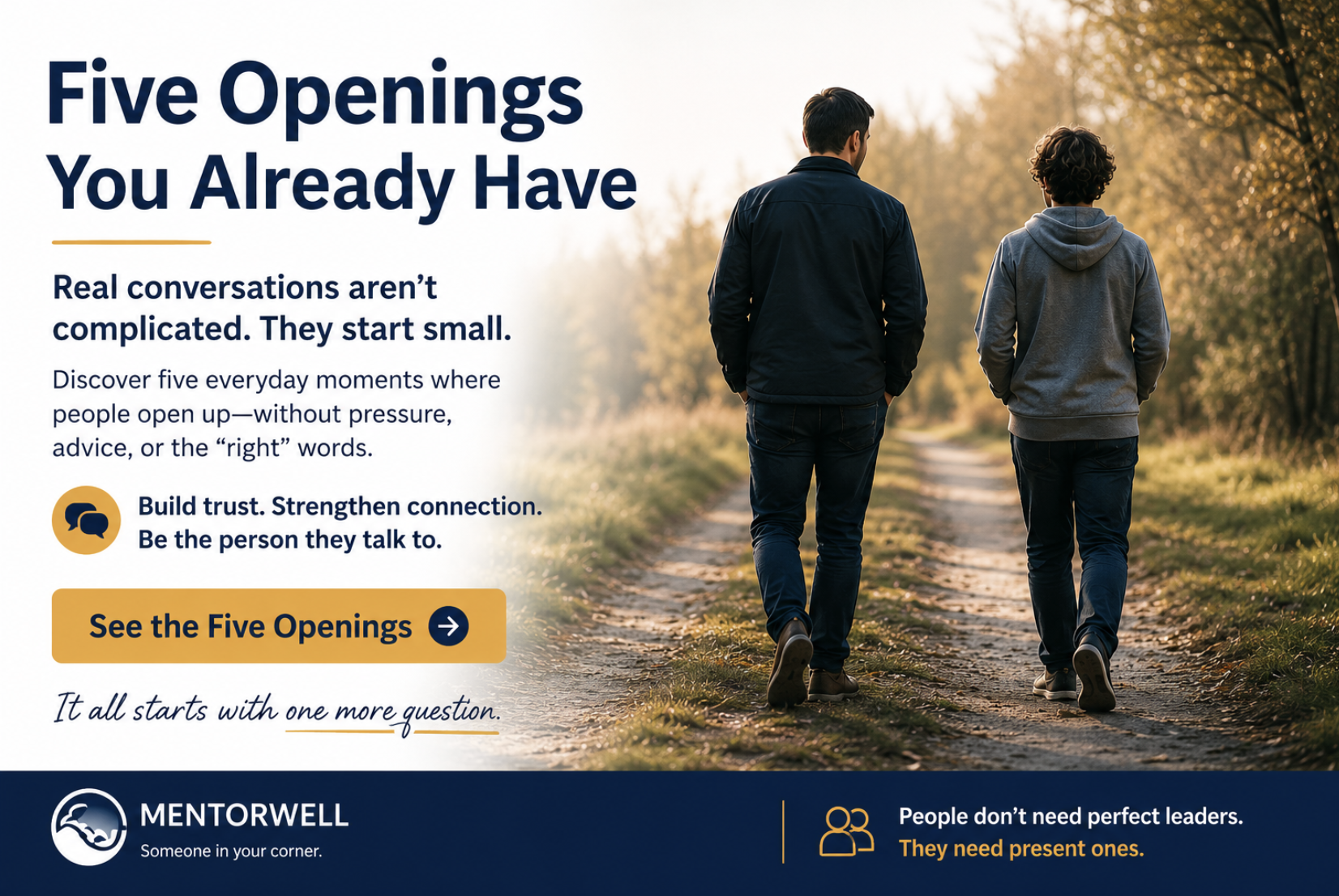
Side by side doesn't do that. In a car nobody watches your face while you answer. On a walk you're both looking at the same thing. In a kitchen the movement fills the gaps so a pause doesn't feel like failure.
The conversation has somewhere to go even when it stops.
The same thing happens at work
I started saying this to parents in 2023. Managers started telling me it sounded familiar.
Here's the version they described. You notice someone's off. You book fifteen minutes. The calendar invite says "quick chat." You close the door, sit across the desk, and ask if everything's okay.
They say they're fine.
You did everything you were trained to do. You created the space. You asked the direct question. And you got nothing, because you built a stage and then asked someone to be vulnerable on it.
Managers who get real answers tend to get them walking to the parking lot. On the way to a client meeting. Standing at the counter waiting for coffee. Not because those managers are more skilled. Because the setup asked less.
What this actually means for you
Think about your own house, or your own team.
When does the person you're worried about actually talk? Where do the one-word answers stop? Every family has a place where the truth comes easier. So does every working relationship.
Find yours. Then show up there without questions ready.
That last part is harder than it sounds. Most of us arrive at these moments with an agenda, and the other person can feel it before we open our mouths. Presence without an agenda is the skill. It's also the thing nobody trains you for.
The first conversation is rarely the one you plan. It's the one you're ready for when it shows up.
First Conversation Coaching works on the setup rather than the script. For parents, that's learning to recognize the openings you're already being given. For managers, it's the same skill in a different room.[Link: First Conversation Coaching]
I'm Chris Coulter. I lost my daughter Maddie in 2015. Everything I build now exists so other people have what I didn't.
FAQ Section
Why do employees say they're fine when they aren't? Usually because the setup asked them to perform. A scheduled meeting behind a closed door signals that something is being assessed, and most people default to reassurance under assessment. There's a second reason that surprises managers: people hide struggles from managers they like, because they don't want to add to what you're carrying.
What is first conversation training for managers? It's training on how to open a conversation about something personal, rather than what to say once it's open. Most manager training focuses on scripts and language. First Conversation Coaching works on setting, timing, and what to do in the moments after someone actually answers you.
How do I talk to an employee about personal struggles without overstepping? Lower the stakes before you raise the subject. Walk somewhere rather than sitting across from them. Name what you noticed rather than what you concluded, and be specific about the observation. Then stop talking and let the silence sit longer than feels comfortable.
Is this the same thing as psychological safety training? Related but narrower. Psychological safety work usually addresses team culture and how people raise problems about the work. This is about individual conversations regarding what someone is carrying outside the work, which is where most managers feel least equipped.
Does this apply to parenting a teenager as well? It started there. The reason side by side conversations work with teenagers is the same reason they work with adults: face to face with someone who has authority over you activates a social risk response that has nothing to do with trust. The room changes what people can say in it.
You May Also Like
Side by Side: How to Get Your Teenager to Open Up The parent-facing version of the same principle, built around the car ride home from swim practice and why the conversations you schedule with a teenager tend to go nowhere.
The Slide That Made 200 Employees Look at Each Other What happens in a room when a workforce realises how many of them are carrying the same thing privately.
Why Your Best Employee Is Quietly Struggling Performance is the last thing to go, not the first, and why the people you're least worried about are often the ones holding the most.