There is a slide I use in corporate workshops that quiets a room of two hundred people inside of ten seconds.
Because it is true. And because everyone in the room is doing the same math at the same time.
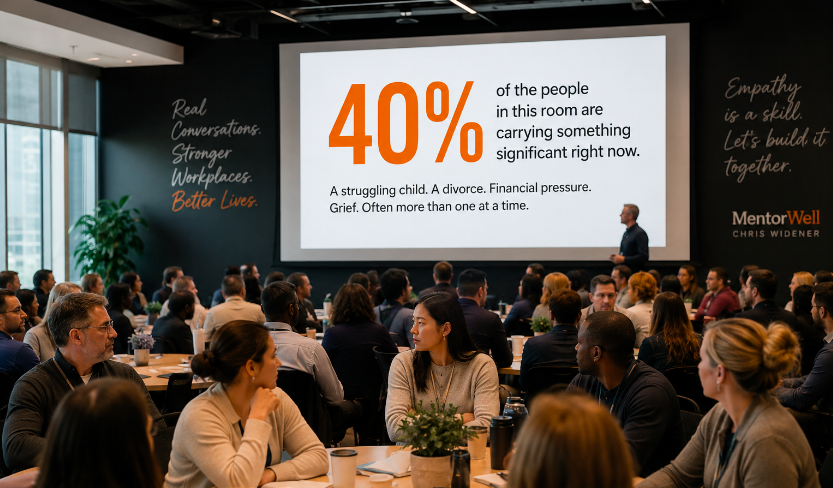
I presented yesterday to two large groups, more than two hundred employees across two sessions. They had been told there was a meeting. Not much more context than that. Early on I could see some of them wondering what parenting had to do with them. A few were checking their phones. Some had the particular look of people who have been pulled away from something they would rather be doing.
Then I put up the slide.
More than 40% of the people in this room are carrying something significant right now. A struggling child. A divorce. Financial pressure. Grief. Dealing with an elderly parent. Quietly dealing with physical or mental health issues. Often more than one at a time.
The room went quiet in a way rooms do not usually go quiet.
I was walking through the audience with a microphone. What I saw next is something I have never seen captured in an online forum or a virtual session. People started looking at each other. Quietly. The person next to them. The colleague across the table. The person they eat lunch with three times a week and have never asked how they are actually doing.
You could almost hear the math happening in real time.
If more than 40% of us are carrying something right now, who in this room is it.
Some people already knew the answer. I could see it in the room. You don’t always catch the subtle signals when you are presenting to two hundred people. But you catch some of them. The ones that are not subtle at all.
There are always people who linger afterward. Because they need a minute. They position themselves near the door, or they find something to look at until most of the room has cleared. They are hoping to catch a word without making it too obvious that they needed to.
That is what fear and shame look like in a workplace. A person standing near a door waiting to see if it is safe to say something.
I learned early on, giving my personal email out, ensured employees didn’t have to face the scrutiny of speaking out in front of their peers.
Even one person coming forward, said the HR manager afterward, makes the whole thing worthwhile.
Let’s just say there were more than one.
She was right. And she had also noticed something I had seen from the front of the room. Some of her staff had been quietly weeping during the session. The kind of crying people do when they are trying very hard not to.
She knew some of her people were struggling. She had known for a while. What she did not know was how to address it. And neither, she told me, did their managers.
This is the part that stays with me long after the workshops end.
It is almost never indifference that keeps managers from having the conversations that matter. It is that nobody ever taught them what to do when someone on their team is not okay. How to open the conversation without making it worse. How to listen without rushing to fix. How to stay in the discomfort long enough for the person across from them to feel safe enough to say something real.
She told me about one manager who had wanted to let someone go. Because he did not know how to have the conversation the situation actually required. So he reached for the only tool he had been given, the performance management system, and used it for something it was never designed to do.
I asked her one question.
What if you could teach your managers to have that conversation. If it could come from a place of empathy instead of awkwardness?
She already knew what it costs to replace a person. Between 50 and 200 percent of their annual salary, depending on the role. She did not need the business case. She needed to know the alternative was real.
That is what First Conversation Coaching is. A structured program that teaches managers the specific skills they need for the moment when someone on their team is not okay. The actual conversation. What to say, what not to say, how to listen without an agenda, and what to do with what you hear.
The manager who wanted to let someone go did not need to be a better person. He needed one skill he had never been given.
Most of the people in that cafeteria yesterday are going back to work today. Most of them are still carrying what they walked in with. Some of them are feeling slightly less alone because of what happened in that room.
But the managers who lead them are walking back into the same conversations they have always had. Unless something changes.
That is the question worth sitting with.
Not whether your employees are struggling. Yesterday proved that 40% of them are.
The question is whether the people you have put in charge of them know what to do about it.
[Learn about First Conversation Coaching] [Take the Manager Signal Check — Free]