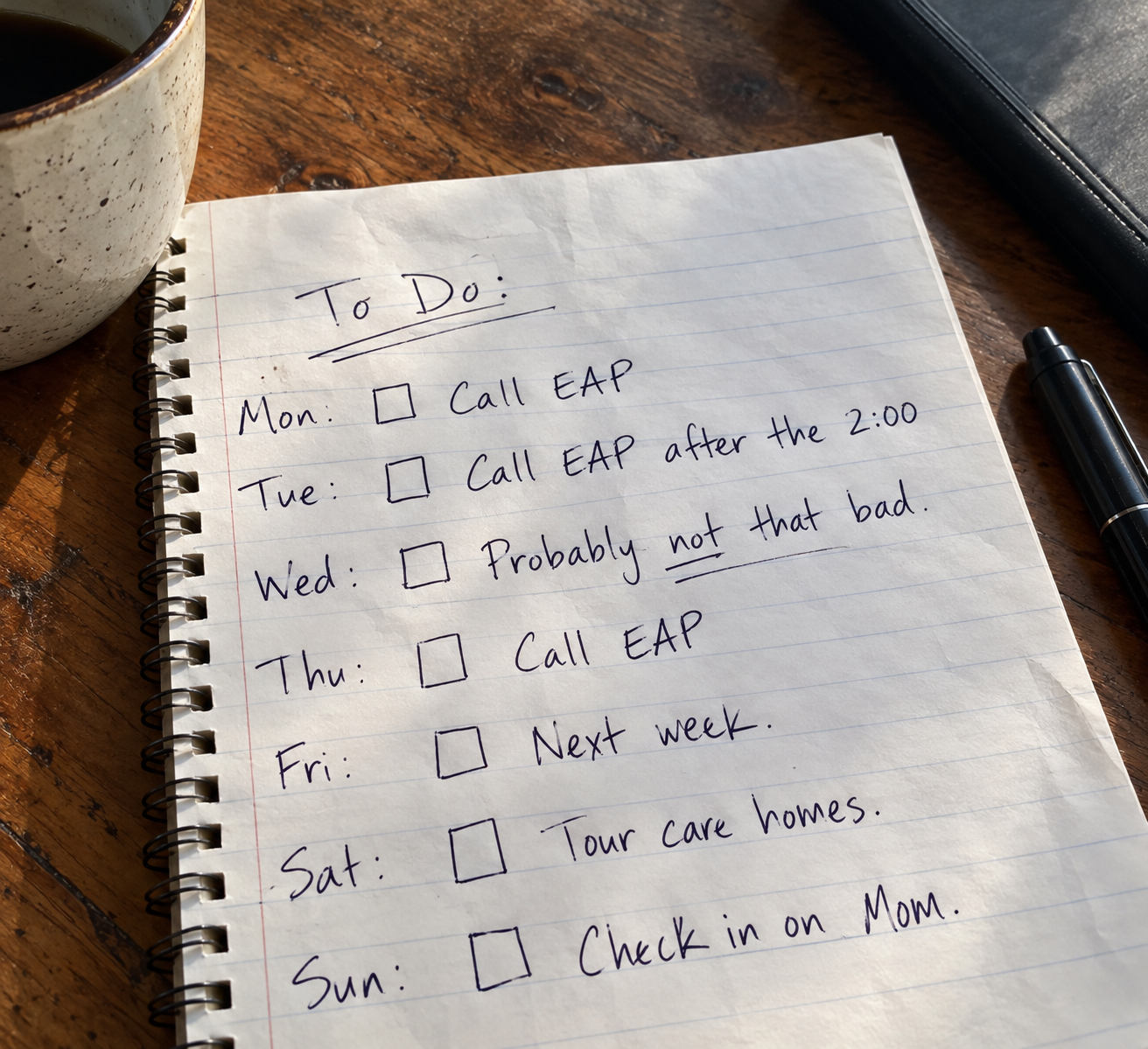
Quick one for the HR folks.
Think of the person on your team who’s been a bit off lately. You know the one. Third absence this month. A missed deadline from someone who has never missed a deadline in their life. Camera on in the Monday meeting, nodding along, and you get the distinct feeling they’re somewhere around last Thursday.
You’ve probably told yourself it’ll pass. That it’s none of your business. That if something were really wrong, they’d tell you.
They won’t. I say that with love.
They’ve done the math. Telling you costs something. Looking fine costs less. So they look fine. I’m Canadian, so I consider looking fine a national sport. Turns out people everywhere play it too.
You don’t know what that person is carrying. Neither do I. But I can make some educated guesses.
Maybe they spent Saturday touring assisted living homes for their dad, doing math on a napkin in the parking lot.
Maybe they lost someone in the spring. They took the five bereavement days. Anyone who’s buried someone close can tell you how far five days goes.
Maybe it’s the brother who gets loudly, reliably drunk every holiday. Or every Wednesday. And who calls them afterward.
Maybe it’s the credit card interest quietly eating the holiday fund, never mind the kid’s university fund.
Or maybe it’s the kid. A teenager who stopped coming down for dinner. Or stopped talking. Or stopped sleeping. And a parent searching symptoms at 1 a.m., then pretending they didn’t.
That last one isn’t rare. About 22% of working parents have a child with mental health challenges (Deloitte, 2023). In the US, roughly 65% of employees are parents. Do the math and it’s about one in seven people on your payroll. That’s before you count anyone’s dad, grief, brother or credit card bill.
If you have an Employee Assistance Program (EAP), good. I’m a fan. It’s built for the moment someone picks up the phone and says “I need help.” Most of the people I’m describing haven’t reached that moment. They’re in the months before it, deciding whether it’s bad enough to mention. Most decide to wait and see.
I know that place well. I waited and hoped once. I’d give a great deal to have that time back.
When it finally shows up at work, it’s usually a doctor’s note, or a one-on-one where someone falls apart, or the day they just don’t come in. Then comes the part nobody budgets for. Everyone else on the team quietly taking notes on how this place treats people when life gets hard.
The employers who handle this well do two fairly modest things.
First, their managers notice. And when someone finally says “things are a bit much at home right now,” the manager doesn’t fumble it.
Fumbling is easy, by the way. Most of us jump straight to fixing. Or we reassure: “I’m sure it’ll work out.” To someone who just toured three care homes, that lands about as well as you’d expect. The person walks away wishing they’d kept their mouth shut. And they will, next time.
Second, they make it known that support exists before things get serious. Nobody has to disclose anything. HR doesn’t have to become a counselling service. (Please don’t. You have enough on your plate.)
This is where I make my pitch. I’ll keep it short.
First Conversation Coaching is for your managers. Two one-hour sessions, online. The first is about spotting when someone on the team is struggling, whatever the reason. The second is about the conversation itself: how to respond so the person feels supported and glad they spoke up. Half of it is role-play, which everyone dreads and then enjoys. Nobody leaves thinking they’re a therapist. They leave knowing what to say in the first five minutes. Up to 40 managers per workshop. Every manager gets the Manager Signal Check, a confidential tool that shows them where their own blind spots are. You keep the recordings.
LifeLine Parent Workshops are for your parents. 2-3 virtual sessions, all recorded. They answer the questions parents carry around and don’t ask at work:
Is my kid struggling, or is this normal teenage stuff?
How do I talk to my teenager without shutting them down?
If we need professional help, how do I actually get it?
I open every session by asking parents how the “How was your day?” conversation goes at their house. The answer is “Fine.” Every time. Then we talk about what happens next. Fewer than one in ten parents gets that part right, and there’s a lot of laughing when they realize they sound exactly like their own parents, and like the other parents on the call.
I also give out my personal email at the start of every session. More than 30 employees from across North America have written to me afterward, telling me things they haven’t told anyone at work. That’s what one in seven looks like up close.
The business case is solid. The tricky part is your leadership team. Leaders who haven’t lived this tend to underestimate how much of it is already in the building. So here’s an email you can borrow. I won’t be offended.
Subject: A gap in how we support people before things get serious
Hi [Name],
I want to flag something I think deserves a short conversation.
A lot of our people are carrying things at home we never hear about: aging parents, grief, family members who are struggling, money worries. For working parents, one of the heaviest is a child’s mental health. Deloitte puts that at 22% of working parents. Most aren’t saying anything. What we see instead is the downstream effect: more absences, more distraction, and people quietly pulling back.
Our current support is designed for when someone reaches out in crisis. We have very little for the stage before that.
The MentorWell offers two programmes that fill that gap:
First Conversation Coaching trains managers to notice when someone is struggling and to handle that first conversation well. Two sessions, up to 20 managers, $5,000 CAD.
LifeLine Parent Workshops help parent employees recognize what they’re seeing at home, talk with their teen, and find professional support if they need it. 2 sessions, $5,000 CAD
Keeping one good person from resigning would likely cover either one.
Could we take fifteen minutes on this? I’m happy to set up a call with the founder too.
[Your name]
If you’d rather talk to me first, here’s my booking link. Fifteen minutes, no pitch.
FAQ
Why don't employees use the EAP? An EAP works when someone reaches out. Most people carrying something heavy at home are still deciding whether it's serious enough to mention. Some worry about who will find out. By the time they call, things have usually gone on for months.
Why isn't the EAP enough anymore? It still matters. It just starts late. The gap is the stretch between "something's off" and "I need help," when the person is still at work, still performing, and still deciding whether to say anything. That's where a manager's first response makes the difference.
What should a manager say when an employee shares a personal struggle? Thank them for telling you. Ask what would help this week, and listen before offering anything. Skip "I'm sure it'll work out" and resist fixing it on the spot. Be honest about what stays private, then follow up a few days later.
How do I support employees with struggling kids at home? Start by making it known, early and out loud, that support exists before things get serious. Give parents practical tools: how to tell normal teenage behaviour from something more, how to talk with their teen, and how to find professional help. LifeLine Parent Workshops cover all three.
How does parenting stress affect work performance? Usually quietly. More absences, missed deadlines, and people who are present in meetings but somewhere else. About 22% of working parents have a child with mental health challenges (Deloitte, 2023), so it's likely already on your team.
You May Also Like
"Do You Have a Minute?" The Conversation Most Managers Aren't Ready For An employee tells their manager their son has stopped going to school. Five ways to respond, and why that first conversation affects who stays.
The Emotional Load Economy: The Cost Your Company Is Already Paying How the weight people carry from home shows up as lost attention and turnover, and what workplaces do that adds to it or lightens it.
7 Things I Got Wrong About Mental Health as a Business Owner Chris looks back at running a 70-person company, including how he responded when people struggled and the EAP he never paid attention to.