Most kids won’t tell you they’re struggling. They’ll shrug. They’ll smile. They’ll say what they think you want to hear.
“I’m fine.” “Just tired.” “It’s nothing.”
The real story is in what they don’t say. In what they stop doing, or start hiding.
I published an earlier version of this piece last summer. Over 165,000 people saw it. But the numbers aren’t what stayed with me. It was the messages. Parents writing to say they’d read it and looked at their kid differently that night. With attention, instead of panic.
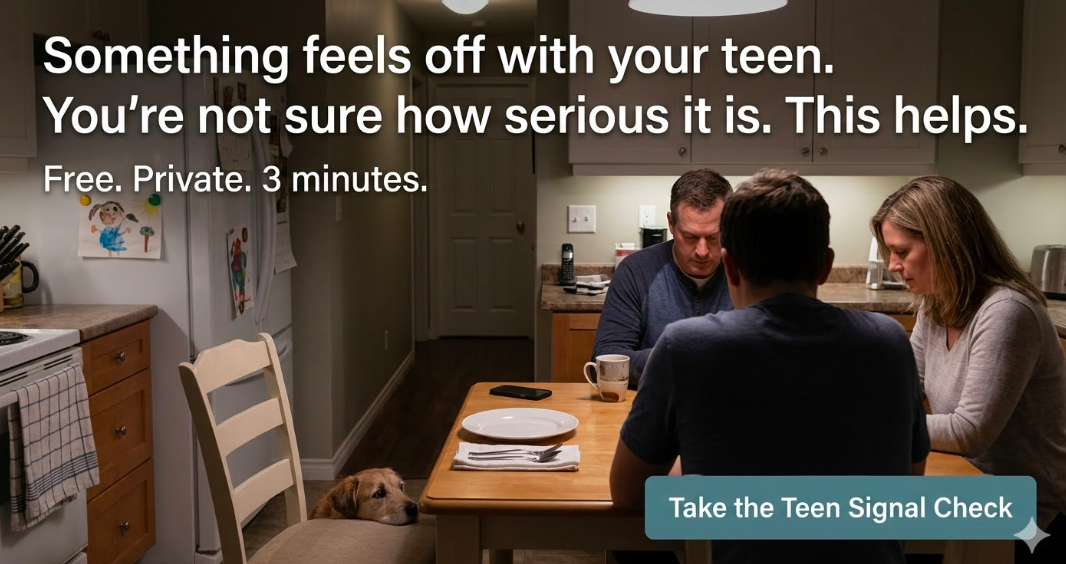
Since then, over 3,500 parents have taken the Teen Signal Check, a free tool I built to help sort what you’re observing into something clear. That tool didn’t exist when I first wrote this. Now it does. And it changes what you can do with what you’re about to read.
This isn’t meant to scare you. It’s meant to sharpen your instincts. To help you notice the quiet shifts that too often go unseen.
Because when kids don’t have the words, they speak through behaviours.
Here are seven subtle signs that might be asking for your attention.
1. They’ve pulled away from things they used to love.
The guitar gathers dust. The group chat goes quiet. No more hockey practice. No more sketchbook.
It’s easy to call it a phase. Or say they’ve outgrown it. But sometimes, it’s emotional burnout. Or the first sign of withdrawal.
When a kid stops doing the thing that used to light them up, pay attention to what replaced it. If the answer is nothing, that’s the signal.
2. Their sleep is completely off.
Scrolling until 3am. Sleeping 12 hours and still waking up drained. Or lying awake, stuck in their own head.
Sleep patterns are windows into emotional health. They rarely lie.
If you’re noticing consistent changes, not just a bad night here and there, but a pattern, that’s worth noting.
3. They snap over nothing.
Mood swings. Eye rolls. Sudden anger when you ask, “Have you eaten today?”
It might look like attitude. But often, it’s dysregulation. They don’t know what to do with the overwhelm they’re feeling, so it comes out sideways.
The instinct is to correct the behaviour. The better move is to get curious about what’s underneath it.
4. They isolate.
No interest in hanging out. No texts. No calls. Even family dinners feel like too much.
They might say they’re just “tired” or “introverted.” And sometimes that’s true. But when withdrawal becomes the default, not the exception, something else is happening.
Watch for the shift. Not the single night in their room, but the pattern of choosing to be alone when they didn’t used to.
5. They seem “too okay.”
Always polite. Always smiling. Never asking for help.
This is the one parents miss most. Because it doesn’t look like a problem. It looks like a good kid.
But sometimes, it’s perfectionism. People-pleasing. Or the belief that their pain will only become your burden. So they hide it.
Maddie did this. She carried things quietly because she didn’t want to worry anyone. By the time we understood what that silence meant, it was too late.
If your child never seems to struggle, ask yourself whether that’s because they’re not struggling, or because they’ve decided you can’t handle knowing about it.
6. Their grades or motivation suddenly shift.
School performance dips. Or spikes. They miss assignments. Or overwork. You hear, “I don’t care anymore.”
Don’t write it off as laziness or distraction. Sudden academic changes, in either direction, are often emotional exhaustion wearing a new mask.
The kid who stops caring and the kid who can’t stop working can both be struggling with the same thing.
7. They joke about disappearing.
“Maybe the world would be better without me.” “I wish I could just disappear.”
Even if it sounds like a joke. Listen.
It might be the only way they know how to say, “I don’t feel safe in my own head right now.”
You don’t need to have the perfect response. You just need to not let it pass. A simple “That’s a heavy thing to say. Do you want to talk about it?” is enough.
If You’re Seeing Some of These
Don’t panic. And don’t try to fix everything at once.
Lean in.
Ask gently. Without pressure.
“I’ve noticed you haven’t been yourself lately. Want to talk?” They might not say much. That’s okay. Stay close.
Validate, even when it’s hard to hear.
“That sounds heavy.” “Thank you for telling me.” Don’t rush to solve. Just listen.
Remind them they are not a burden.
Kids often stay silent to protect you. Be very clear: “You can always talk to me. Nothing you say will scare me away.”
Bring in support.
A therapist. A mentor. A trusted adult outside the family. That doesn’t mean you’ve failed. It means you’re building a team around your kid.
Take the Teen Signal Check
If you’re reading this and recognizing some of these signs, the Teen Signal Check can help you sort what you’re seeing.
It takes 3 minutes. It’s free. It’s private. No sign-up required. You’ll get a clear zone, green, yellow, or red, with specific next steps based on what you’re observing.
Over 3,500 parents have used it since we launched. It wasn’t because something was in crisis. Because something felt off and they wanted clarity.
You Don’t Have to Carry This Alone
If you’re noticing something and you’re not sure what to do with it, When Something Feels Off is a free parent community where over 90 parents worldwide are navigating the same thing. Non-judgmental. Confidential. You’re welcome any time.
→ Join When Something Feels Off
If you lead a team and you recognize this in your workplace, our LifeLine Parent Workshops help companies support the working parents who are carrying this quietly.
→ Learn about LifeLine Parent Workshops
One Final Thought
Most struggling kids aren’t asking for miracles. They’re asking to be seen. Heard. Noticed.
You don’t need all the answers. You just need to stay close for when they’re ready to share.
So if your child says “I’m fine,” don’t walk away. Ask again. Sit beside them in the silence if you have to.
Because the right conversation, at the right time, could change everything.
If this was helpful, send it to one parent you think needs to see it. Not on social media. By text. Privately. The way this kind of thing actually reaches the person who needs it.