95% of Students Said Their School's Mental Health Program Wasn't Working. The School Disagreed

"If you run a school mental health program, your students have something to tell you. Most of them already have. You just weren't asking the right question."
A few years ago, we ran a program at a Toronto school called How Are You Feeling? Eight teenage girls completed it. Every one of them said it changed their lives.
That's not unusual. We heard versions of that regularly. What was unusual was what came next.
When we surveyed the broader student body at that school, 95% of them said the mental health programs already in place weren't meeting their needs.
Ninety-five percent!
Nearly every student in the building was telling the school the same thing: what you think is working isn't working.
The school's response was familiar. They had programs. They had counsellors. They had initiatives they could point to. On paper, the box was ticked.
But the box and the experience are two different things. And nobody was asking the students which one was true.
This is not a problem unique to one school. It's a pattern.
Schools across Canada are operating under a version of the same assumption: that having mental health resources means students are being supported. That the presence of a program equals the effectiveness of a program.
Here's what that assumption misses.
A guidance counsellor with a caseload of 300 students cannot provide meaningful mental health support. They can provide triage. They can provide referrals. They can provide a sympathetic face for the eleven minutes between classes. But the kind of sustained, relational support that actually moves the needle for a struggling teenager? That requires time, consistency, and trust that most school structures simply cannot offer.
Students know this. They figured it out years ago. They learned that the counsellor's office is where you go to change your course schedule, not where you go when you're falling apart. They learned that the wellness assembly happens once a year and changes nothing. They learned that the mental health poster in the hallway is wallpaper, not a pathway.
And they stopped expecting the school to help.
That's the real cost of the gap. Not that students aren't getting support. It's that they've stopped believing support exists inside the building.
I don't say this to blame schools. I say it because I've sat across from administrators who genuinely care about their students and genuinely believe their programs are working. They're not being dishonest. They're being under-informed.
The information they're missing is the student's experience.
It’s not the survey that asks "do you know where to go if you need help", because students will say yes to that. They know where the counsellor's office is. Knowing where it is and trusting it are completely different things.
The question that matters is: "When you were struggling, did you feel supported by this school?"
Most schools don't ask that question. Because the answer is uncomfortable. No school wants to publish the real results to the question.
When Maddie was in school, there were programs. There were resources. There were people who cared. I'm not going to pretend the school didn't try.
But trying and reaching are different things.
The programs existed. Maddie didn't use them. Did she know about them? Because they didn't feel like they were for her. They felt institutional. They felt generic. They felt like something the school did for the school, not something the school did for her.
I don't know if a different kind of program would have changed her trajectory. I can't make that claim and I won't. But I do know that the programs that were there didn't connect with her. And she's not the only one.
The students who are most at risk are often the ones least likely to engage with institutional support. They don't trust the system. They don't believe it sees them. And a poster on the wall or an assembly in the gym does nothing to change that belief.
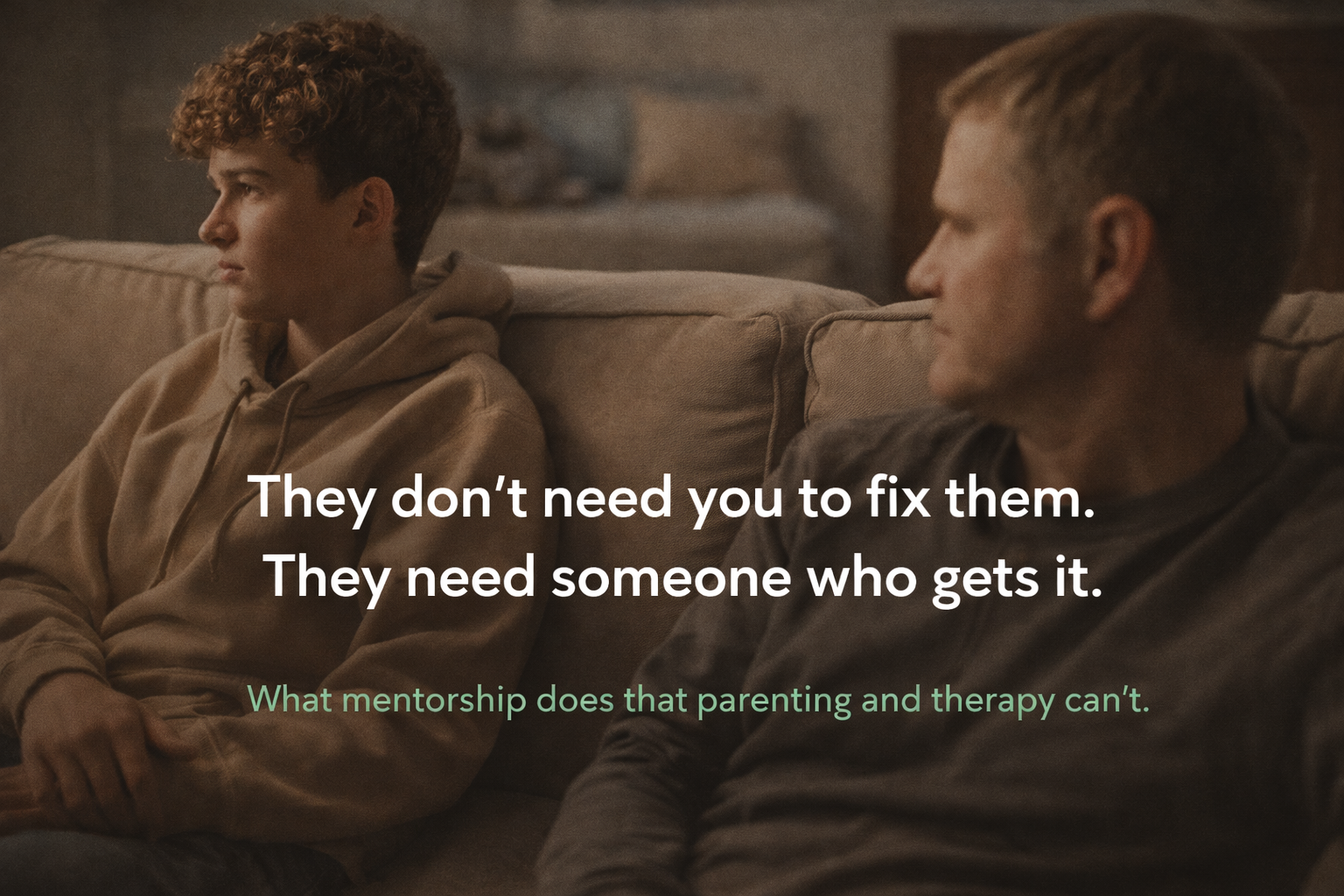
What changes it is a relationship. A real one. With someone who isn't a teacher, isn't a counsellor, isn't a parent. Someone whose only role is to show up, listen, and help them figure out what they need.
That's what mentorship does inside a school. It fills the gap that programs can't.
At The MentorWell, we work with schools to put mentors inside the building, as the relational layer that makes everything else more effective.
Our mentors aren't clinicians. They're not there to diagnose or treat. They're there to be the person a student actually talks to. The person who earns trust through consistency, not authority. The person who helps a struggling teen feel seen in a building where they've learned to be invisible.
When a student has a mentor, the counsellor's office stops being the place they avoid and starts being the place their mentor helps them walk into. The wellness resources stop being wallpaper and start being pathways. The school's existing programs start working because there's finally a human bridge between the student and the system.
It's called an activator.
If you're a school administrator reading this, I have a question for you.
Have you asked your students if those mental health programs are reaching them?
Whether they trust them. Whether they've used them. Whether, in the moment they were struggling most, the school felt like a place that could help.
If you haven't asked, the answer is probably the same one we found. And that's not a failure. It's a starting point.
If you want to know what your students are actually experiencing: We can help you find out., but not with a generic survey. With a process designed to surface what students won't say in an assembly. Learn about Mentorship for Schools
If you want to explore what mentorship looks like inside a school:See how it works, and what changes when students have someone they actually trust.
If you're a parent and this resonates: Share it with your child's school, as a conversation starter.