Aren't We Talking About Mental Health Too Much?
I run a mental health company. I've built my life around this. And some days I think we're talking about mental health too much.
Or maybe not too much. Maybe just wrong. I'm still working out which.
Either way, not for the reason you're bracing for. Give me a few minutes.
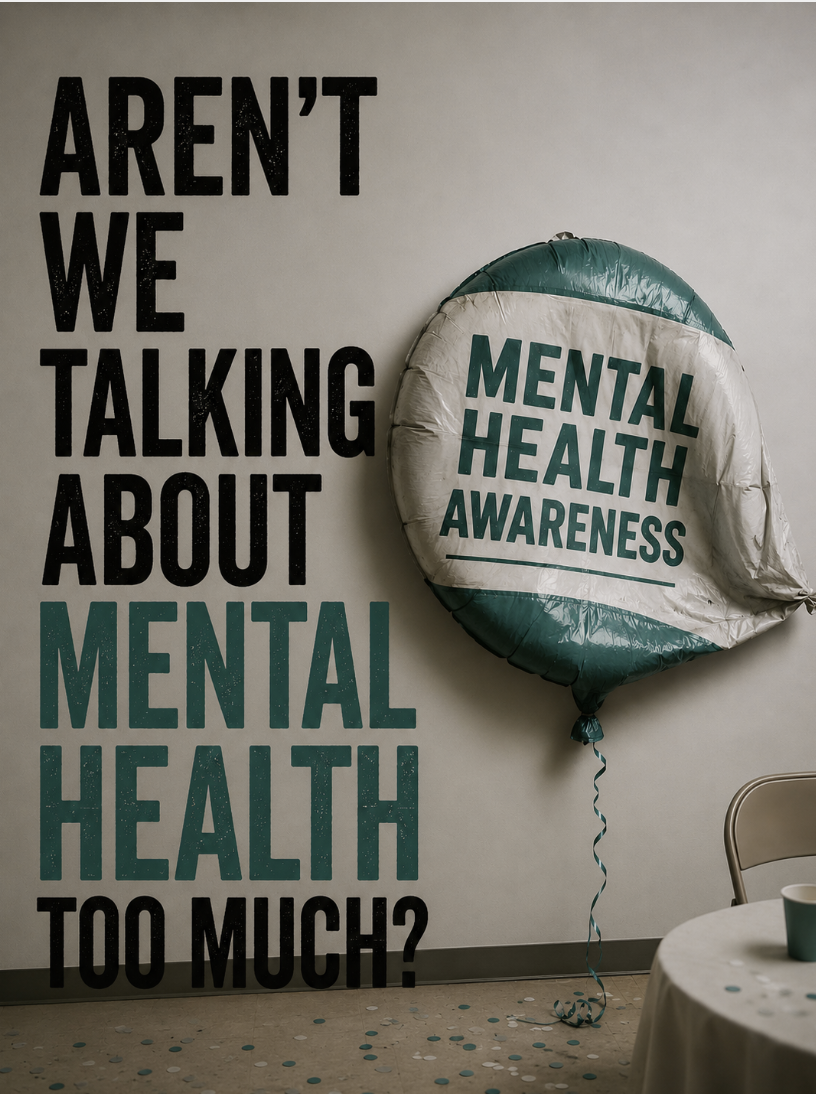
Here's what I've watched happen, over and over, in boardrooms, school gyms and living rooms. Somebody says the words "mental health," and the air goes out of the room. Not with hostility, but something quieter. Eyes drift. Shoulders drop half an inch. Even the people who care, even the ones living through something hard right now, do a small internal sigh. The phrase lands and something deflates.
I used to think that was resistance. People not wanting to deal with it. It isn't resistance. It's fatigue, and it's fatigue with a word.
Let me try to explain what I think happened.
We all have mental health. That's true. It's also useless.
We all have physical fitness too. Some good, some bad, but everybody's got a version of it. Same as mental health. Same as having a nervous system. Same, honestly, as being an animal. All true. All completely inert.
A sentence that includes every human being who has ever lived cannot tell you a single thing about what to do next. That isn't a flaw in how we're saying it. It's the ceiling of the words themselves. "We all have mental health" is the "we're all animals" of wellbeing. Technically correct, and it moves nothing, because it points at no one in particular.
Here's where it gets interesting.
I'm a middle-aged man with depression. Some days my focus scatters so badly it looks like ADHD. It isn't. It's grief, eleven years of it, still rearranging how my brain works when I least expect it.
Feel the difference between that and "we all have mental health"?
That sentence has edges. It leaves people out. And the moment a sentence could have been false about someone and wasn't, it starts to mean something. "We all have mental health" can't be false about anyone, which is exactly why it lands on no one. What I just told you about myself could easily have been false, and it isn't, and that's why you actually heard it.
I could have hidden it, by the way. There's a word for what I described. I could have written "I'm neurodivergent" and moved on, and you'd have filed me under a category and stopped looking. But it wouldn't have been true. The truth is messier and has no tidy label, which is the whole reason it was worth saying out loud. The easy word would have let both of us off the hook.
That's the thing about the specific sentence. It's the only kind that ever changes anything.
Now, you might think the fix is a better phrase. Retire "mental health," find something fresher. It won't work. Whatever we replace it with goes to wallpaper too, give it a few years. "Wellness" already did. "Self-care" already did. The problem was never the particular words. It's that we keep hunting for one term to cover a thousand different human situations, and no term survives that job. We don't need a new phrase. We need to stop hiding behind phrases.
So watch what happens when we put the dead one down and pick up the real thing.
"Mental health" makes people numb. "My son stopped seeing his friends and I honestly can't tell you when it happened" does not. "The guy on my team used to talk in every meeting and now he goes quiet" does not. "Her bedroom door started closing earlier and I told myself it was just her age" does not.
Same subject. Completely different room. Nobody sighs at those sentences. They lean in, because those are scenes you can see, and a scene you can see is a scene you might be able to do something about.
Which brings me to the questions that actually matter. Sit with each one honestly.
Does a parent know what to look for. Not "is the parent aware of mental health." Does she know that the friends quietly disappearing might matter more than the slammed door everyone warned her about.
Does a manager know what to say. Not "has he done the training." Does he know what comes out of his mouth when someone on his team is clearly carrying something and he's got about four seconds to not make it worse.
Does an employee know where to go. Not "is there an EAP." Does she know, at eleven at night, what the actual first step is, and believe it's safe to take.
Awareness answers none of these. You can be completely aware and frozen at every one of them, because awareness lives up in the clouds with the phrase, and every one of these questions lives down on the ground where real life happens. The whole problem is the distance between the two.
We spent years getting people to care, and we were right to. There was a time you couldn't say the word depression at work, and breaking that silence saved lives. I'm not sneering at any of it. I've done plenty of it myself.
But we won that fight. Most people now know mental health is real, that teenagers struggle, that the person across the desk might be going through something. The caring is largely handled. And we never built the thing that was supposed to come after it. So we keep running the awareness play, at people who are already aware, and we call it progress.
That's why it feels like too much. It isn't the volume. It's the altitude. The conversation never comes down far enough to become useful, so it just repeats, hovering, and repetition without usefulness is exactly what curdles into that sigh I described at the start. The eye-roll isn't people caring too little. It's people being handed an important thing, over and over, with no instructions, until they tune it out to protect themselves.
So no. We're not talking about mental health too much.
We're talking about it from too high up. And the height is what feels like too much.
The fix was never more conversation, and it was never less. It's lower. Come down off the phrase and land on the specific. The actual kid. The actual silence in the actual meeting. The particular Tuesday when something felt off and you talked yourself out of it. That's the altitude where a conversation finally has somewhere to go.
Stop asking people to care about mental health. They already do. Show them the one thing right in front of them that they're looking straight at and can't quite name.
That's the part we skipped.
FAQ
Are we actually talking about mental health too much?
No. We're talking about it too vaguely, and the vagueness is what feels like too much. The fix isn't less conversation or more. It's more specific conversation, the kind that names an actual person in an actual situation instead of a category everyone already agrees matters.
Why does mental health awareness feel exhausting now?
Because awareness was the right goal fifteen years ago and it largely worked. Most people already know mental health is real. Running the same awareness campaigns at an audience that's already aware produces fatigue, not change, which reads as "too much" when the real issue is "not useful."
Isn't awareness still important?
Yes, and this isn't an argument against it. It's an argument that awareness was step one, not the finish line. Knowing a problem exists and knowing what to do about it are different capabilities, and most programs stopped at the first one.
What should companies do instead of another awareness campaign?
Build capability, not just awareness. That means giving managers actual words for the conversations they're avoiding, giving employees a real and safe first step, and finding where silence is building before it becomes a resignation or a crisis. Awareness tells people to care. Capability tells them what to do with the caring.
Why does specific language work better than "mental health"?
Because a sentence that could apply to anyone applies to no one. "We all have mental health" can't be false, so it lands on nobody. "My son stopped seeing his friends" has edges, it's a scene you can picture and act on. Specificity is where meaning and action both live.
You May Also Like
The Hidden Cost of Teen Crisis on Your Workforce
The invisible bleed this article describes, made concrete. What it actually costs a company when a parent is quietly falling apart at their desk.
What I Learned Delivering LifeLine Workshops
Three sessions inside real companies, and the pattern that emerged: people trusted a stranger more than their colleagues, and the real conversations happened privately.