"I Will Not Say Suicide in School Again.”
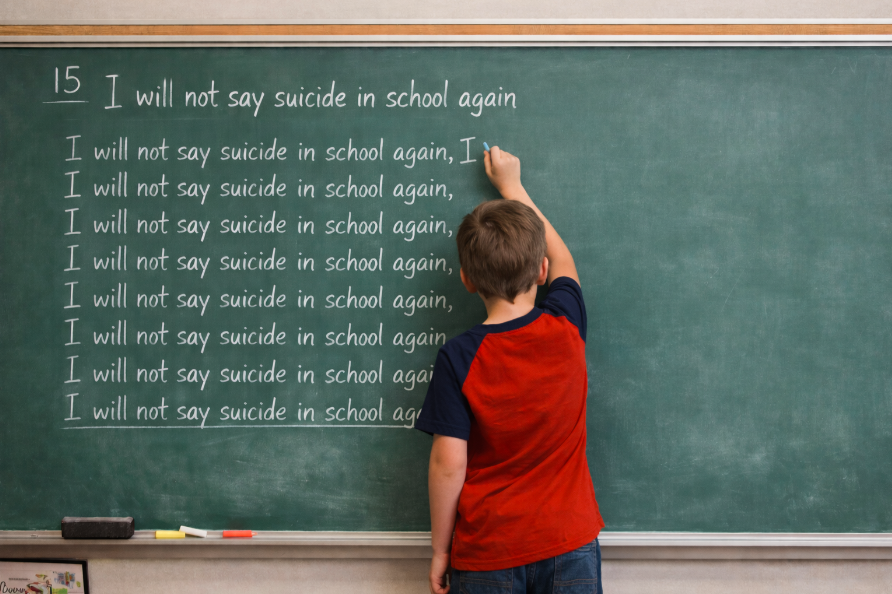
This is what we teach kids about suicide. Don't say it.
Look at that image for a moment.
A child at a chalkboard, writing the same line over and over. We used to call it, “writing lines”.
I will not say suicide in school again.
Nobody put that child there.
This is a metaphor. And like all good metaphors, it is more accurate than the thing it's describing.
This is what our schools do with the topic of suicide. They write it out, over and over, in the negative. They don't say it. They don't teach it. They don't give it context, language, or a framework that might help a young person understand what they're feeling, or recognize it in someone sitting next to them. They simply ensure, through policy and practice and institutional silence, that the word does not appear.
I will not say suicide in school again.
Fifty times. A hundred times. A thousand times. Until the lesson is learned.
The system that refuses to prepare, and then scrambles to repair
Suicide is the second leading cause of death among young people aged 15 to 24. Approximately 20% of high school students report having serious thoughts about it. The majority of those thoughts go unreported and untreated.
And yet most students will pass through thirteen years of formal education without a single structured conversation about what suicide is, what it feels like from the inside, what the warning signs look like from the outside, or what to do when you're carrying something that dark and don't know where to take it.
The justification is always the same. Contagion. The fear that naming it will spread it. That if we say the word in a classroom — calmly, clearly, with care, we are somehow putting the idea into the heads of children who, statistically, are already carrying it in record numbers.
The research does not support this.
Every major mental health organization, the Canadian Mental Health Association, the American Foundation for Suicide Prevention, the World Health Organization, has reached the same conclusion: talking about suicide does not plant the idea. It reduces risk. Open, honest conversation is protective. Silence is not.
Studies on school-based suicide screening programs have found that 72% of young people identified as at-risk were not receiving any prior mental health treatment. Of those referred for care following a screening, 70% obtained help they otherwise would never have accessed. Talking about it didn't create the problem. It created the pathway out of it.
What actually causes contagion is the glamorization or romanticization of a death. It’s the thing that happens in a vacuum, when students are given no framework for understanding what occurred and are left to fill the silence with social media rumours and unchecked misinformation. Silence is not a preventive measure. It is an open door to the exact outcome it claims to be preventing.
The institutions know this. The research is not new. The evidence is not ambiguous.
And yet the chalkboard stays blank on this topic. Every single year.
Until someone dies.
What happens after
Here is the part that should stop us cold.
When a student dies by suicide, schools mobilize. Crisis counsellors arrive. Support rooms open. Trained professionals move through the hallways, sitting with students who are shocked and grieving and trying to make sense of something they have never been given any language to understand.
The system that spent years refusing to teach this topic now spends thousands of dollars responding to its consequences.
It will address the wound. It simply will not acknowledge the conditions that created it.
The children sitting with those counsellors are experiencing something for which their education left them entirely unprepared. They don't know what the warning signs look like because no one taught them. They don't know what to say to a friend who is struggling because that conversation was never modelled. They don't know how to process what they're feeling because grief and mental health and the reality of suicide have been written out of the curriculum. This has been done carefully, consistently, year after year, as though the subject might be contagious.
It turns out the silence is.
What the numbers say about what silence costs
For LGBTQ+ youth, already among the most vulnerable students in any school, the data on what open conversation provides is unambiguous.
Students in affirming school environments have 40% lower odds of attempting suicide. Those who learn about LGBTQ+ history and people in class have 23% lower odds of a past-year attempt. Teachers who respect students' pronouns see measurable reductions in suicide attempts.
Silence on these topics is not a neutral position. It is a policy decision. And it shows up in the data.
For all students, the impact of education is equally clear. Young people who receive suicide prevention education are 28% more likely to feel prepared to help a peer in crisis. They are more likely to seek help themselves. They are more likely to notice when someone next to them is struggling, and more likely to say something about it.
Research also shows that students often know their peers are struggling but hesitate to tell an adult. They've watched how adults handle this topic and drawn the obvious conclusion: this is not something the system is equipped to hold. So they hold it themselves. Quietly. Alone.
More than half of public schools in North America cite staffing and funding as primary barriers to providing mental health services. That is a real constraint. But it doesn't write the policy of silence. Budget shortages don't design a curriculum that treats this topic as too dangerous to name. That is a choice. Defended by a myth the science dismantled twenty years ago.
What Maddie taught me
In 2015, I lost my daughter Maddie to suicide. She was 14 years old. I loved her. I was present. I just didn't know what I was looking at, and neither, I believe, did she.
The silence wasn't just institutional. It was absorbed. By the time Maddie was struggling, she had already learned from school, from culture, from the careful way adults changed the subject, that some things are too dangerous to name. That you carry certain things alone because that is what you do.
When she was gone, there was support. There were people who came. There were conversations that finally happened.
They came too late to matter for Maddie.
I built The MentorWell because I believe those conversations can happen before. Because preparation is not the same as provocation. Because giving a young person language for what they're feeling is not planting a seed of darkness, it is handing them a door.
What it should actually look like
The answer is not complicated. It is just uncomfortable, which is why it’s not happening.
Normalized, ongoing conversation, the same way we talk about physical health. Not a crisis response after something has gone wrong, but regular, embedded, unremarkable discussion that gives students a framework before they need it.
Teachers trained to hear the word without flinching. To stay in the room with it, and say: tell me more about that.
A culture where a student can say "I've been having some dark thoughts" and the response is a calm adult who knows what to do next not because a tragedy just happened, but because the school prepared for this possibility the same way it prepares for anything else that matters.
Parents equipped to continue that conversation at home. Who don't change the subject. Who don't minimize. Who don't inadvertently teach their child that this particular feeling cannot be spoken.
None of this requires a new program or a budget line or a committee. It requires the willingness to stop writing silence into the curriculum and calling it caution.
Back to the chalkboard
"I will not say suicide in school again."
Nobody put that child there. But the system did.
Line after line, year after year, the message gets written into every child who passes through the building. It happens in the absence of conversation. In the topics that never appear on a syllabus. In the careful institutional dance around a word that 20% of their students are already living with.
And then, when the worst happens, the counsellors come.
They are good people doing important work. But they are cleaning up a mess that didn't have to be made. They are giving children, in the worst moment of their young lives, the language and context and permission to speak that could have been given to them years earlier, in a classroom, on an ordinary Tuesday, before anyone was in crisis at all.
Maddie grew up in that silence. So did a lot of teenagers who are still here, still carrying things they learned long ago not to name.
We can do better than this. Now.
It starts with being willing to say the word, and not waiting for a tragedy to make it acceptable.
Chris Coulter is the founder of The MentorWell, a parent support and youth mentorship ecosystem built in memory of his daughter Maddie Coulter, June 28, 2000 — April 11, 2015.
thementorwell.com · When Something Feels Off · LifeLine Home