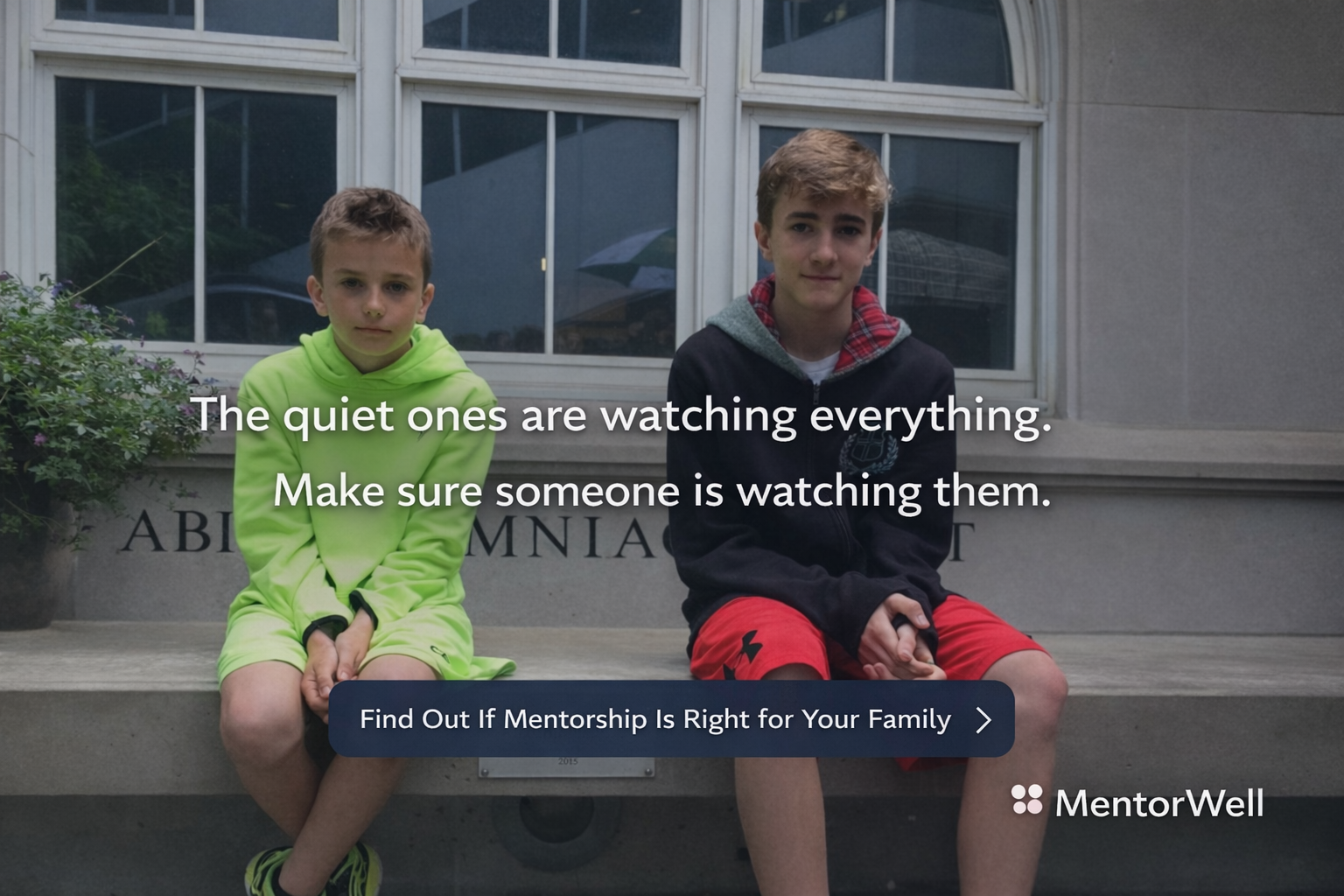
The Child Who Isn't Asking for Help Is Often the One Who Needs It Most.

Before you read this, I want to say something directly.
I know your hands are full. I know you're already stretched beyond what you thought you could handle. And the last thing I want to do is add another weight to what you're already carrying.
But I'd be doing you a disservice if I didn't bring this to your attention.
My two sons, Zac and Sawyer, were incredible through everything we went through as a family. Steady. Supportive. Never once said "I'm struggling too." And ultimately, thankfully, they were okay.
Not every sibling escapes unscathed.
That's not meant to frighten you. My job isn't to add fear to a situation that already has enough of it. My job is awareness. And this is something too many parents discover too late. It’s because nobody told them to look.
So consider this me telling you. Gently. With full knowledge of what you're already carrying.
_________________________
When my daughter Maddie was fighting her darkest battles, all eyes were on her.
Including mine.
But sitting quietly in hospital chairs beside her were my two sons, Zac and Sawyer.
They didn't complain. They didn't ask questions. They didn't ask for time, reassurance, or comfort.
They just sat there. Calm. Steady. Not wanting to make anything harder than it already was.
At the time, I thought their quiet meant strength.
What I've since learned is that silence can also mean strain.
The Child You're Not Worried About
When one child is in crisis, survival mode kicks in. The loudest pain takes priority. The highest risk gets the most attention.
Meanwhile, the quiet child makes themselves smaller so you can keep going.
They see how tired you are. They don't want to add weight to what already feels like a fragile system. So they become the easy one. The strong one. The one you don't have to worry about.
They stop asking for things. They try harder at school. They step into the peacekeeper role without being asked. They swallow their own fear, anger, sadness, and confusion. They do it quietly, because they love you and they can see what you're already carrying.
Beneath that quiet compliance often sits a set of beliefs nobody ever meant to give them.
‘My problems don't matter right now.’
‘I can't add to what Mom and Dad are already dealing with.’
‘Struggling is something I'm not allowed to do.’
This is emotional suppression dressed up as maturity. And it often has a cost.
What the Research Shows
Suppressed emotions don't fade. They settle.
43% of siblings of children with mental health challenges report experiencing psychological struggles themselves. Siblings are almost twice as likely to develop anxiety or depression within a few years of their sibling's diagnosis. When addiction is present in the family, siblings have 2.4 times higher odds of developing depression than those in families without it.
Studies show that siblings often experience a decline in emotional wellbeing and school performance within the first one to five years of their sibling's mental health crisis, especially when they feel they must stay strong for the family.
The child who seems fine is often the one who is missed the longest.
Until something breaks.
What It Looks Like
It doesn't look like crisis. That's the problem.
It looks like a kid who's doing well at school. Who doesn't cause trouble. Who checks in on you more than you check in on them. Who says "I'm fine" and means it, until one day they don't.
It looks like anxiety they can't explain. Depression masked as exhaustion. Perfectionism as a way to avoid ever being a burden. People-pleasing so ingrained they've forgotten what they actually want.
We say kids are resilient. And they are, to a point.
But resilience without support becomes emotional isolation. And isolation, left unsupported, can become its own crisis.
The Question Nobody Is Asking
If you're in this right now, if one child is consuming most of your emotional bandwidth, ask yourself one question.
Who is watching the one who isn't crying out loud?
It's not a question of love. Every parent in this situation loves all their children. It's a question of bandwidth. And bandwidth, when one child is in crisis, is a finite resource.
You cannot be everything to every child at the same time. It makes you human.
Why This Is Where Mentorship Fits
The struggling child likely needs clinical support. Therapy. Professional help. That's the right call and the right priority.
But the sibling, the quiet one, the easy one, the one sitting in the hospital chair not asking for anything, often isn't in enough distress to trigger clinical intervention. They don't meet any threshold. They're coping.
They're just coping alone.
This is where a mentor can be life-giving in a way that therapy isn't designed to be.
Someone who has stood in a similar place and can say:
“I know what it's like to not want to cause more worry.”
“I know what it feels like to carry something alone because everyone around you is already carrying enough.”
“You're allowed to talk about what scares you.”
“You're allowed to not be okay.”
A mentor becomes the safe person the sibling doesn't have to protect. The one they can be honest with precisely because the relationship carries none of the weight of family.
While you are doing the hard work of helping one child heal, someone can walk alongside their brother or sister, making sure they don't break quietly in the background.
The Moment I Can't Shake
I look back at Zac and Sawyer in those hospital chairs.
They were calm. They were steady. They were love in silence.
And I wish that someone had looked at them and asked:
"How are you doing through all this?"
Nobody did. Because everyone's eyes, including mine, were on the child who needed help most urgently.
The child who needed it most quietly got missed.
If One Child Is Struggling, Please Don't Assume the Others Are Fine
Glance at the quiet one.
Ask the easy one how they're really doing.
Notice the child who isn't asking for anything, because that child learned, somewhere along the way, that asking wasn't something they were allowed to do.
If you don't have the bandwidth to be that person for every child right now, that's the reality of what you're living.
And it may make a mentor exactly the right next step, for the one you almost forgot to worry about.
[Learn more about mentorship for siblings and families at The MentorWell]
Sometimes mentorship isn't for the loud cries, it's for quiet ones.