
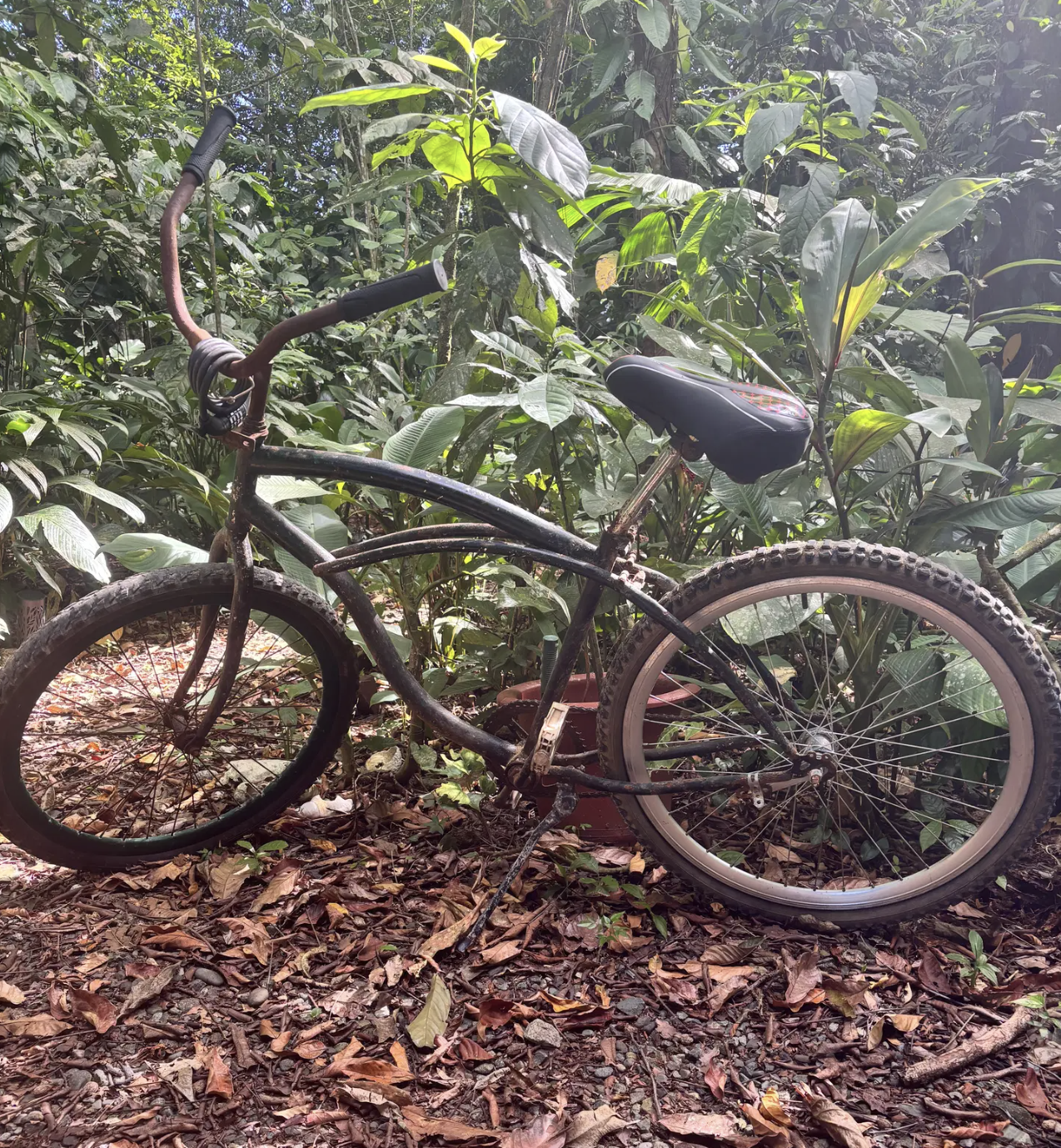
The owner of the place I’m staying lent me a bike for the rest of my stay. It’s about three sizes too small and rusted from the salty air. I look a bit ridiculous on it. But I’m grateful.
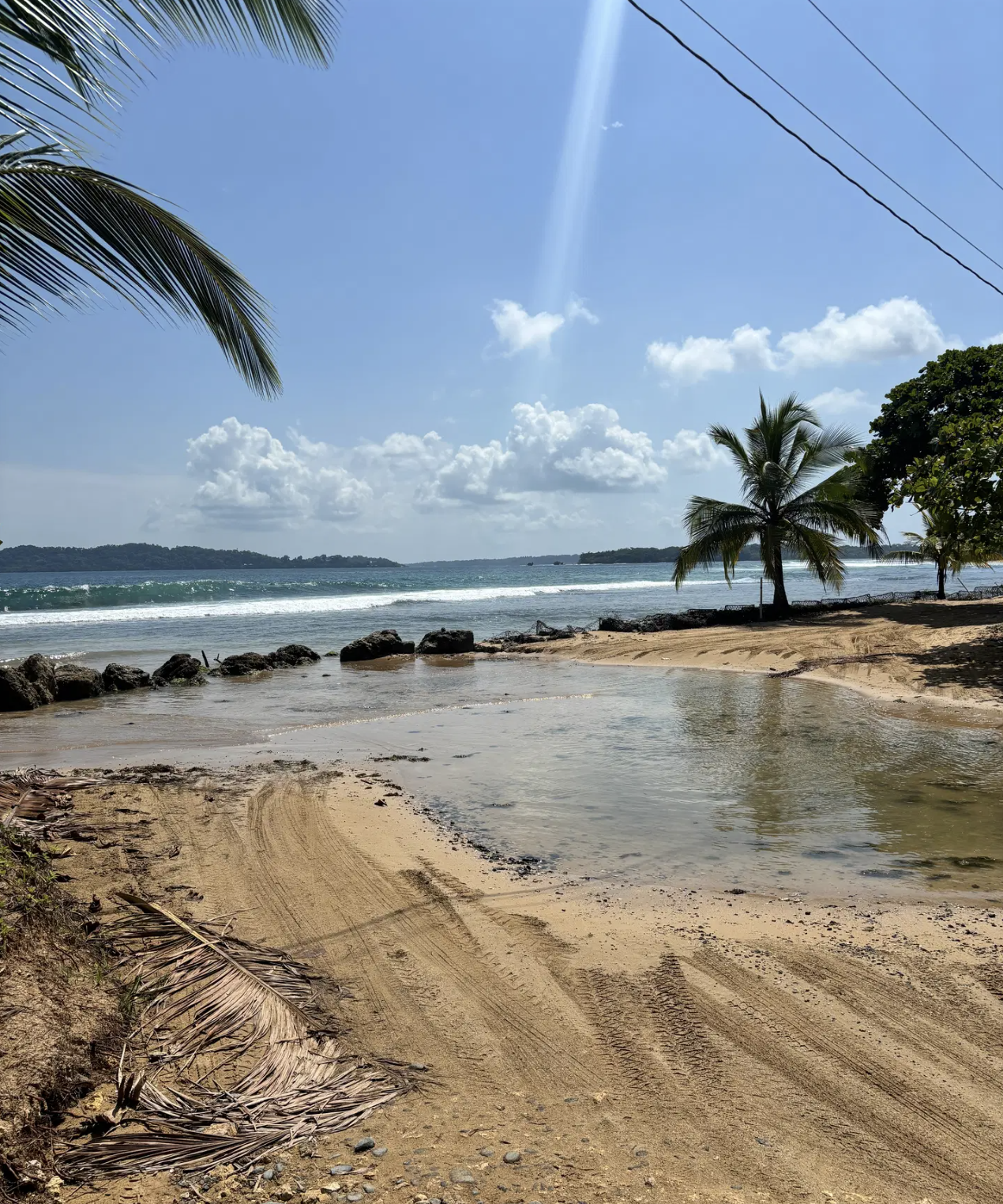
I use it for grocery runs, 5 to 7 km from my jungle cabin in Paunch depending on which store I decide to go to. To get to town you cross a sandy, rocky road that runs along the ocean as a causeway. It’s subject to high tides, and in parts you cross rivers that rise with them. It’s part of the adventure, and I love this little detail about where I live.
On Saturday I decided to go to the store 5 km from my place. I took my bike, with my knapsack on my back.
I’ve become quite used to not wearing a watch, and most times not carrying my phone. On this particular occasion I took it, tucked into my front pocket the way I usually do.
On a bike that fits, that works. On this one, my knees come up much higher than they should. Somewhere over that bumpy, rocky terrain, my iPhone must have been dislodged and fallen onto the road.
I didn’t realize it was gone until I got to the store. I was half convinced I’d left it back at the cabin, so I didn’t fret about it. In the past, that would have angered or frustrated me.
When I got back to the cabin, I realized it must have fallen out. I walked the rocky road hoping to find it. I was unsuccessful.
I went back to the cabin, opened Find My iPhone on my MacBook, and saw where it was. I put a message on the screen for anyone who found it.
About an hour later, I got a message from Ana. She’d found my phone.
There was no urgency to get it that night. On Sunday, she was spending the day at Playa Estrella (Starfish Beach) and wouldn’t be back until later that evening. We agreed to meet when she returned, at the Iglesia Católica (Catholic Church) in Bocas Town, near where she was staying.
The taxi pulled up out front, and Ana smiled as I got out. We exchanged greetings. She wouldn’t accept anything. I said, “Let me at least buy you dinner as a thank you.” She agreed.
We spent the next 90 minutes learning about each other. She was a lovely young woman from Ecuador with a passion for travel. She worked as an interprettor back home. She was travelling on a shoestring budget, working five hours a day making lionfish jewelry, an invasive species in the Caribbean, in exchange for a room.
I guessed Ana was a few years older than Maddie would have been today.
We had a fish dinner and a lemonade and talked about our travels, and the circumstances that had brought us together.
She asked what I did for work. I told her about The MentorWell, and then I explained the why behind it.
Maddie died eleven years ago. She was fourteen. She spent two months on a psychiatric ward, and we told her friends it was her stomach, because that was what she asked us to do. Those friends cared about her. They just didn’t know. That is the reason The MentorWell exists: so the next family has a way to notice sooner than we did.
Ana told me she was heading to Panama City in the next few days to volunteer with a group that works with youth that are struggling with their mental health.
Every Signal Check I’ve built is in English only. Very few of the families she’s about to meet can use them.
It was then I decided the next revision needed to be a Spanish version of the Signal Checks for a concerned parent or friend.
I walked her back to the place she was staying. I didn’t want her to feel weird about it, but I could tell she preferred that I walk her home, and as a dad I was more than happy to make sure she arrived safely. We kept talking along the way. When we arrived, I gave her a hug and told her how grateful I was that she had come into my life.
Then I walked back to the main street, flagged down a taxi, and rode home to my little jungle cabin in Paunch.
Since that dinner, Spanish has moved from a good idea to the top of my list. French belongs there too. Both should be considered properly rather than treated as a translation job, because a Signal Check that reads like a form somebody ran through a translator is not something a parent or a friend will finish.
There’s an old Chinese parable I’ve been thinking about since Saturday. A farmer’s prized horse runs away. The neighbours say, what terrible luck. The farmer says, maybe yes, maybe no. A week later the horse comes back, and it brings wild horses with it. The neighbours say, what wonderful luck. Maybe yes, maybe no. The farmer’s son breaks his leg trying to ride one of the wild horses. Terrible luck said the neighbours. Maybe yes, maybe no, repeated the farmer. Then the army comes through the village conscripting every young man. The farmer’s son was exempt because of his broken leg.
Losing my phone felt like something happening to me. By the next evening it had already become something that happened for me. Sometimes you have to let the story play out further before you decide what it was.
That was a phone. Gifts have happened to me after Maddie’s passing. What happened to her will always be the most tragic event of my life. It will also become the most meaningful.
The Friend Signal Check is for anyone 14 or over worried about a friend. The Teen Signal Check is for an adult worried about a young person. Both are free and anonymous awareness tools. They cannot diagnose.
If you work with Spanish or French-speaking families, or know a group like the one Ana is helping, I’d be glad to hear from you.
If you're worried about someone right now: in Canada, call or text 9-8-8; in the US, call or text 988. If someone is in immediate danger, call 911.
You May Also Like
1. Are You There, Maddie? It's Me, Dad.
The same stretch of time in Panama, and the same daughter, written on a beach before sunrise.

2. We Told Her Friends She Had Stomach Issues
The full version of the why this post only summarizes over dinner.

3. My 85-Year-Old Dad Noticed Something I Hadn't
What someone else sees in you that you cannot see yourself, which is the whole argument under the Signal Checks.

4. If You Were Struggling, Wouldn't You Want Someone to Notice?
The practical version of noticing, for whoever finishes this post and wants to do something.