When the Casseroles Stop: The Hidden Suicide Risk Facing Bereaved Parents

Eleven years ago, I lost my daughter Maddie.
People checked in during the funeral. They brought food. They sent cards. A few called in the weeks after.
Then life moved on.
For us, it didn't.
That is not a criticism of the people who showed up and then disappeared. Grief makes people uncomfortable. They don’t know what to say six months in, so they say nothing. They assume you are doing better because you are still standing. Because you showed up to things. Because you smiled when they saw you.
I was good at smiling. Fake smiling.
What I did not tell people, for years, was where my head actually went. I told my boys I was fine. I told friends and family I was managing. I said the things that kept everyone comfortable and carried everything else alone.
No one truly understands where your brain goes after losing a child to suicide unless they have been there themselves. The thoughts are not something you announce at dinner. They arrive quietly, in ordinary moments. You learn to manage them in private because the people around you are already stretched thin with their own grief, and adding yours feels like too much to ask.
I never attempted suicide. But I thought about it almost every day. For years.
I’m saying that plainly because a bereaved parent reading this right now may be carrying the same thing and hasn’t said it out loud to anyone. What’s happening in your head isn’t weakness. It’s what profound loss does when the support disappears and the world keeps moving and you are still standing in the kitchen at 2am trying to understand how.
What the research actually shows
Large registry studies suggest that parents bereaved by a child's suicide face a markedly elevated suicide risk, often around two to three times higher than relevant comparison groups, with especially high risk in mothers and in the first months after the death.
A Danish study of more than 18,000 suicide cases found the adjusted odds ratio for parental suicide after a child's suicide was 2.54 overall, 1.90 for fathers and 3.47 for mothers. A South Korean national cohort found hazard ratios of 1.82 for fathers and 2.65 for mothers compared with families bereaved by non-suicide deaths. The Public Health Agency of Canada, the CDC, and the WHO all recognize suicide bereavement as a risk factor for suicidal behaviour in those left behind.
That number stopped me when I first read it. Because I understood it completely.
And yet we don’t talk about this. We talk about suicide prevention. We don’t talk nearly enough about what happens to the people left behind after a death.
Postvention is prevention
When a young person dies by suicide, the story does not end with one death. There is a ripple that moves through parents, siblings, grandparents, friends, teachers, and entire communities. The research on this is consistent. Bolton and colleagues found that parents bereaved by an offspring's suicide face sharply elevated rates of depression, anxiety, and psychiatric hospitalization in the years that follow. Pitman and colleagues, in a review published in The Lancet Psychiatry, specifically identified increased suicide risk in mothers bereaved by an adult child's suicide.
These aren’t soft findings. They’re clinical evidence that the people left behind after a suicide are themselves at measurable risk.
Supporting them isn’t simply grief care. It’s suicide prevention.
Most communities don’t treat it that way. The clinical infrastructure around suicide focuses almost entirely on the person in crisis before the death. What comes after, for the family, is largely left to chance. A few weeks of condolence calls. A therapist if they’re lucky enough to find one and can afford to keep going. A support group if one exists within driving distance.
Then the casseroles stop coming and the real work begins. Alone.
What no one tells you about surviving it
For a long time I believed, without examining it, that the goal was to get back to who I was before I lost Maddie. That recovery meant returning to some previous version of myself.
It took years to understand that was the wrong destination entirely.
I wasn’t meant to get back to the person I was before. I was supposed to embrace the person I had become. A kinder person. Softer. More patient with people who are struggling than I ever was before I knew what struggling actually looked like from the inside.
When I stopped trying to return and started accepting who I’d become, my relationship with Maddie changed too. It moved from constant sadness and overwhelm to something I didn’t expect. Memories that sparked joy. Moments of laughter. A sense of purpose that feels, on the best days, like we are still working on something together.
That’s not a tidy resolution. Grief does not resolve. But it can shift. And the shift, when it comes, is worth staying for. You just don’t realize it until many years later.
What needs to change
Every community that experiences a death by suicide should have a long-term support plan for the family left behind. A real, sustained, structured commitment to the people most at risk in the aftermath of that death.
Employers need bereavement policies that reflect the actual timeline of grief, which doesn’t follow a calendar and does not resolve in five days. Schools need protocols not just for students after a peer suicide but for the parents of those students, who are also absorbing a trauma they didn’t ask for.
And all of us, individually, need to keep showing up past the point where it feels necessary. The bereaved parent who looks fine at month three is often in the hardest stretch of their life. The looking fine is the tell.
If we’re serious about suicide prevention, we can’t stop caring once the funeral is over.
The people left behind need support. Long-term, sustained, unglamorous support.
Their lives depend on it. And I mean that without exaggeration, because the research says so, and because I lived close enough to that edge to know it’s true.
If you are a bereaved parent and this piece brought something up, please reach out for support. In Canada, call or text 9-8-8. In the United States, call or text 988. You do not have to carry this alone.
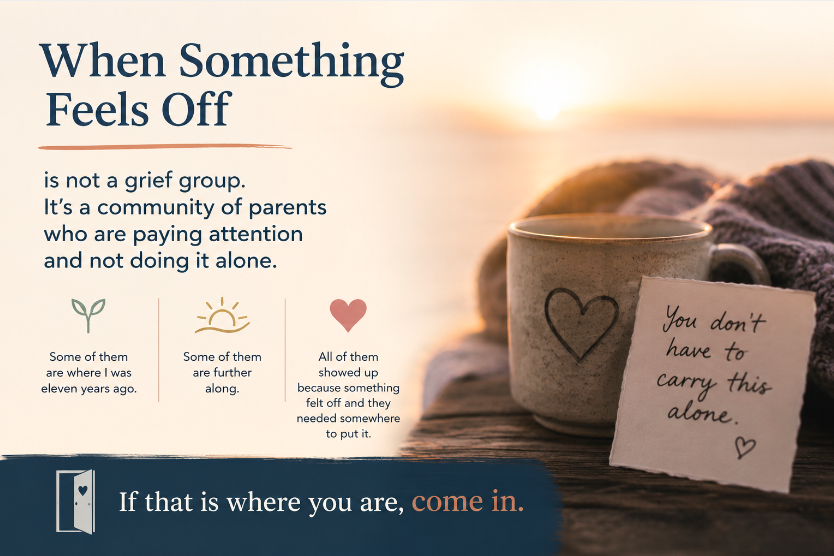
The MentorWell exists because of Maddie, and for every family that is still in it. If you are looking for a place to start, the When Something Feels Off community is there.