The Best Benefit Items Aren't Even In Your Benefit Booklet

A CPO showed me her benefits guide last spring. Twenty-two pages. Dental on page four, vision on five, the EAP near the back with a phone number and a QR code.
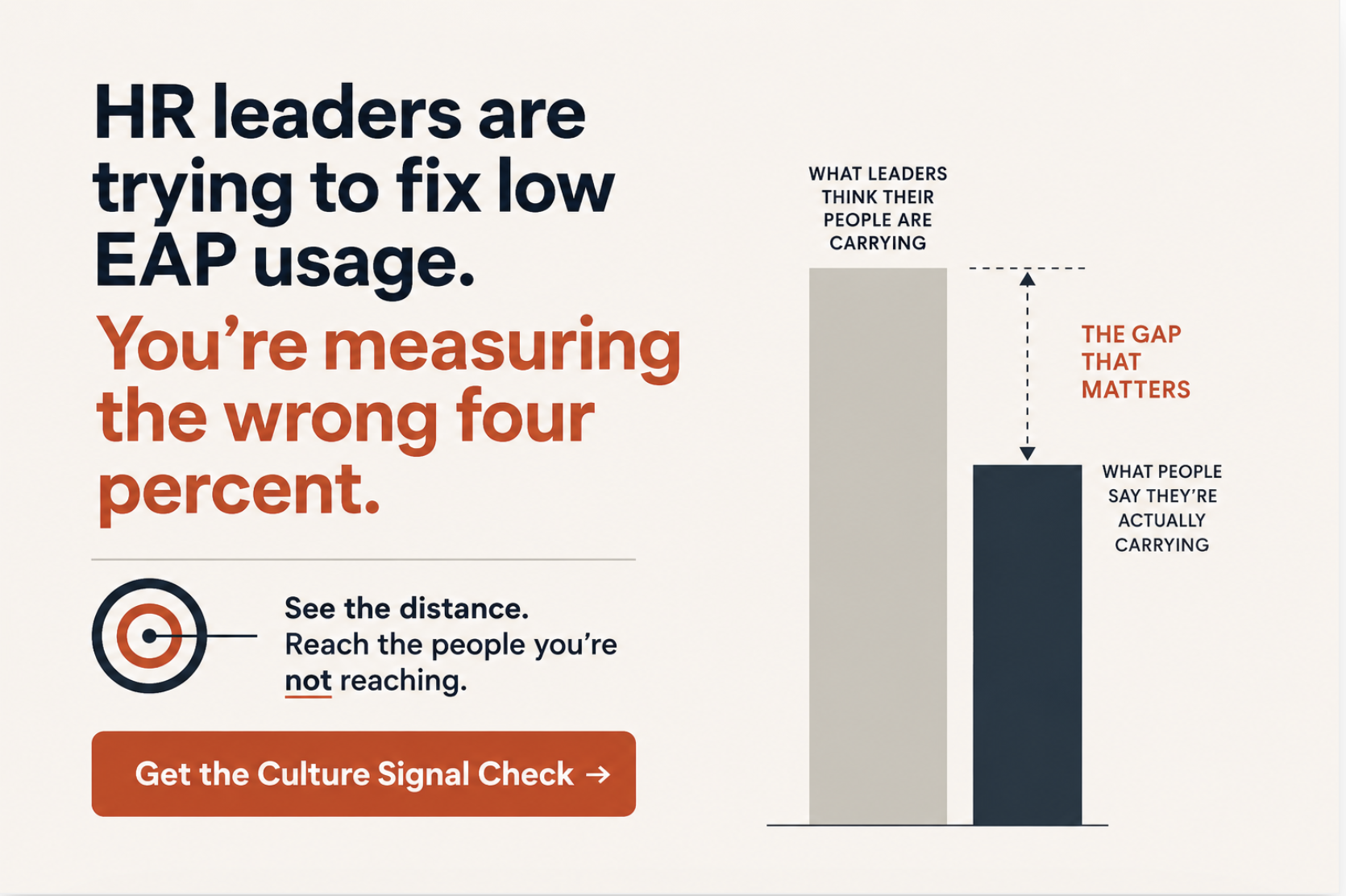
She said utilization on the mental health piece was around four percent and she wanted help with messaging. More awareness. Maybe a relaunch at the fall town hall.
I didn't say what I was thinking, which was that everything in that booklet covers a person from nine to five, and almost every reason that number sits at four percent happens after six.
The arithmetic nobody does out loud
Take the major workforce surveys, Gallup among them, and apply the conservative end of what they find to your headcount. Anxiety. Depression. Grief. Addiction in the house. A parent slipping into dementia. A kid coming apart.
If the people who needed that EAP actually used it, you'd be looking at forty percent. The higher estimates go well past that. I'll stay at forty.
You're at four.
So thirty-six percent are somewhere. They're in the building. They're on the calls. They're the ones who said they were fine when you asked in the hallway, and they meant it in the sense that they were still upright.
Four percent isn't a communications problem. It's the portion of your people willing to raise a hand before anyone asked them anything.
Where the thirty-six went
The person whose work slipped last quarter has a fifteen-year-old who stopped eating lunch at school. She found out from another parent, not from her daughter.
The one who went quiet in meetings around March is four months into something at home he hasn't told anyone at work about. He's still hitting his numbers. That's most of what he has left.
Neither of them is calling the number on page nineteen.
Here's the part that surprises people when I say it in a room. Neither of them expects the company to fix any of it. That's not the ask. The ask is smaller and stranger. They want some acknowledgement that the person in the chair has an entire other life, and that it walked through the door with them this morning.
I learned that at home first, and later than I should have.
Mentorship, and who it's actually for
This one isn't for your employee. It's for their kid.
The fifteen-year-old who stopped eating lunch. The one carrying a divorce that isn't hers. The one who thinks she's disappointing everyone at home and has stopped saying so.
Parents love their kids more than anything and are usually the wrong person for this job. I say that as one. When your own child is struggling, you fix. You advise. You suggest three things before she's finished the sentence. And she stops talking, because she's not looking for a plan, she's looking to be heard by someone who won't panic.
A mentor is someone five or ten years older who went through something close to it and came out the other side. Close enough in age to be believable. Far enough along to be proof. They listen first, which parents almost never manage, and they're not carrying any fear about how it turns out.
What they build is confidence and some sense of direction, and a kid who's been through something hard and knows she got through it.
If a CFO asked me tomorrow to cut something, this is the last thing I'd give up.
The one nobody in benefits will say out loud
Now the mother.
A large share of that thirty-six percent are parents, and their hardest hour this week involved a teenager. They will not book an EAP session about it. Most won't say it out loud to a friend. They'll come in Monday, sit down, and work.
Running a workshop for parents raising a struggling kid is the strangest thing you can put in front of a forty-five-year-old employee, because almost nobody has ever done it. It says the company noticed the largest thing in their life and didn't pretend it stops at the parking lot.
I won't tell you it fixes anything at home. It doesn't. Offering it is the point.
What managers actually need
The ask for a manager is narrow. Notice something, and open a conversation you're not qualified to finish.
That last part matters. Nobody's asking a team lead to diagnose anything. The job is getting a person from "I think something's going on with you" to the support the company already pays for. That's the skill.
Most organizations either skip managers or hand them an awareness module and consider it handled. Both fail the same way. Awareness of mental health isn't the gap. Knowing what to say on a typical morning to someone who's clearly not okay, that's the gap.
You're probably wrong about your own people
Before any of this, there's a measurement worth doing.
Ask your leaders to estimate what their people are carrying. Then ask the people. The distance between those two answers is the finding, and it's always wider than the top of the house expects.
That number changes the conversation faster than anything I could say.
Back to the booklet
I'd answer her differently now.
The four percent isn't the problem. It's the thirty-six you never hear from, and they were at their desks that day.
Ask anyone what got them through this year. Nobody names a page number. It was a manager who noticed, a colleague who asked twice, someone further along who took the call at nine at night.
None of that was ever printed anywhere.
FAQ
Why don't employees use their EAP?
Because using it requires four decisions made alone: noticing you're struggling, deciding it's serious enough, finding the service, and booking it. All four have to be made by someone whose capacity to make decisions is the thing that's degraded. Awareness campaigns only address the third one.
What is a normal EAP utilization rate?
Most organizations report somewhere between three and eight percent. Set against workforce prevalence data, the number that would reflect actual need starts around forty percent and runs higher. The gap between those figures is the useful measurement.
What mental health benefits do employees actually use?
The ones somebody points them toward. Utilization rises when a manager notices something and opens a conversation, rather than when a benefit is announced. The service still does the clinical work. A person has to be the door.
How do I support an employee whose child is struggling?
Start by not requiring them to explain it. Most parents will not raise a teenager's mental health at work, because it feels like disclosing a private failure. Benefits that name parenting directly, including workshops and mentorship for the teenager, remove the need for the employee to ask.
Is mentorship the same as therapy for a teenager?
No, and they aren't substitutes. A mentor is someone five to ten years further along who has been through something similar. They listen first and build confidence and direction. A therapist provides clinical treatment. Many families need both, and many are waiting months for the second one.
You May Also Like
The Thirteenth Question
https://www.thementorwell.com/blog/the-thirteenth-question
Engagement at a record low and managers declining fastest. What employees carry to work and never mention, and why it sits outside the reach of every survey measuring it.
How Well Do You Actually Know Your Team
https://www.thementorwell.com/blog/how-well-do-you-know-your-team
Most managers can name the commute and the hockey schedule. What sits underneath that, and why the gap between the two is wider than anyone assumes.
The Gap: What You Believe and What They're Carrying
https://www.thementorwell.com/blog/the-gap
The distance between what leaders and parents believe about the people they're responsible for and what those people are actually carrying.