What to Do When Your Teen Refuses Therapy (Most Parents Get This Wrong)

Last year, parents started finding their way to The MentorWell looking for something specific.
They wanted someone to talk to their teenager because they couldn't get their teenager to talk to a therapist.
"I can't convince them to go to therapy," one mother told me. "But I think I could convince them to try mentorship."
I heard versions of that sentence more times than I can count.
And every time, I had to say no.
I couldn't put my mentors in that position. They aren't licensed practitioners. They aren't trained to hold a teenager in clinical distress. And those adolescents, the ones whose parents were standing in my inbox desperate for an answer, deserved more than what mentorship was designed to give.
I turned families away. That's was hard, but it was the correct and ethical thing to do.
But something else was happening every time I did.
These parents were arriving at the problem too late. By the time a teenager is refusing therapy, something has already been building for a long time. The window for earlier, easier intervention had usually closed.
I kept thinking: what if they'd seen it sooner?
That question is what eventually became LifeLine Parent Workshops. But before we get there, if your teen is saying no right now, here's what actually helps.
The Instinct That Backfires
When your teen refuses therapy, every parenting instinct you have says push.
Book the appointment again. Find a different therapist. Make the argument more compelling. Be firmer. Be gentler. Try a different angle. Don't give up.
Because you can see something is wrong. You can feel it. And therapy is the answer, everyone says so, and they are going to go whether they want to or not.
So you push.
And the door doesn't just close. It locks.
Here's what's happening underneath that dynamic. The harder you push, the more agency your teen reclaims by saying no. You think you're fighting for their wellbeing. They think you're taking the last thing they can control. Neither of you is wrong. Both of you are stuck.
The parent who pushes isn't a bad parent. They're a scared one. But fear expressed as pressure almost always produces the opposite of what you need.
What the Refusal Is Actually Saying
This is the part most parents miss.
When your teen says no to therapy, they are almost never saying I don't want to get better. They're saying something more specific than that. Something worth slowing down to hear.
"I'm not broken."
Agreeing to therapy can feel like admitting something is seriously wrong with them. For a teenager whose identity is still forming, that's a significant ask. They may hear "you should see a therapist" as "you're not normal." That's not what you meant. But it's what they heard.
"I don't trust a stranger with this."
Being asked to sit in a room with someone they've never met and talk about the hardest things in their life is intimidating. Most adults would resist that too. Their refusal might be less about therapy and more about vulnerability with an unknown person.
"This is the one thing I can control."
When everything feels overwhelming, saying no can be the only place a teen feels any sense of agency. They may not have control over what's happening at school, in their friendships, or in their own head. But they can control whether or not they walk into that office.
"I'm scared of what I'll have to say out loud."
Some teens know exactly what they're carrying. They're not in denial. They're terrified of putting it into words. Saying it out loud makes it real. And real is the thing they've been trying to avoid.
"I don't think you actually hear me."
Sometimes refusal is an unconscious test. They want to know if you'll keep showing up even when they push you away. They want to know if you'll listen to what they actually want, or just keep telling them what you think they need.
Their no is not the end of the conversation. It's the beginning of a different one.
The Thirty Seconds That Matter Most
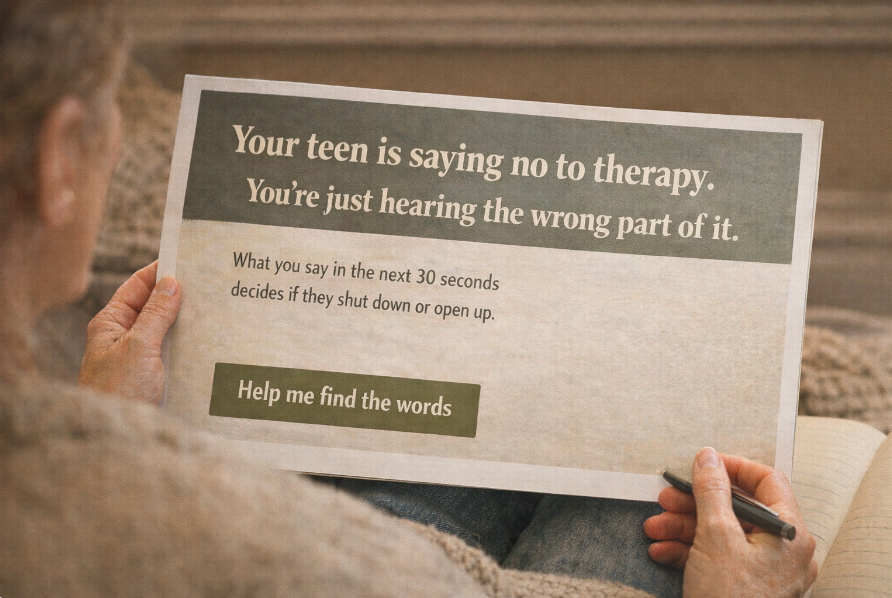
What you say in the immediate moments after they refuse determines whether the door stays open or closes.
The thirty seconds right there in the moment.
Here's what closes the door:
"You're going whether you like it or not." This communicates that their feelings don't matter and you know what's best. Even if you believe that's true, saying it removes their agency and increases resistance. Every time you override their no without acknowledging it, you teach them that speaking up doesn't change anything.
"Just try one session and if you hate it, you never have to go back." Bargaining reduces therapy to a transaction. It communicates that you need them to do this more than you need to understand why they don't want to.
"Do you know how worried I am?" Guilt shifts the emotional weight from their struggle to yours. They end up managing your feelings instead of processing their own.
Here's what keeps the door open:
"I've noticed you've seemed quieter lately. I'm not asking you to explain it. I just want you to know I see it." This communicates that you're paying attention without demanding anything in return.
"I hear you. You don't want to go. Can you help me understand what feels wrong about it?" Validating the refusal before responding to it tells them their no matters, that you won't bulldoze past it, but you won't disappear either.
"Therapy is one option. It's not the only one. What matters to me is that you have someone to talk to." Separating the tool from the goal communicates that you're not attached to one solution. You're attached to them being okay.
The pattern in every response that keeps the door open is the same. It starts with their experience, not yours.
What to Try Instead
If therapy is off the table for now, that doesn't mean support is off the table.
The goal is to get something into their life that they're willing to accept. One step. Just the next thing that doesn't feel impossible to them.
Mentorship is often the right first step, and I say this carefully, because I've been clear for years that mentorship is not a replacement for therapy. It isn't. But a mentor can be something therapy can't be yet: a consistent, calm adult who shows up without an agenda, who earns trust through presence rather than authority, who your teen doesn't have to protect the way they protect you.
Teens often open up to someone who isn't emotionally invested in them the way a parent is. The emotional weight between you and them is sometimes too heavy to carry without a third person to help distribute it.
Mentorship doesn't replace therapy. But it can be the relationship that eventually leads them there.
A physical outlet is underrated and underused. When a teen has no physical release, emotional energy turns inward. It shows up as irritability, withdrawal, sleep disruption, numbness. This doesn't mean signing them up for a sport they don't want. It means finding something physical that gives them somewhere to put what they're carrying. The activity matters less than the movement.
A different kind of professional is worth considering before you give up on professional support entirely. Is your teen refusing therapy specifically? Or a particular format? Art therapy. Walk-and-talk. Online or text-based counselling. A different practitioner. A bad fit doesn't mean all professional help is wrong for them.
Peer support is developmentally normal and often the first bridge. Some teens will talk to a close friend before they'll talk to any adult. That's a starting point. If your teen has someone they trust, that relationship has value. Don't underestimate it.
And the hardest one. Your own support.
If the emotional intensity at home is high. If your teen senses that their struggle is creating panic in you, they'll shut down to protect you. They love you and they don't want to make it worse.
Getting your own support lowers the temperature in the house. And it shows your teen, without a single conversation about it, that asking for help is something adults do too. That's not a small thing. That's modelling. And it lands differently than anything you'll say directly.
What I Wish I'd Known Earlier
Coming back to where we started.
The parents who contacted me asking for mentorship in place of therapy weren't bad parents. They were parents who had arrived after the window had already narrowed. By the time their teenager was refusing everything, the signals had usually been present for months. Quieter. Easier to explain away. The kind that feel like a phase right up until they don't.
What they needed wasn't a workaround for the refusal. They needed someone to have helped them see what they were looking at before it reached that point.
That's what I couldn't give them. And that gap is what eventually prompted me to build LifeLine Parent Workshops.
The pattern was too consistent to ignore. Parents arriving after the fact, asking for help that should have started earlier. Because nobody had given them the tools to see what was already there.
LifeLine exists to close that gap. Three sessions built around helping parents read what their teenager is actually showing them: the early signals, the quiet changes, the things that are easy to dismiss until they aren't. And to do it before the window closes.
Earlier is almost always better. And earlier requires seeing what's already there.
If your teen is refusing right now:
The guide below was written for exactly this moment. What the refusal is telling you. What to say and what not to say. What alternatives exist when therapy isn't where they're willing to start.
It won't give you a script that magically changes their mind. It will help you understand what's actually happening, and respond in a way that keeps the door open.